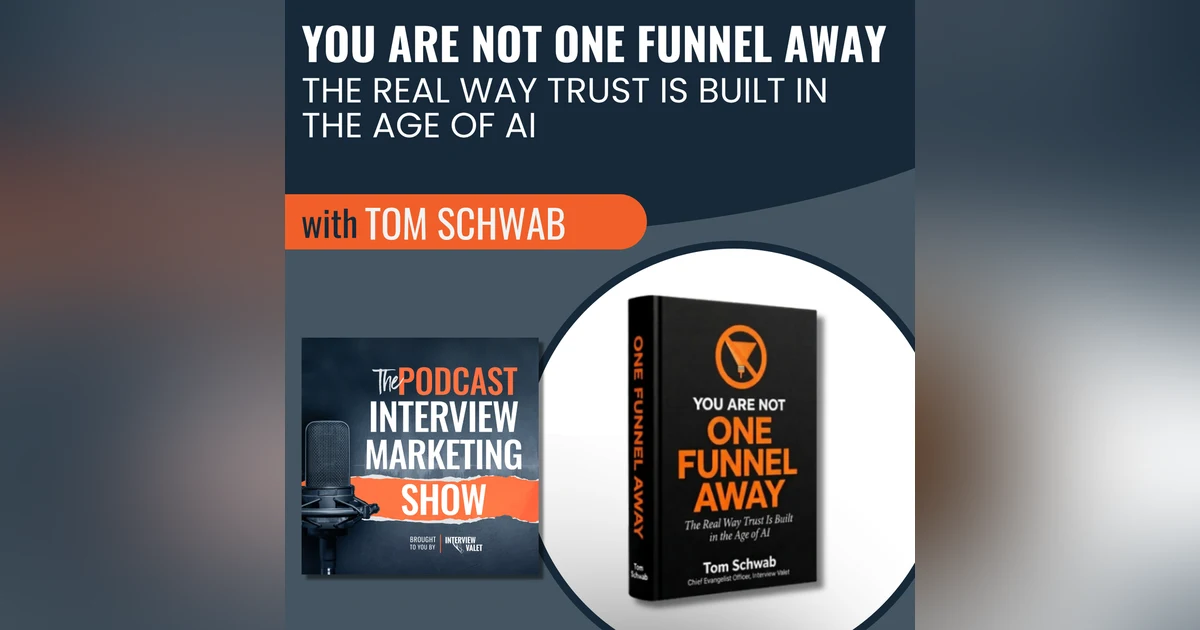
You Are Not One Funnel Away with Tom Schwab

 Apple Podcasts
 Spotify
 YouTube
 Interview Valet founder Tom Schwab challenges the seductive promise that one funnel, automation, or perfect sequence stands between you and business growth. Instead, he traces 200 years of communication technology - from Morse code to AI - revealing a pattern: each new tool got cheaper but stripped away human richness, until now. As synthetic content floods the internet, real conversations (especially podcast interviews) become the scarcest, most valuable form of trust-building. You're not one funnel away. You're one conversation away.
The second installment in this special monthly series, Tom reads from his new mini-book, You Are Not One Funnel Away: The Real Way Trust Is Built In The Age of AI.
Timestamps From This Episode
[02:36] The lie we were sold
[09:24] Optimizing for an outdated detour
[12:16] You are not one funnel away. You are one conversation away.
[16:14] Will AI fake conversations?
Resources From This Episode
Download the minibook – InterviewValet.com/minibook
Get the minibook on Amazone Kindle – You Are Not One Funnel Away
PodcastInterviewMarketing.com
InterviewValet.com
Looking For More?
Here are some resources to help you get started with a Podcast Interview Marketing strategy to grow your brand or business.
 |  |  |
Unknown Speaker (0:00): You ever been told you're just one funnel away? One funnel away from freedom, one automation away from scaling, that one perfect sequence, an ad or hook away from your business that you've always wanted. It's a seductive promise. It's also one I believe we need to change.
Unknown Speaker (0:19): Welcome to the podcast interview marketing show where we explore big ideas with leading experts on how to grow your brand and business with targeted podcast interviews.
Unknown Speaker (0:32): This month's mini book is you are not one funnel away. It's really about the way trust is built, especially in the age of AI. We're becoming astonishingly efficient at reaching people but less effective at actually connecting with them. More messages, more automation, more noise,
Unknown Speaker (0:54): and somehow less and less trust. The truth is the best things in life and in business rarely come through a funnel. Your best clients,
Unknown Speaker (1:04): best partners, best referrals, and best opportunities usually come through a conversation. One human being trusting another enough to make an introduction, ask a question, or take the next step. So today we're talking about moving from funnel thinking to conversation thinking. From trying to automate trust to actually earning it. Because in a world drowning in synthetic content, your real voice, your real point of view,
Unknown Speaker (1:36): your real conversations may be your greatest advantage. Let's get into it. The Lie We Were Sold You're not one funnel away.
Unknown Speaker (1:48): That's a promise you've heard from marketers. You've heard it a thousand times. You're one funnel away from freedom, one automation away from scale, one clever sequence, one viral hook, one perfectly tuned ad set away from the business you've always wanted. The secret, we're told, is in the app. It's in the code.
Unknown Speaker (2:13): It's in the software. It's in
Unknown Speaker (2:15): the outreach that runs while you sleep. Build the machine. Feed it strangers at the top, and customers will magically fall out of the bottom. Set it and forget it. It's a seductive story.
Unknown Speaker (2:30): It's also a lie and increasingly a bigger lie. Not because the tools don't work, they do. They've made us astonishingly efficient. We can reach more people faster and cheaper than any moment in human history.
Unknown Speaker (2:49): But somewhere in the chase for efficiency, a quieter truth got buried. We've been getting more efficient and less effective at the same time. We're sending more messages and earning less trust. We're reaching more people and connecting with fewer of them. We have optimized the funnel to a science and watched our reply rates fall to a rounding error.
Unknown Speaker (3:16): Here's what I've come to believe. After a decade of helping people build real authority and a lifetime of watching what actually moves human beings, the best things in life and in business have never come through a funnel. They've come through a conversation. That's the argument for this mini book. It's also, I believe, the most important shift you can make in how you grow your business right now at this exact moment as the ground seems to be shifting under all of us.
Unknown Speaker (3:49): To see why, we have to go back a couple hundred years. Chapter one: Two Hundred Years in one: Two Hundred Years of Getting in the Way. In 1838 Samuel Morris stood in front of a room of skeptics and he sent a message down a wire. It was a small thing and an enormous thing at the same time. You see, for the whole of human history up to that morning, a message could travel no faster than the human being could carry it on a horse, a ship, a runner.
Unknown Speaker (4:25): Distance and time were the same problem. Then Morris closed the loop. He closed the circuit and the thought crossed a continent in the time it took to tap it out. That was the beginning of the electrical age and for the next two hundred years we've been chasing that same dream to communicate across distance instantly and to make that communication richer,
Unknown Speaker (4:53): faster, and less expensive. The Wire The telegraph, it taxed every word. Now the telegraph was a miracle, but
Unknown Speaker (5:04): a clumsy one. To use it you needed a trained operator who knew Morse code. You needed access to the line and you paid by the word, so messages were short, compressed, stripped of everything but the bear signal, arrived safely, Send money. Mother ill. There was no room for warmth, for nuance, for the small human texture that tells who is really on the other end.
Unknown Speaker (5:35): The technology connected us and it dehumanized us in the same
Unknown Speaker (5:39): stroke. The line. The telephone was richer and costlier. The
Unknown Speaker (5:49): telephone gave us back the voice, suddenly could hear the person, the catch in their throat, the laugh, the hesitation. It was a leap forward in richness, but it was expensive and the price shaped behavior. Now, anyone old enough to remember waiting till after eleven p. M. At night to make a long distance call will remember.
Unknown Speaker (6:13): That's when the rates dropped overnight. We rationed our conversations by the minute. We let the meter decide how human we could afford to be. Then came the inbox. Email was free and hollow.
Unknown Speaker (6:30): We taught computers to carry our messages for us and the price collapsed. Email was essentially free. You could send a thousand messages for the cost of zero, but something was lost. Bill Gates is often credited with the observation that email may be a great way to share information, but not always a great way to communicate. He was right.
Unknown Speaker (6:54): We gained infinite reach and gave up the richness. We could transmit data perfectly and connect terribly. Then there was the screen. Video brought back the face. In 2020, almost overnight, the world moved to Zoom and FaceTime.
Unknown Speaker (7:14): It was near free, face to face communication at any distance. We got the voice back and the face with it. The richness returned and the price kept falling to nothing. And now, in 2026, the wire has thinned to almost nothing at all. We don't just talk to each other.
Unknown Speaker (7:35): We talk through machines. We talk to the machines. We describe what we want in plain language and watch the software build itself. The barrier between human intention and machine action is dissolving in real time. The pattern.
Unknown Speaker (7:56): This is where we were always headed. Step back and look at the whole arc. Morse code to the telephone to email to video to talking out loud to a machine that understands you. Every step did two things. It made the wire cheaper and it tried to give humans back the richness the previous step had stripped away.
Unknown Speaker (8:19): Now we should not be surprised where this is going. We imagined it long ago. No one on the bridge of the Starship Enterprise sat hunched over
Unknown Speaker (8:28): a keyboard. They spoke. They asked. They conversed. We always knew somewhere that the future of communicating with our tools and each other was simply to talk.
Unknown Speaker (8:41): One day typing as a skill will seem as quaint as knowing Morse code. Think about that. For a brief, strange window of human history, we trained ourselves to move our fingers in precise patterns to make a machine understand. We called it a skill. It was taught in schools and now it's ending the same way Morse code ended.
Unknown Speaker (9:07): One day the idea that you had to type to be understood by a computer will sound as archaic as tapping out dots and dashes on a brass key because we are not and we never were typing creatures. We're talking creatures. We have always talked to connect. The two hundred year detour through wires and keyboards was just that. It was a detour and now it's ending.
Unknown Speaker (9:36): Which raises an uncomfortable question for anyone trying to build a business right now. What if we're optimizing for the detour and that detour just ended? Chapter two
Unknown Speaker (9:48): Efficient but Ineffective Most business owners today are doing something that feels smart and is quietly self defeating. They're optimizing for the past. They're pouring their energy and their budgets and their best people into automating transactions and building funnels, trying
Unknown Speaker (10:09): to connect with human beings at scale by removing the human from the process. They're getting more efficient by the month. They're also getting less effective at an even faster pace. Here's the tell When the trick breaks. You know the moment the machine reveals itself, that automated email that opens with the line, Hi, first name, the message that calls you by the wrong name or no name or your company's name if it was yours.
Unknown Speaker (10:42): In that instant, you learn the truth. This was never a conversation. It was a computer trick. Someone built a sequence designed to sound personal at scale and the moment, well it almost worked until the seam showed and once you see that seam you can't unsee it. Every message from that sender is now suspect.
Unknown Speaker (11:07): This is the hidden cost of the efficiency game. Each automated touch that gets exposed just doesn't fail to build trust, it actively destroys trust. Now here's the math, a game that insults everyone. The logic of a funnel is that it's a numbers game. Target a million people to capture a thousand leads in hopes of closing a single client, then optimize the conversion rate by a fraction of a percent and then call it growth.
Unknown Speaker (11:42): I reject that model. Not because it's inefficient, even though it is. I reject it because it's inhumane,
Unknown Speaker (11:50): and it's inhumane in both directions. It's inhumane to millions who are treated as raw material to be processed, interrupted, and discarded. It's inhumane to you, the business owner, who is reduced to spreadsheets of conversion rates grinding through rejection at industrial scale, wondering why work that is going so well by the numbers feels so empty. The truth is you were never one funnel away. You're one conversation away.
Unknown Speaker (12:23): And here's the evidence. Look at your own life. Here's the test I keep coming back to. Look at the best things in your life and ask how did they actually arrive. Now I did not meet my wife Karen through optimized Facebook ad and the perfect funnel.
Unknown Speaker (12:40): We met through a conversation and an introduction, a human being who knew us both and thought we should know each other. I did not win the best clients through spammy cold outreach and scraped databases. The clients I'm most proud of came from personal referrals and word-of-mouth someone who trusted me telling someone they trusted. I did not find the best business partners through paid campaigns. I found them through introductions and conversations.
Unknown Speaker (13:13): The slow compounding work of one good relationship leading to the next. None of
Unknown Speaker (13:19): it came through a funnel. All of it came through conversations. And I don't think I'm unusual. I think if you run the same audit on your own life, you'll find the same answer. I think if you run it on the people running the funnels, they'll tell you the same.
Unknown Speaker (13:36): The thing that's mattered most was never automated. We were never one funnel away. We were always one conversation away. The funnel is not the future. It was a phase, a brief stretch when the wire was cheap enough to spam, but the machines were not yet good enough to get caught.
Unknown Speaker (13:56): That stretch is closing fast. What comes next rewards exactly what the funnel never could deliver. And that's trust. Chapter three, trust lies in the conversation. If the funnel is fading fast,
Unknown Speaker (14:12): the obvious question is what replaces it? The answer is the thing that the funnel was always a poor substitute for trust. And trust, real trust, the kind that makes someone choose you, refer with you, and stay with you is built in conversations. It always has been. We simply lost sight of it while the wires were in the way.
Unknown Speaker (14:39): The source. What trust is actually made of.
Unknown Speaker (14:45): People don't come to trust you because you reached out to them often enough. They come to trust you when they get
Unknown Speaker (14:52): a sense of your heart, your point of view, the problem you have chosen to solve and why it matters to you. Whether you're a missionary or a mercenary, in a word, are you authentic? None of that survives compression into a funnel. You can't automate your point of view. You cannot sequence your sincerity.
Unknown Speaker (15:15): These things are revealed in time and in the give and take of actual exchange where you cannot fully script what happens next.
Unknown Speaker (15:25): That is what a conversation is, and that's why conversations build trust in a way that funnels never could. The interrogator. Listen to how they say it. Someone who spent years in national security work explained to me how they evaluate whether a person is telling the truth.
Unknown Speaker (15:44): I expected him to talk about the words, the story, the facts that did or did not line up. He barely mentioned the words. The transcript, he said, is just the script. Anyone can write a script. It's largely useless.
Unknown Speaker (16:02): When he watched the body language, and above all, what he listened for was the voice, the confidence or the lack of it, the inflection, the hesitation in the wrong place. Not what they were saying, he told me, but how they said it. This has stayed with me because it names something we all know in our bones. The truth of a person lives in how they say a thing, not just what they say. The meaning is the music, not only the lyrics, and the music only exists in real conversations.
Unknown Speaker (16:40): The transcript, it's just the script. The truth isn't how they say it. The objection, but won't AI just fake that too? It's a
Unknown Speaker (16:52): fair question to ask. If machines are getting better at sounding human, won't they eventually fake the conversation, the voice, the warmth, and erase our human
Unknown Speaker (17:03): advantage? Notice what the machines are doing and why. The frontier of AI is racing toward voice and conversations, multimodal as fast as it can. This isn't an accident. The machines are chasing voice precisely
Unknown Speaker (17:24): because that is where the richness and trust live. They're validating the thesis of this book, not refuting it. The most valuable form of communication is the human conversation, and even the machines know that. But here's the
Unknown Speaker (17:40): part that matters. As more of what we read, see, and hear turns out to be synthetic, the value of verifiable human goes up, not down. When anything can be faked, proof of real becomes the scariest asset there is. The answer to a flood of synthetic content is not to out automate it. It is to be unmistakably, verifiably human in your conversation, on
Unknown Speaker (18:16): the record, where people can hear your heart and not just your script. Chapter Four The Proof is Already Here If conversations are becoming the unit of trust, you would expect to see the evidence already in the places where the stakes are highest and the feedback is fastest. You do. The election, where conversations beat broadcasts. Consider the twenty twenty four U.
Unknown Speaker (18:45): S. Presidential elections. Now set the politics completely aside. What's striking looking back is not who won, it's what people could not stop talking about afterwards. It wasn't the television ads.
Unknown Speaker (19:00): It wasn't the traditional press coverage or the polished broadcast appearances. The story that dominated the post election coverage was the long form podcast interviews, sometimes hours long, unscripted, human conversation, and the reach they generated. One approach leaned on the old playbook legacy media, controlled messaging, broadcast at the audience. The other leaned into long, open conversations on shows where the audience had already gathered to listen. The conversational bet reached people the broadcast could never, and it shaped the outcome in ways almost no one had priced in beforehand.
Unknown Speaker (19:50): Conversations built trust. If conversations can move an electorate that size against that much money spent on broadcast, well, it certainly can move a handful of right fit clients, your super consumers, that your business actually needs.
Unknown Speaker (20:07): The internet where the humans still are. Now look at the open web. By some estimates, more than half of all content on the internet is now generated by artificial intelligence and every projection has that number climbing. Text, images, videos, entire articles and profiles synthesized at scale no human effort could ever match. In this environment, ask yourself where the genuinely human content still reliably lives.
Unknown Speaker (20:43): One answer keeps coming back podcasts. Two people talking, thinking out loud in real time where the seams of automation cannot easily hide. It's among the last large thriving formats that still unmistakably humans talking to humans.
Unknown Speaker (21:04): This isn't a small thing. The machines have noticed, even the large language models, when they look for trustworthy signals about a person or idea, they weigh this kind of human conversation heavily because it's so much harder to manufacture at scale. It's scarce. It's valuable. The trust we feel looking to a real conversation is the same trust the systems are learning to look for.
Unknown Speaker (21:34): As the internet fills with synthetic, the human conversation becomes priceless.
Unknown Speaker (21:41): The channel. The conversations that scale. So we arrive at a practical question. If trust is built in conversations and conversations is becoming the scarcest and most valuable thing online, how do we have those conversations with enough of the right people to grow a business? Now, you can't personally sit down with every ideal client one coffee at a time.
Unknown Speaker (22:11): That doesn't scale and you have
Unknown Speaker (22:13): to have a business to run, but there's one format that lets you have real human unscripted conversations with thousands of the right listeners at once on a stage your prospects respect,
Unknown Speaker (22:29): one that's already been built with an audience that is a 100% chosen to be there. It's the podcast interview, not a megaphone to shout, but a room to be genuinely human in, a real conversation with a trusted host heard by the people most likely to need what you do, where they can hear your heart and decide for themselves whether to trust you. It's a magnet to attract the right people and repel the others. Now, this is not a coincidence. It's not a fad.
Unknown Speaker (23:05): It's the oldest form of trust building, the human conversation, finally meeting the format that lets it scale. That is why podcast interviews have exploded as a way to build your business.
Unknown Speaker (23:21): They're the funnels opposite. They're winning for exactly that reason. Conclusion: one conversation away. For two hundred years, we put a machine between ourselves and the people we wanted to reach. The machine was expensive and it cost us something human.
Unknown Speaker (23:38): And we spent two centuries trying to win back what each machine took away.
Unknown Speaker (23:44): Now the machine is nearly free. It's nearly invisible, and the strange gift hidden inside the fact is this. The wire is finally getting out of the way. We are returning to where we started and where we were always headed to conversations, to voice, to one human being talking to another, building the kind of trust that no funnel ever could. The business owners who see this will stop doubling down, investing in automation of the past.
Unknown Speaker (24:19): They'll stop playing the numbers game that insults millions to maybe reach a few. They'll reorient around the thing that actually moves people. The thing that brought every good client, partner, and relationship into their life in the first place. They'll have the conversation. You were never one funnel away from the business you want.
Unknown Speaker (24:42): You were one conversation away. Your ideal client is out there right now. They're listening, Not to your ads, not to your scheduled posts, not to your predetermined sequence. They're listening to a conversation, leaning in, deciding who's worth the trust. Make sure it's your voice they hear.
Unknown Speaker (25:06): Make sure they hear your heart, your unique point of view, the problem you were put here to solvenot your script, but you. Because in a world drowning in this synthetic, the most powerful, most human, most valuable thing that you can do is also the simplest. Have the conversation. Tom Schwab. To get a
Unknown Speaker (25:30): copy of this mini book, you can go to Amazon or just visit the show notes at podcastinterviewmarketing.com.