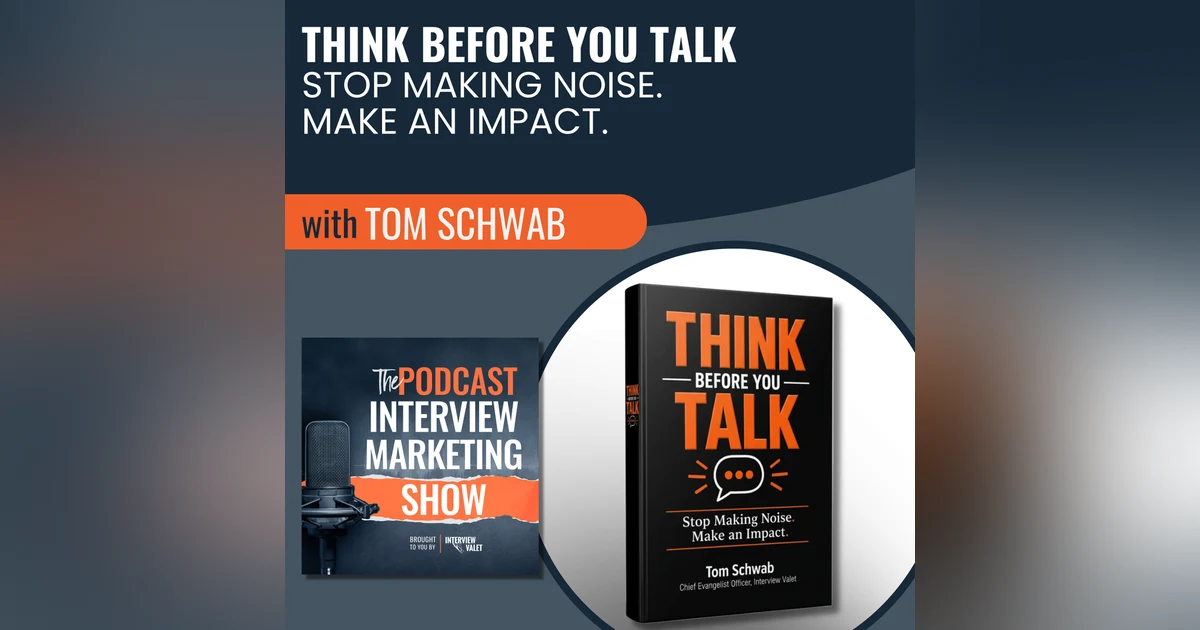
Think Before You Talk: Stop Making Noise. Make An Impact.


 Apple Podcasts

 Spotify

 YouTube
Most podcast guests don't have a content problem. They have a clarity problem. In this special episode, Tom Schwab reads his new book, Think Before You Talk: Stop Making Noise, Start Making an Impact.
You show up to your interview and start talking, and your audience is wondering why they should care. Lessons from a childhood habit of rambling and decades of coaching experts behind the mic, Tom shares 10 principles for podcast guests to prepare for interviews that build trust instead of filling airtime.
Timestamps From This Episode
[03:32] Right listeners beat big audiences every time
[06:47] Know, believe, feel, do: plan the change
[11:11] One interview, one big idea, go deep
[23:11] Send them to one place with three ways to say yes
[29:11] Take note from the professionals and watch the game film to keep improving
Resources From This Episode
InterviewValet.com/minibook
InterviewValet.com/podcast-assessment
PodcastInterviewMarketing.com
Looking For More?
Here are some resources to help you get started with a Podcast Interview Marketing strategy to grow your brand or business.
 |  |  |
00:00
Tom Schwab
One of the leaders in the Navy, Lieutenant Commander Gary Duncan, had a line that stayed with me today your friends and family, they want you to be happy. I want you to better. That is what good feedback does. It helps you get better, not just book another interview.
00:32
Tom Schwab
Think before you talk. Stop making noise. Start making an impact By Tom Schwab My mom used to tell me all the time, tom, think before you talk. You see, I was the kid who would come running into the room, excited about something and just start vomiting. Words fast. Lots of them. Details that nobody needed, context that nobody asked for, side stories that led to other side stories. Somewhere in all those words, there might have been a point. But good luck finding it. My mom wasn't telling me I didn't have anything worth saying. She was trying to help me by teaching me that having something to say and communicating it effectively are two very different things. It took me decades to understand how that great advice was.
01:29
Tom Schwab
Now it's something I tell all of our clients at Interview Valet before they consider leveraging targeted podcast interviews. Today, I see grown adults making the same mistakes that I did as a kid. They get handed the microphone and they just start talking. Now, it could be a wedding toast or on a physical stage, but I see it mostly on podcasts. They've been invited to a show, the host asks a question, and they start talking and talking. They share their life story, their resume, their founder stories, what happened a decade ago and what happened just before they hit record. They want to make sure they include their mentor who changed everything. The book they wrote, the awards they won. Meanwhile, the listener is thinking, why should I care? Why should I listen?
02:26
Tom Schwab
Now, that could sound harsh, but those are the questions every listener is asking, consciously or subconsciously. You see, there's an old quote often attributed to Abraham Lincoln. Better to remain silent and be thought a fool than to speak and remove all doubt. Now, whether Lincoln said it or not, the lesson still works. Speaking can build authority or destroy it. That's especially true today. There's never been more opportunities to Talk. Podcasts, videos, LinkedIn, webinars, live streams, virtual summits, social media. The problem is no longer being handed the mic. The problem is saying something that builds your authentic human authority. Stop making noise. Make an impact. That's what this whole book is about. And while these principles may work in many forms of communication, we're going to focus on podcast interviews. Because a podcast interview is a remarkable opportunity.
03:32
Tom Schwab
For 30 to 45 minutes, someone gives you access to their audience. That's a warm audience, one that already trusts the hosts enough to give them their time. It's valuable. Don't waste it. Think before you talk. Chapter number one. You can't say enough of the right things to the wrong people. My friend Shane Duffy taught me something I've never forgotten. You can't say enough of the right things to the wrong people. Shane owns an amazing business called GlowGeeks. They serve high end commercial and residential property owners. If he's talking about doing premium holiday lighting, it doesn't matter how brilliant his message is. If he's talking to people who rent small apartments and love hanging their own Christmas lights, wrong audience, same message, completely different results. Podcast guesting well, it works the same way. Too many guests start with the wrong question.
04:33
Tom Schwab
How big is the podcast? It sounds logical, it's just not a very useful data point. See, I'd rather be interviewed on a small podcast listened to by 500 of the right people than a huge podcast listened to by 50,000 people who have no reason to care about what I'm talking about. More is not better. Better is better. The right listener is what Eddie Yoon calls a super consumer. They care more about the problem, they spend more in the category, they pay attention, they take action. And perhaps most importantly, they tell others that last part really matters. Your best listeners aren't simply potential buyers, they're future clients. They also may be the people that send the episode to two or three colleagues and say, you need to hear this. That one listener now became four. They're your vocal advocates.
05:37
Tom Schwab
Your super consumers are your unpaid sales force. Look at the host. Here's another shortcut we've learned over the years. Very often the audience resembles the host or aspires to resemble the host. If the host is 27 and the show is built around life ambition challenges of a 20something founder, chances are the average audience skews younger. It could be an enormous show. But if your topic is preparing for retirement, the size of the audience doesn't matter. Conversely, a smaller show hosted by a 60 year old successful business owner whose listeners are navigating exits, succession and retirement, they might be perfect. Don't confuse audience size with audience fit. Before you say yes to a podcast, ask who listens. Why do they listen? Do they have a problem that I solve? Can they act? Meaning do they have the budget and authority?
06:47
Tom Schwab
Will they care enough to tell someone else? That's the beginning of a great interview. It's not the microphone. It's not the opening question. It's the audience. Chapter number two. Know what you want to change. You have a finite amount of time. That means you can't teach everything you know, nor should you try. One of the biggest mistakes experts make is believing that value is measured by how much information they can squeeze into the interview. It isn't. If your listeners finished the episodes with 50 ideas and remembered none of them, you didn't give any value. You baffled them with brilliance. You confuse and you lose. Before every interview, I urge you to answer four questions. What do you want the listener to know, believe, feel and do. These four questions cover the head, the heart and the action?
07:53
Tom Schwab
What do you want your listener to know? What do you want them to understand? Not everything you know, but one thing. Maybe you want them to know that you truly understand the problem they're facing. Maybe you want them to recognize a mistake they didn't even know they were making. Maybe you want to give them language for something they've always felt but could never explain. That's enough. What do you want them to believe? What do you want them to believe differently after the conversation? This is where your point of view comes in. Information by itself is rarely memorable. Heck, you can get that from AI much faster. Your unique point of view. That's what's valuable. Perhaps the industry says the answer is more leads for your sales funnel. You reject that and believe the answer is self selected people in your sales cylinder.
08:53
Tom Schwab
Perhaps everyone is obsessed with inflated reach. You reject that and believe relevance matters more. Perhaps the masses are telling you to ramp up that synthetic AI generated content. You reject that and believe in doubling down on authentic human authority. Give the listener something to consider, something to believe. What do you want them to feel? People don't act because they received enough proof. They move because something changed emotionally. Maybe you want them to feel hopeful, curious, relieved, challenged. Or there's just a sense of possibility. You're helping them move from where they were to where they could be. Category designers call this a froto A. From to from pain to progress. From stuck to possible. From confusion to clarity. Show them a future they can see themselves in and it'll be difficult for them to stay stuck in their current reality.
10:05
Tom Schwab
What do you want them to do? This is the final part. If they listen to you for 45 minutes and nothing changes, you entertain them. Perhaps that was enjoyable, but it's probably not the goal. Maybe you want them to come back to your website to visit a page, download an assessment. Maybe buy a book, share the episode, maybe talk to their team. Heck, even schedule a call. You want them to change how they think about a problem, whatever it is? Decide before the interview. Otherwise you'll reach the end and realize you've been speaking without knowing where you were going to. A simple exercise before your next interview, write one sentence under each heading. Know what do I want them to understand? Believe what should change in how they see the issue? Feel what emotion should the conversation create, and do what should happen next.
11:11
Tom Schwab
If you can't answer those questions before the interview, you probably aren't ready to do the interview. Think before you talk. Chapter three One interview One Big Idea Radio trained us to think in terms of canned interviews on the morning drive. Years ago, new authors went on dozens of radio stations for their 10 minute interview and told exactly the same story. Nobody cared. The audience was separate. That person listening to you in Chicago probably wouldn't hear your interview in Philadelphia. Podcasts are a new medium today. If I hear you one show and I like what you say, I can immediately search your name and find five more interviews. That's great. Unless all five interviews are the same. The same origin story, the same three talking points, the same examples, the same pitch, it becomes Groundhog Day.
12:10
Tom Schwab
Sure, you've technically done five interviews, but to the listener, you've done one interview five times. It's as ludicrous as somebody posting a daily blog and having it be the same exact content. That creates a challenge. You want consistency in what you stand for, but you also want each conversation to add something. Go narrow, then go deep. Jeff Madoff wrote an amazing book called Creative Careers. When promoting the book, the obvious pitch was Jeff can come on your podcast and talk about creative careers. Sounds reasonable, but it also creates a huge problem. Hosts can easily say we're not a creativity podcast or were not a careers podcast. But a great book isn't just one idea. It's a collection of ideas. Individual chapters can be individual conversations. For Jeff, one interview could be about the myth of the lone genius.
13:18
Tom Schwab
Another could be exploring running your idea like a business or finding the right collaborators. Now, the book isn't one giant topic. It's a shelf full of conversations. That's how I want you to think about your expertise. You don't need to cover it all every time. Pick one interesting topic where your expertise overlaps with the host audience. Then go deep. Here's the test. Every story, example, statistic, or tangent should earn its place. Ask yourself, does this help explain the problem? Does this support my point of view. Does this make my idea clearer? Does this make the idea more memorable? If not, cut it out. This is the difficult part for many experts. You know so much, you want to give everything. Don't. Expertise isn't demonstrated by emptying the thought warehouse. It's demonstrated by knowing what to pull off the shelf for this particular conversation.
14:33
Tom Schwab
One interview, one big idea. Go deep. Chapter number four don't start with your resume. One of the most predictable questions in podcasting is so tell us about yourself. And one of the most predictable mistakes is answering it literally. Well, I started my career in stop, Nobody cares. And I'm saying that with love. In the mini book we're all selling Preparation H, I made the point that nobody cares about your product, your service, or your story. They care about the pain. The pain in the rear end. The same principle applies here. You don't need to spend the first eight minutes proving you deserve to be on the podcast. The host already invited you. Your bio's probably in the show notes. Your credentials have already been established. Use those first moments to earn attention. Start with the problem.
15:35
Tom Schwab
Instead of saying, I've been consulting for 23 years, try, I've seen a lot of companies make the same mistakes. Instead of saying, I started my company in 1997, try the problem nobody is talking about is instead of biography, create recognition. If the listener has that problem, they will lean in. If they don't, that's okay too. Not every listener is your super consumer. Never forget, you can't say enough of the right things to the wrong people. You aren't trying to trap everyone into listening. You're trying to let the people recognize. This is for me. The pause is the white space of speech. Michael and Amy Port at Heroic Public Speaking taught me an illustration I love. Now imagine you have a 200 page book. Now imagine somebody says, I need you to fit it into 100 pages. That's easy.
16:42
Tom Schwab
All you need to do is remove the heading, remove the paragraph breaks, take away the margins, take out the space between sentences. Just pack in everything as tightly as possible. Congratulations. You got a 200 page book into 100 pages. All the words are still there and nobody wants to read it. Why? Because white space is not wasted space. It helps you understand. The same is true when we speak. Too many podcasts believe I only have 45 minutes. I need to get everything in so they talk faster and faster. They pack more words into every minute. All the words are there, but nobody can absorb them. The comedians, they understand this. Watch a great comedian. They pause before the punchline, they pause. After the punchline, the silence gives the audience time to anticipate, understand, and react.
17:45
Tom Schwab
The pause isn't the absence of performance, it's part of the performance. Podcast listeners often speed up the shows they consume. That makes rushing even more dangerous. If you speak at a machine gun's pace and the listener presses 1.5 times on the speed, congratulations, you've now become an auctioner. Slow down. Let your thoughts land. Silence feels much longer to the speaker than it does to the listener. Trust the pause. Say less land, more. Preparation is not simply about deciding what you're going to say. It's deciding what you will not say. That may be one of the hardest lessons in communication. We confuse abundance with value. Sometimes the most valuable can. Sometimes the most valuable thing you can do is. Is leave something out. Don't measure the value of the interview by words per minute. Measure it by ideas remembered.
18:54
Tom Schwab
The pause is the white space of the speech. Chapter number six. Never make the listener write the moral of the story. Stories are powerful. Stories are also dangerous. A story without a point can become an entertaining detour. Or worse, the listener can attach the wrong meaning to it. Dr. Adrian McIntyre and I had a great conversation on the art of the anecdote on the podcast interview marketing show. And one of the lessons struck with me. Don't just tell the story. Tell people what the story means. Let me give you an example. Think about Icarus now. Icarus father made wings from feather and wax. He warned Icarus, don't fly too high. Well, Icarus ignored the warning. The heat of the sun melted the wax and he fell. Now imagine stopping there. What's the lesson? Flying is bad. Never try anything ambitious.
20:00
Tom Schwab
Always listen to your father. Avoid wax. The listener can make the story mean almost anything. And that's the danger. Know the point before you tell the story. Before the interview, think about the story you may use. You don't need to script it, but you should know where they go. What's the setup? What happened? What's the point? Why does this matter? The story isn't valuable merely because it happened to you. It earns its place because it supports the idea you're there discussing. And when you finish the story, don't assume the listener made the connection. Make it for him. So what I learned from that was that matters. Because the reason I tell that story is you don't have to beat them over the head, but don't make them guess either. Memorize the point, not the words. This is another distinction worth remembering.
21:06
Tom Schwab
If you memorize every sentence you sound rehearsed. If you understand the point, you can tell the story naturally. That's what you want. Not a canned story. A clear story. Prepare enough to be present. This book is called Think before your Talk. It's not called Script Everything your say. There's a difference between being prepared and being rehearsed. Before the interview, learn about the host. Listen to the show so that you can understand the audience and notice the tone. Is it tactical? Philosophical? Funny? Serious? Does the host interrupt and challenge? Do they let the guests tell long stories? Do they ask short questions or build long conversations? Do your homework. Then remember something important you still might be wrong. You see podcasts evolve. A Show description written 3 years ago May no longer reflect the current focus.
22:13
Tom Schwab
The host may be taking the podcast in a new direction. The audience may have changed. So before they hit record, ask One of my favorite questions is always to tell them before they hit record. I want to bring as much value as I can to your audience. Where are you hoping to go with this conversation? Then ask, what's your audience really looking for around this topic? The host knows their audience better than anyone. Listen. They may hand you the perfect interview. Preparation should give you a map, not railroad tracks. You see, railroad tracks only go in one direction. A map? Well, that gives you options. You know your destination. You know the terrain. You know the important landmarks. Then stay present enough to go somewhere interesting. Some of the best moments interviews are the ones that nobody planned.
23:11
Tom Schwab
The best interviews feel more like conversations. You can only follow them if you aren't desperately trying to get back on track back to your script. Be prepared enough to be present, but not enough to be scripted. One place to go three ways to say yes Toward the end of almost every podcast interview, the host is going to ask some version of so where can people learn more? Where can they find out about you? Any final thoughts? That's not housekeeping. It's one of the most valuable moments for you. In the interview, you spent 30 to 45 minutes building trust. Now the host is handing you the microphone and saying, what should the person do next? Don't blow it. Send them to one place. Podcast listeners are usually multitasking. They're doing something else. They're driving, walking, working out, mowing the lawn, or cooking dinner.
24:15
Tom Schwab
They're not sitting at the desk with a legal pad writing down your 11 contact options. Yet guests still say things like, you can find me here on LinkedIn, here on TikTok, Instagram, YouTube, Facebook, email. Stop. One place. Usually it's your website. If appropriate, it can be a dedicated landing page for that podcast or campaign that can help you measure what happens after the interview. Keep the destination simple enough to remember. Say it slowly enough for them to understand. Even if they're listening at one and a half times speed. One place doesn't mean one choice. Traditional digital marketing will often teach you one call to action. Well, that works beautifully on an ad or a blog post. Podcasting is different. This person may have spent 45 minutes with you. Don't give them a take it or leave it ultimatum.
25:22
Tom Schwab
Different listeners will finish at different levels of readiness. Don't force all of them to the same next step. Give them three ways to say yes. A small yes, I'm interested. Give them something that requires little commitment of time or money. It could be a checklist, an assessment, a guide, a template, something that gets them back to your website. Then there's people that have a medium. Yes, I want to go deeper. You can offer them a book, a case study, a video, a workshop, or some more substantial resource. It may cost them a little bit time or money, but that's okay. That's where they want to engage. And finally, give them a heck yes. If you're exactly who they've been looking for. Don't slow this person down. Let them book a call. Let them buy your product or service. Let them invite you to speak.
26:25
Tom Schwab
Let them engage with your company. Too many funnels treat every prospect like they need 12 small steps before they're allowed to buy. That makes no sense. As Bill Troy said in his book how digital marketing is ruining your business, whales don't click and big fish don't swim through funnels. Finally, make it memorable. At the end of every interview, use this pattern. Tell them where to go. Tell them what they'll find there. The small yes, the medium yes, and the heck yes. Then remind them where to go. Again, repetition is your friend. You don't want them remembering your seven social media accounts. You want them to remember one destination to engage, one place to go. Three ways to say yes. Chapter 9 the Interview it's not the end when the host stops recording. The value of the interview has not ended.
27:30
Tom Schwab
In many ways, it's just begun. A good podcast interview creates at least three things. Content, relationships, and improvement. Let's start with the content. The conversation can become social media posts, email content, website content, short clips, quotes, articles, sales, enablement, and even future talking points. One thoughtful conversation can produce content for weeks, but only if that conversation contains actual ideas. This is another reason Groundhog Day interviews are a problem if you say the same thing every time, you're producing the same material every time. When each interview explores a distinct idea, your body of work expands. That matters to humans, and increasingly, it matters to the AI machines. Podcasts are becoming part of the searchable information environment. AI systems can now index what you say, connect with your topics, and surface your ideas later.
28:40
Tom Schwab
Every thoughtful interview gives the world more context for what you know and what you believe. Make sure you're giving AI something worth indexing. Next is the relationships. The host is not a distribution channel. The host is a person, and if their audience contains your super consumer, that relationship may be more valuable than the episode itself. So stay in touch, help promote the show, share useful ideas, introduce them to people. Be useful without asking for something every time. Great hosts often invite great guests back maybe 12 to 18 months later. Make sure you can come back with something new to say, or bring an expert from your company into the relationship. That's the idea at the heart of the mini book I wrote. From Soloist to Choir. If your entire company's authority rests in one voice, you've created a fragile system.
29:41
Tom Schwab
One relationship can lead to many voices. One interview can become something much bigger. Chapter number 10 watch the game Film Practice doesn't make perfect, it makes permanent. If you practice the same mistake a hundred times, you get very good at doing it wrong. Now people will say, we learn from our mistakes. I reject that. We learn from reflecting on our mistakes. There's a difference, you see. After a podcast, everyone will tell you, it went well. The host will say, oh, that was great. Your friends will say, I loved it. Your family, well, they'll say, you're amazing, even if they didn't listen to it. Encouragement is wonderful, but it's not actionable. Feedback. Great interview doesn't help you get better. Watch the game Film Athletes do this constantly. They watch what actually happened, not what they remembered happening.
30:48
Tom Schwab
Speakers, and especially podcast guests, should do the same. Listen to your interview. Yes, I know Most people hate hearing their own voice. Get over it. You don't have to like it, you just need to learn from it. Ask Did I answer the questions that were asked? Did I ramble? Did I interrupt? Did I speak too quickly? Did I leave space? Did my one big idea come through? Did my stories support the idea? Did I explain the point of my stories? Did I start with the problem or with my biography? Did I make that next step clear? Was there anything that I said that I never need to say again? Was there a moment I should develop further for my Next Interviews At Interview Valet, we've developed a 21 point assessment to evaluate podcast interviews.
31:51
Tom Schwab
If you'd like to access it, go to interviewvalet.com podcast assessment. You can use it or develop your own. The tools matter less than the habit. Don't just do more interviews. This is the mistake I see people make in every form of marketing. Something doesn't work, so they do more of it. More posts, more emails, more interviews, more activity. Before you do more, ask whether you're getting better. One of the leaders in the Navy, Lieutenant Commander Gary Duncan, had a line that stayed with me till today. Your friends and family, they want you to be happy. I want you to better. That is what good feedback does. It helps you get better. Not just book another interview. Think before you talk. Conclusion My mom was right. I just didn't understand her at the time. Think before you talk doesn't mean be quiet. Be timid.
33:00
Tom Schwab
Be perfect. Wait until you have every word figured out. No, what it means is to be intentional. Think about who's listening. Think about what they need. Think about the one idea worth exploring. Think about what you want them to know, what you want them to believe, what you want them to feel, and what you want them to do. Think about the stories that will help them understand. Think about where you need to slow down. Think about what you could leave out. Think about where you want to send them after the conversation. Then stop thinking and have that conversation. Because the goal was never to say more. The goal is to matter more because there's enough noise in the world. Don't add that. Think before you talk. Stop making noise. Make an impact.