Business Superfans to Revenue Reactor AI: Frederick D's Content Playbook

 Apple Podcasts
 Spotify
 YouTube
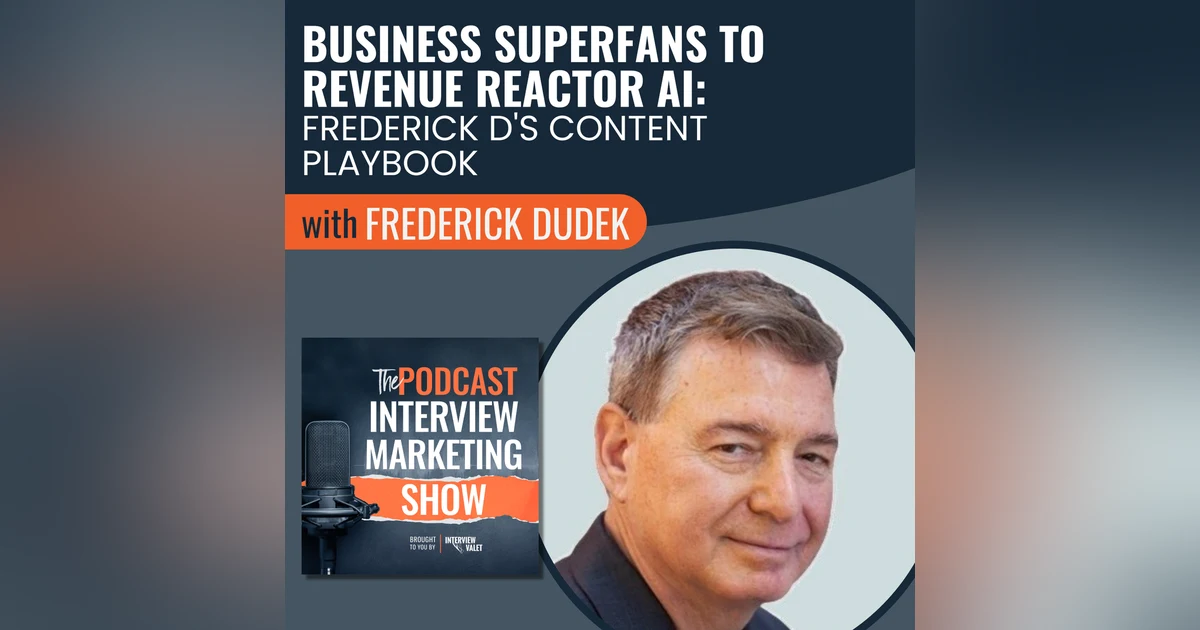
 Frederick Dudek - "Frederick D," host of the Business Superfans Advantage podcast - joins Tom Schwab to tackle a bigger problem than podcast discoverability. The real challenge is discovering the right idea inside a podcast.
After 215+ guest interviews, Frederick built Revenue Reactor AI. The platform runs on his custom AI mentor "Metis." It diagnoses where businesses are leaking revenue using his "seven Rs" framework: reach, recognition, retention, reputation, reviews, referrals, and revenue. The two dig into SEO/GEO/AEO-optimized show notes and why AI now weighs "share of voice and sentiment" over self-promotion. Plus, how real business superfans, not just customers, build unbuyable authority and drive referrals.
Timestamps From This Episode
[03:43] The SEO/GEO/AEO optimized show notes strategy
[06:06] Revenue Reactor AI platform and Superfans framework explained
[15:17] Helping solopreneurs
[23:30] AI sentiment and clone bots
Resources From This Episode
FrederickDudek.chat
RevenueReactor.ai
PodcastInterviewMarketing.com
InterviewValet.com
Looking For More?
Here are some resources to help you get started with a Podcast Interview Marketing strategy to grow your brand or business.
 |  |  |
00:00
Frederick Dudek
You know, those that don't move forward are going to be left behind. I basically have a simple saying. There's three kinds of people. Those that make things happen, those that watch things happen, and those that wonder what the heck happened. Welcome to the Podcast Interview Marketing show, where we explore big ideas with leading experts on how to grow your brand and business with targeted podcast interviews.
00:30
Tom Schwab
You often hear me say, don't just do more interviews. Do more with every interview. But what happens to all the value inside those conversations after the recording ends? Now, a podcast may contain a brilliant strategy, a powerful story, or the exact answer that someone needs. But if that insight is buried inside hundreds of episodes, it can be almost impossible to find. The problem is no longer just podcast discoverability. It's discovering the right idea inside the podcast. And today, I'm joined by Frederick Dudek, better known as Frederick D, host of the Business Superfans Advantage podcast and creator of the Revenue Reactor AI. Now, Frederick has taken the wisdom from more than 200 expert interviews, and he's turned it into something listeners can actually use.
01:30
Tom Schwab
Instead offering generic AI advice, his platform uses real business experience, trusted experts that he's vetted, and specific context to help entrepreneurs identify where they're leaking revenue and what they should do next. As you listen, think beyond the interview you're doing today. Ask yourself how can you organize, repurpose, and activate this knowledge so you're creating something to continue serving your audience and building your business long after the microphone is turned off? You often hear me say, don't just do more interviews. Do more with your interviews. And that's why I'm so excited to have today Frederick Dudek, or as his friends know him, Frederick D. You probably know him from the host of the business Superfans Advantage. And what he has put together here is amazing. The value that brings the audience with the tools that he's already created and the content that he's created.
02:34
Tom Schwab
So, Frederick D, welcome to the show.
02:37
Frederick Dudek
Tom. It's a pleasure to be on the show. Thank you very much for the invitation and I'm excited about our conversation.
02:43
Tom Schwab
Yeah. And so how many interviews have you done on the business Superfans Advantage?
02:48
Frederick Dudek
Now I am. I've dropped 215 episodes in a year and a half, and I have about another 10 to drop that I still need to get edited and stuff. And I'm booked for another probably about 60 plus days out.
03:05
Tom Schwab
Perfect. So, you know, if you want to learn everything that Freddy D. Has gone through on his podcast, we'll just block out what about 200 hours, and you can listen to every episode. But when I look for a solution to answer, I don't want to listen to 200 episodes. I want to get the answer and maybe point to one. And that's the problem. Right. They say discoverability in podcasts is a problem, but discoverability of the content inside the podcast is the bigger challenge. And talk to me about how you are addressing this now.
03:43
Frederick Dudek
Well, a couple things there, Tom, is one, I've used both chat, GPT and Claude, and I've customized it over the. Over the 18 months or so to be able to extract from the show notes, you know, the transcript, to actually pull out the proper takeaways and everything else. And so when someone goes to the episode and then looks at the show notes, they're actually designed for SEO, Geo and aeo, so they're all optimized to position the guest as an authority within their market space. So that's the one thing that I've done that I've researched, you know, the top 0.5% shows and just mimicking them and then leveling it up. And that's really where I've been at right now.
04:34
Tom Schwab
Yeah. And then what you're doing there to bring all of that together so that I can ask one question and you go to the podcast to get me the answer and then point me to the podcast where it came from. You know that when you told me about that, I'm like, how come that doesn't exist for all podcasts? Right, but it doesn't. ChatGPT, Claude. They sort of give us this generic answer for everything, and I don't know where it's coming from. It's sort of the average of all information. Good, bad, ugly. Right. So explain more what you're doing on that side.
05:12
Frederick Dudek
Okay. Well, I first wrote a book a couple years ago called Creating Business Superfans. And my whole career was my customers, my distributors, people I worked with were my sales team. I call them business superfans. Think of a sports team, and you got the fanatics that got the faces painted, the jerseys, the banners, the tailgate parties. They're promoting a sports team. So the idea that where all this started is what if a business could create the same level of energy and have their own team of super fans promoting their business? And that's what led me up to the platform that I've created. But where I differ from a lot of different things is a lot of people talk about leadership, they talk about employee stuff, and they talk about customers, and that's really where it falls off.
06:06
Frederick Dudek
And what I looked at is that means that nobody's talking about contractors or VAs, nobody's talking about suppliers or vendors, nobody's talking about distributors or franchisees, nobody's talking about complementary businesses and they're not thinking even about ancillary business. And at the end of the day, that whole ecosystem is the real business growth engine. And so what I created because of the things I've seen over the years is I created a platform called RevenueReactor AI. And what revenue Reactor does is you answer. It basically shows you where you're leaking revenue and leaving money on a table. Short version. And what it does is you go through and answer about 80 questions on a multitude of different things. It takes you about 10 minutes because it's just all slide and go. And what that does is it gives you a score in a multitude of areas.
07:09
Frederick Dudek
It looks at what's your superfan score. And Superfans framework is basically strategize, okay? Then you unite, create a propelling message, elevate everybody, rally the whole part of it, your finance, what are you using? Automation. And then more importantly, nurture all those relationships. And now the last step for superfans is you got to sustainable business. So that's one of the scores. And then it looks at your financial aspect and shows you where you're at. But where it goes deeper, which is pretty cool, is what I call my revenue engine indicators, which is seven Rs. The seven Rs are reach, which is your prospecting.
07:56
Tom Schwab
Okay.
07:57
Frederick Dudek
Second one is your recognition. Are you recognizing people? Customers, contractors, employees, vendors, et cetera. Then it goes from there. You start getting retention because now people, you're recognizing people, so people want to stick around. That in turn creates your reputation. Okay. What's internally and what your street cred is. Reputation creates reviews because now people want to write about the great things that you're doing. Reviews transcends into referrals because you've got the social proof and referrals becomes revenue.
08:39
Tom Schwab
And it's interesting, all of that. It's like that flywheel where one ticks off to the other. And so many times people are just looking at one, not trying to optimize for revenue at the end. Right. You can have a lot of leads, likes and thumbs up, but. But if it doesn't turn into revenue, it's not going to help the business long term.
09:04
Frederick Dudek
Correct. And so what's in a platform is there's an AI called Metis, which is after the Greek goddess of, you know, Strategy and wisdom and everything else. And so what I did is instead of just regular like we talked ChatGPT, Claude and Gemini and Gork and all those things, I actually took 215 episodes and synthes them into the brain of Metis. So it's actually going to be giving you advice on things that are applicable because it's from, you know, Tom who talks about, you know, how to maximize your show experience. That's going to be some advice. This is. Okay, you're guessing on a show, don't just do a one and done and go on 57,000 of them, do seven of them and maximize that exposure. So that's going to be some of the advice that.
10:08
Frederick Dudek
And so it comes into when you look at the foundation that I built in here. So the foundation is, you know, most people don't think about the mission statement. So we've got the mission statement put in here. We've got your core values, what's your ideal client profile? And the system will based upon how you answer will create all that automatically. What's your value proposition? What's your brand voice and messaging? What's your offer packages? What's your culture alignment? What's your reach strategy? What's your stakeholder experience? Again, like we talk to whole stakeholders, is everybody that touches your business is part of your business, whether you think of it or not. Then you move into what's your reviews and proof, what's your referral plan? Most people don't have a plan to get referrals. What's your advocacy? How are you creating advocates in your whole community?
11:01
Frederick Dudek
Then I've created relationship intelligence where a lot of times, you know, back when you and I were learning about personality types, there was a driver, amiable, expressive and analytical personalities. Right. Those were the foreigners, four quadrants in there. Then we came up with the disc system and now there's an entr which who the heck knows what that means. So what I created here is I took that knowledge and set it up so where it's going to tell me how to best work with Tom to create Tom as a super fan of me and that's how the guidance that the system is going to give you. Then I created team dynamics. Okay, how is Tom and Susie going to work together? And so I can see how to deal with that. And then we got what are your automation strategies?
11:52
Frederick Dudek
Customer lifetime value, financial health and of course exit strategy. What's the end game or succession plan? So that's the foundation within the RevenueReactor AI platform that gives you all the Guidance. And then it creates a 90 day action plan with every week things to do tasks and stuff. What are your goals into here? And then you've got the access to Mita's mentor to ask questions or get advice. And everywhere in here you can get metas to give you insight and share strategies. And then it's going to cite the podcast information that it got that it advised you and you can click on the podcast because it's LinkedIn, it displays the podcast, so you can click on it'll take you right to the episode and you can actually listen to.
12:50
Tom Schwab
Makes so much sense. And one of the things I couple things I love about RevenueReactor AI here is first, how you for to give the information needed. Right. And so often I'll see people go into AI and get a stupid answer because they asked a stupid question, right. How do I grow? My business is a meaningless question without the context behind that. Or someone will come to me and say, is this a good podcast? I don't know. Right. Is it good for you? How do you define good? So by you forcing them to think about their business, it can give better answers there. So that's the first thing. And then the next one is that one of the things is when we get advice from someone, you don't want to know where the advice comes from. Right.
13:43
Tom Schwab
If it's just a generic Reddit post, I don't know if I'm going to take their advice on health issues. Right. Or business issues. So you've sort of already vetted, you've put the framework in there, you vetted the experts that it references and then you even reference the experts. So if they want to go back and listen to that expert, they can. If they want to check them out, they can. And they can decide, you know, do I resonate with this or not? It to me it seems like it's taking the podcast and the advice that you get from the podcast to the next level.
14:23
Frederick Dudek
Yeah. Thank you. Yeah, that's exactly it. It's maximizing the knowledge of 200 and some individuals that have been there and done that.
14:35
Tom Schwab
And it will only get better as you're learning from it and putting on.
14:39
Frederick Dudek
More guests every week. Mitas gets smarter.
14:44
Tom Schwab
So where's the vision for where you're going with this? Because I think this is a quantum leap from. If were talking, well, I was on your show business superfans like a year ago, right. And were talking about. It's one conversational way, not one funnel away. And if you would have told me at that time you were doing this, it would have seemed like science fiction and now it's science fact. Where do you see this going? Is this building a community around really the content that you've created?
15:17
Frederick Dudek
It's really looking to help Solopreneurs, okay. Because a lot of times they don't have the money to pay a $5,000 coach. So, you know, Solopreneurs, a small trade services company, you know, it's a window cleaner, it's a small furnace company, you know, those type of things. It's a law firm that's just starting out by themselves and so they don't have all the assets and you know, they went to school for their law degree. They're not a sales and market expert and they got to find clients. Well, what's the strategy you've got? So a multitude of business types is the vision that this is to help them, give them a compass and here's what you need to do.
16:04
Frederick Dudek
And you know, like I, I just had a guy that's a DJ into the platform and his score was 38 out of 100 because he's not, you know, he not doing the things he's need to be doing. He bought my book Creating Business Superfans and he gave me a testimonial on LinkedIn that basically didn't have this prepared. But since we're talking about it is one that I've kind of am proud to have gotten from this guy. And let me just get there real quick. So the testimonial verbatim is Frederick's book had me reach out to past and current clients with a simple action. Within a week of them booked. Within a week, one of them booked me for a gig. Another one wrote back just to say that the note meant something. One strategy, one week, one paying booking.
17:08
Frederick Dudek
Most business books never turn into a single dollar. This one did.
17:14
Tom Schwab
So I would say he's a super fan.
17:17
Frederick Dudek
Yeah.
17:18
Tom Schwab
Yeah. And so it's so interesting. And the analogy to the sports team amazes me, right? Because there you've got a huge profitable franchise, right? And you've got people paying top $100 plus dollars to wear a jersey to advertise them, right? When they're having with their own money,.
17:42
Frederick Dudek
They're spending their own money, right?
17:43
Tom Schwab
So they're, they're making money off their marketing. When they have a bad year or something comes up with them. It's their super fans that are supporting them. It's their super fans that are posting about them that Idea of how you can build a, a dynasty like that. You can look at the same way for any business. And you know, Freddy, when you were talking about why you built Revenue Reactor AI, you were saying, to help these people and the different types of people, they can't afford a business coach, but they need the information. I would dare say if I asked you that same question 241 episodes ago when you started the podcast, it would have been the same answer. So nothing has really changed with that.
18:36
Tom Schwab
It's just you helped them in a certain way, which was state of the art at that point, the best way you could. Now you're taking everything you've done and taking it to the next level to help those same people with really that same content.
18:52
Frederick Dudek
Yeah, I mean, I'm taking 40 years of experience on a global stage. I've taken software products from zero to millions for other companies. I've had my own company. And one of the things I realized is that's where kind of this idea came by is when you're too close to it, you can't see it. So I've made face plants in my own business because it was right here. So, you know, until I stepped away or someone else pointed some things out. And that's where Revenue Reactor AI is all about, is to be able to help people step back and go, oh, wait a minute, you're right. I haven't reached out to this, these customers in six months. And that's my sales team that I'm ignoring.
19:37
Frederick Dudek
You know, I'll share a real simple story of how this drives at home is years ago I ended up unfortunately getting divorced and I had to sell the house because it was the way it was. And so I got two realtors from a real estate agency, two women. And it worked out because my ex wife didn't like one of them and liked the other one. And so the universe kind of set that up. We got rid, you know, got the household, got the divorce done, and I have a new wife that I'm super happy about and we've been together for over a decade. And I moved into an apartment because, you know, I needed to wait till this dust settled. At a divorce, it wasn't done and you know, et cetera. I never heard back from them at all. Nothing.
20:34
Frederick Dudek
And a year later, when the lease was up on the place and the divorce was finalized, I was looking to buy a house. I didn't have their business cards anymore because I moved. So that got lost. I didn't know who don't Remember their name. I still don't remember their name to this day. I ended up buying a house, new house, and then I bought an investment property. So they missed out on two real estate transactions within a two year period because they didn't maintain contact with me.
21:08
Tom Schwab
And that's the. The rule or the exception? Not the rule. Even to the point. I've seen where we've got a client that comes to us. I was just talking to one today. He only wanted a small geography and if you couldn't drive to his business, you weren't going to be a client of his. And I told him straight out that being on national podcasts might be effective, but it's not efficient. Right. You're going to talk to a thousand people and you'll be lucky if one is right for you. I said I would not invest in this. And he stopped and he's like, you're the first company that I've talked to that told me that. And I'm like, well, I want you to get results, not just to sign you up here. So it's like, did I lose revenue there? Could I have sold them?
21:56
Tom Schwab
Well, I wouldn't want to sell them because he wouldn't have had a good experience. He wouldn't have become a super fan. Now he's like going out and saying, well, Interview the valet cared more about my results than they did just signing me up. And at that point, it's like, you can have super fans that even aren't customers or clients there, but it's doing the right thing and being consistent with that.
22:21
Frederick Dudek
Yeah. And that's how you could. That's exactly the way you create superfans. And once you built that credibility in the way that you did, you can't buy that kind of PR because that person's going to tell everybody about Interview Valet and the approach that they handled it. You know, it reminds me again, when I was selling software, there's times in the manufacturing space, there's times I'd say, my stuff doesn't work. You should talk to this company. And they became a super fan and they referred me to someone else that was looking for work and, you know, for technology and poof. And they would introduce me, which is the. You know, it's not even a referral, it's an introduction, which collapses the whole sales cycle. And, you know, my fastest sale was 30 minutes for about a $60,000 sale.
23:13
Frederick Dudek
And the 30 minutes was putting together the order because the guy said, jack says I need to buy this. So how much? How fast? Can you get it to me? And that was it. So my 30 minutes was putting the order together and then using their fax machine back in the day to send it to corporate.
23:30
Tom Schwab
You know, it's interesting when you say you can't buy that kind of PR or that kind of authority, and I think today in AI, it's even more vital, right. Speaking recently to an AI person and they were saying that, you know, there's two things that they're looking for AI that is, they're looking for share of voice and sentiment. Right. How much are people talking about you? And is it positive, neutral or negative? Right. And it's not what do I say about me on my platform. Right. It's what are other people saying? And that's what you're talking about here. I guess you could have super fans out there. You could also have super detractors, right? Because if people are talking negative about you, AI is going to hear that they discard what you say about yourself and it's what are other people?
24:22
Tom Schwab
So your point is let's make sure that those super fans are well taken care of and appreciated and leveraging them because AI is listening to them, it's not listening to us.
24:38
Frederick Dudek
Correct? Absolutely. Spot on. And, you know, I'll share another quick story is when I was, you know, took a product from 03 million back in the late 90s, I set up a distribution channel around the world, had about 60 resellers. And you know, most people deal with deal and spend a lot of time with the owners of those agencies getting their mind shared, the owners, et cetera. I did my obligatory, you know, take them out to dinner and all that stuff. But I would be drinking the beers and hanging out with the sales team and the tech team, the actual people that were promoting my product. And I got mind share.
25:14
Frederick Dudek
And then when we would bring all these resellers in for awards, top reseller performer and all that stuff, not only did I recognize the agency, I recognized the team of that agency that sold the most of my product.
25:29
Tom Schwab
Those are the influencers on there. That's who your buyer is actually listening to. And as you were talking about the AI here, internally, we've set up, we call it the Tombot, where it's all of my books, all of my interviews, all of my webinars have been put into one. And we use mostly internally. And one of the things that my team has told me is they would rather ask the Tombot than ask me because they get an instant answer. Whereas I might take a little Bit time to get back to them. The Tombot references where it came from. So if they need to get more information and then their other point is the Tombot is consistent. Right. Whether do you catch me at 5am or 5pm when it's I'm tired after a day, you know.
26:23
Tom Schwab
And it gives you the answer, not the stories that go along with it too.
26:27
Frederick Dudek
Right? Yeah. It's the new world today and you need, people need to be embracing that because the game is changing and you know, those that don't move forward are going to be left behind. I basically have a simple saying. There's three kinds of people. Those that make things happen, those that watch things happen, and those that wonder what the heck happened.
26:54
Tom Schwab
Yes. Well, you're definitely one of those that are making it happen. Right. People can listen to you on the Business Superfans podcast. I highly recommend them to check out Revenue Reactor AI. I've been blown away as I played around with it here. And then if people want to get in touch with you, what's the best way? What's the next step after this, they've heard you. What's the next step for them to.
27:22
Frederick Dudek
Sign up and get their free Revenue Leak score. It's free, no credit card needed and it'll actually point them to where they're leaking revenue in their business via the Revenue Reactor AI platform. So there's no fee for that. And then if they want to, they can upgrade to. There's a couple levels. Level one is the ignition, which is the free. Think of it as starting up a reactor. Level 2 is gets you more access to certain things that call that momentum. And then the next level, the top level right now is Overdrive. Think of it as, you know, hitting the over passing in a car. You kick it into high gear. That's one way. And your way that people can reach me is at Frederick Dudek.
28:06
Frederick Dudek
FrederickDukek.chat
28:18
Tom Schwab
D what's ordinary to you is amazing to others. Thank you so much for being here.
28:23
Frederick Dudek
Thank you for the opportunity, Tom. Appreciate it very much.
28:26
Tom Schwab
What I love about this conversation is that it proves that an interview, it doesn't have to be a one time event. Frederick D took more than 2, 200 podcast conversations and transformed them into a growing library of trusted business intelligence. That content can now answer questions, recommend next steps and point people back to the original expert and the episode. That's what I call doing more with every interview Your interview should not disappear into an archive. They can become articles, videos, training materials, internal tools, client resources, or even part of an AI knowledge base. The conversation? Well, it may last 30 minutes, but the value? That can continue working for years. So here's your next step. Choose one interview you've already completed. Identify the three best ideas from that conversation. Then decide how each one can be reused to serve your audience.
29:33
Tom Schwab
Again, turn it into a post, into a client resource, and one into a region to reconnect with the host. You do not always need more content. You may simply need to unlock more value from the content you already have. Because what's ordinary to you, buried inside an old interview could be exactly what someone else needs to hear today.