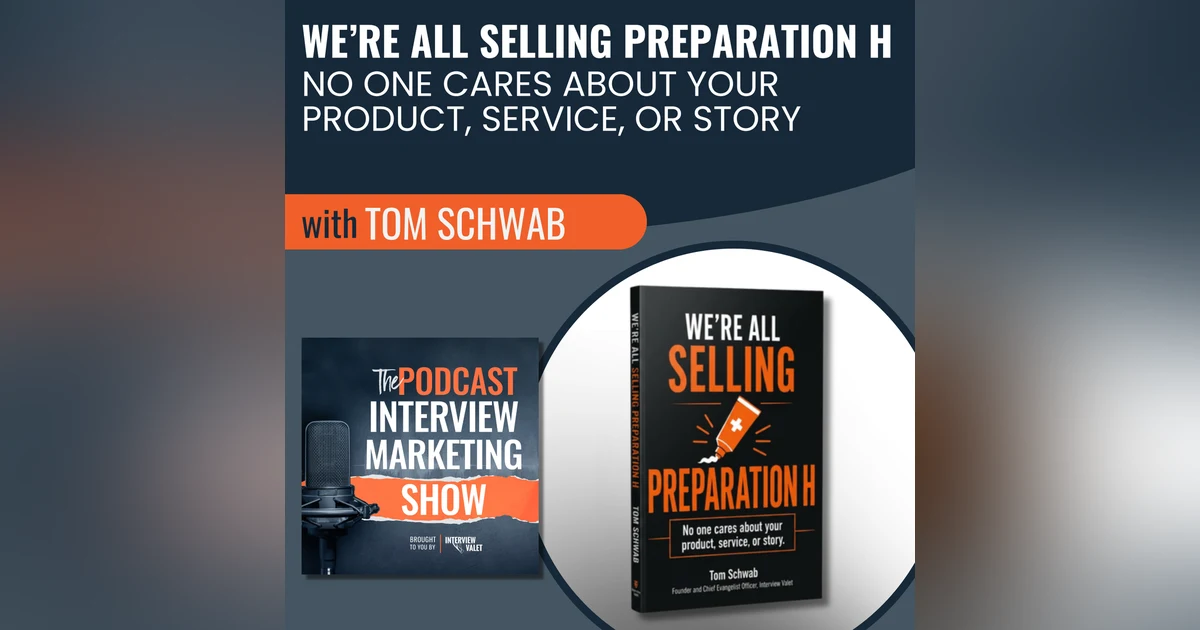
We're All Selling Preparation H: No One Cares About Your Product, Service, or Story


 Apple Podcasts
 Spotify
 YouTube
 Your prospects don’t want your product, service, or story. They want relief. Interview Valet founder shares the full audio edition of his latest mini book, We're All Selling Preparation H.
Tom shares why founder stories fail when they lead instead of support. A clear point of view, built on category design principles, becomes the foundation for standing out. Plus, why becoming a magnet outperforms the megaphone approach. This episode is a practical guide for anyone tired of shouting into the void and ready to become the obvious choice.
Timestamps From This Episode:
03:57 The founder story myth
08:30 Start with the problem, not you
20:01 Become a magnet, not a megaphone
28:06 Relief is the product
Resources From This Episode:
InterviewValet.com/minibook
PodcastInterviewMarketing.com
Looking For More?
Here are some resources to help you get started with a Podcast Interview Marketing strategy to grow your brand or business.
 |  |  |
00:00
Tom Schwab
Every no protects your ability to deliver on an even bigger yes. You don't become the obvious choice by accepting everyone. You become the obvious choice by relentlessly being clear about who you serve, what problem you solve, and why you uniquely are equipped to solve it.
00:37
Tom Schwab
Today's episode is a little different. Instead of an interview, I'm sharing the complete audio version of my newest mini book. We're all selling Preparation H. Why no one cares about your product, service, or your story. The title may make you uncomfortable, but the lesson is simple. Nobody buys the tube. They buy the relief. Your clients are not buying your process, credentials, or that founder story. They're buying a better future. In this book, we'll explore how to lead with the problem, share a clear point of view, and use your story as proof, not the product. As you listen, ask yourself, are you selling the tube? Are you? Or are you selling the relief? Let's get to it. The tube and the relief. One day I was covering the phones during lunch. I took a call from a client. He was happy, very happy.
01:38
Tom Schwab
And he said, you guys are great. You're just like Preparation H. I honestly didn't know if I'd been complimented or insulted. Then he said, you came recommended. You gave me fast relief, and I'll recommend you to everyone I know. It clicked. Nobody wants to buy hemorrhoid cream. People buy relief fast, trusted relief. And that's the uncomfortable truth that most founders don't want to hear. People don't wake up caring about your product or your service, much less your story. They wake up thinking about their problems, their pain, their frustration, their I wish this was different moment. Yet most businesses market exactly backwards. They fill their website talking about their business. They open up podcast interviews with their biography. They tell their founder story because someone told them. That's marketing. I firmly reject that premise. Stories matter, yes, but they matter later.
02:47
Tom Schwab
People become interested in your story only after they believe you understand theirs. This book is about flipping the order. Start with the problem, then bring a specific, clear point of view. And only then use your story as evidence, not as a performance. That's when marketing stops being a megaphone. A megaphone that just makes noises. More content, more posts, more shouting into the void. A magnet works differently. It magically attracts the right people and repels the wrong one. That repelling isn't a failure. It's a focus. You're not trying to be for everyone. It you're not chasing more eyeballs, more bad leads, or more buzz. What is buzz anyway? You're trying to be the only obvious choice for the people who have the problem you solve and who value your solution. Let the influencers optimize for fame and impressions.
03:57
Tom Schwab
As a business owner, you're optimizing for profits. That's a very different kind of confidence. It's not built on attention. It's built on clarity. In the chapters that follow, we'll talk about why the Founder's Story myth is so seductive. How to uncover your point of view, how to tell your story in a way that supports rather than overshadow, and why saying no might be one of the kindest business decisions you ever make. For now, just hold that one line. We're all selling Preparation H. Make sure you're talking about the relief, not the tube. And remember what Bixon said. If you haven't changed your mind lately, how do you know you still have one? Chapter 1 the Founder Story Myth Founder if you spend any time around entrepreneurs, you've probably heard the advice. Just tell your story. People say it on stages. Marketing agencies repeat it.
05:04
Tom Schwab
Branding consultants. They build entire businesses around it. The social media influencers. They insist that authenticity means talking about yourself. It sounds like good advice. It just isn't. At least not if your goal is to grow a business. Why the Myth survives I think this advice survives because it appeals to our ego. Nobody knows your story better than you do. It's comfortable to tell. It feels authentic because it happened to you. Better yet, every time you tell it, you get to relive your victories, your struggles, and the obstacles you've overcome. The problem is that your audience isn't thinking about your life. They're thinking about theirs. Every person you meet is carrying around a list of problems they wish would disappear.
06:03
Tom Schwab
They're thinking about growing their business, finding more customers, reducing stress, making payroll, losing weight, sleeping better, finding more time, or simply getting through the week. Their attention naturally goes to anything that promises relief. Everything else, it's just background noise. That's not selfish. That's just human nature. The Book Test Think about your own life when was the last time you bought a book because you couldn't wait to hear someone else's life story? Probably not very often. You bought it because you hoped it would solve a problem, answer a question, or help you become someone different. Even biographies work this way. People don't read about Winston Churchill because they're curious about every detail of his childhood. No, they read it because they want insights into leadership, courage, decision making, or history. The story. It's simply the vehicle. The insight is what they came for.
07:14
Tom Schwab
Storytelling is incredibly powerful. Founder storytelling. Well, it's too often self indulgent. That's why I believe we've confused storytelling with founder storytelling. There's a huge difference. The Order that Works the best speakers in the world understand this. Yes, you eventually learn pieces of their personal story, but that's not how they begin. They begin by talking about a problem that the audience recognizes immediately. Only after the audience says, yeah, that's exactly what I'm struggling with, does the speaker earn the right to explain how they arrived at their point of view. Notice the order. Problem 1st point of view 2nd story 3rd too many entrepreneurs reverse it. They start with the story, hope someone cares, then wonder why no one remembers. The irony is that when you stop trying to make people interested in your story, that's often when they become most interested.
08:30
Tom Schwab
Not because you've become more fascinating, because you've become more useful. As Joe Pulizzi, the founder of Content Marketing World, said, your customers don't care about your products, or your service. They care about themselves. Chapter to Start with the Problem if your story isn't where you start, well, what do you start with? Start with the problem. Always the problem. Every buying decision begins with someone trying to improve their future. Nobody buys a drill because they love drills. They buy it because they need a hole. Nobody buys Preparation H because they admire the ingredients. They buy relief. Your clients are no different. They aren't looking for another marketing agency, another consultant, another coach, another podcast Interviews. Those are simply vehicles. What they're really buying is the destination. The question that changed our business Years ago, our team changed the first question we asked all prospective clients.
09:46
Tom Schwab
Instead of asking about their company, their founder story, or what podcast they wanted to be on, we ask a much simpler question. What problem are you trying to solve? That single question changed everything. Some people wanted more leads. Some wanted to become recognized authority in their industries. Others wanted to shorten their sales cycle. Some wanted to recruit better employees. Others wanted to increase the value of the company before an exit. None of them wanted podcast interviews. Podcast interviews were simply one possible path to the outcome they wanted. That realization changed our business. It also changed who we choose to work with. If someone couldn't clearly explain what success looks like six months from now, they probably weren't ready for podcast interview marketing. Not because they weren't smart. Because they didn't have a strategy. They wanted activity, not direction.
10:53
Tom Schwab
Strategy before activity Simon Sinek famously encouraged leaders to start with why? I agree. Without a clear why, you're just working hard, expending valuable resources with no goal. I view it as a person in a rowboat. They've got one. Or the harder they row, the faster they go around in circles. You see, marketing without strategy is just an expensive activity. The same is true for content. The same is true for podcast interviews. The same is true for storytelling. Before you say anything publicly, ask yourself a better what problem am I helping someone solve? When you become crystal clear on that, something remarkable happens. Your marketing stops sounding like everyone else's. Your conversations become easier. Prospects begin explaining their goals before you can explain your services. They start seeing themselves in your message. That's because you're no longer talking about yourself. You're talking about them.
12:08
Tom Schwab
That's where trust begins. And trust is what every sale is built on. As Clayton Christensen said in Harvard Business Review, customers don't buy products or services. They hire jobs to do. Chapter 3 your point of view is your product. Once you're clear on the problem, you solve, the next question is obvious. Why should anyone listen to you? The answer isn't because you've been in business longer. It isn't because you've served more clients. It isn't because you've accumulated more certifications. It's because you see the problem differently. That's what a point of view is. It isn't an opinion for the sake of being controversial. It isn't picking a fight. It's having the courage. The courage to articulate something you believe to be true, even when it runs against the conventional wisdom.
13:07
Tom Schwab
Two sentences that force clarity One of the simplest frameworks I found from category design is completing to sentences I reject. Fill in the blank, I believe. Fill in the blank. That's it. Those to statements force clarity. They force you to decide what game you're playing for this book. Mine would be simple. I reject the idea that founders should lead with their story. I believe buyers care far more about solving their own problems. Everything else in the book flows from those to beliefs. Without a point of view, you're just another option, a voice drowning in this sea of sameness. With a strong and clear point of view, you become the only option. Memorable, thought provoking, and referable. God hates a coward. Too many businesses trying to be agreeable and cast the widest net.
14:12
Tom Schwab
They don't want to deter anyone, so they say nothing that anyone remembers. Rick Bennett wrote legendary copy for companies like Oracle on the podcast Interview Marketing Show. He said something that's haunted me ever since God hates A coward and the market ignores them. He's not encouraging people to be offensive. He's encouraging them to be clear. There's a difference. Notice I didn't say you should tell people they're wrong. In fact, I avoid the phrase you should. Nobody likes being told what to do. Not kids, teenagers, clients or founders. Instead, say what you believe. Explain what you've observed. Share what you've experienced. Invite people to think differently. That's leadership. Clarity. Well, clarity is confidence. There's another reason this matters. When you're clear about what you believe, you become a magnet. The right people move toward you because they recognize themselves in your thinking.
15:24
Tom Schwab
The wrong people move away because your perspective doesn't fit with what they're looking for. Both outcomes are great. Generalists see this as a losing opportunity. Specialists understand it's creating focus and differentiation. The irony is that the clearer you become on your point of view, the larger your business grows. Not because everyone agrees with you, but because the right people know exactly how, why, they should choose you. Clarity is not confrontation. Clarity is confidence. And confidence attracts. As one of my old bosses in the Navy, Lieutenant Commander Gary Duncan, said, most of the world wants you to be happy. Those who really care about you want you to better. Chapter four. YOUR story is proof, not the product. By now, you may think I'm against telling your story. I'm not. I'm against leading with it. There's a huge difference. Stories are powerful.
16:32
Tom Schwab
Stories help us remember. Stories build trust. Stories create emotion. Stories connect us. But only after they have a purpose. Your story is not your product. Your story is proof that your point of view was earned and is owned by you. The COURTROOM Think about a courtroom. The attorney doesn't begin by presenting evidence. First, they explain the case. They establish what happened. They describe why it matters. Only then do they introduce evidence that supports the argument. Your story plays the same role. It isn't the argument. It's the evidence. When I tell the Preparation H story, I'm not telling it because it's entertaining. I'm telling it because it explains why I believe People don't buy products, they buy relief. Without that insight, it's simply an amusing story about a customer saying something totally unexpected. The value? It's not in the story.
17:47
Tom Schwab
The value is in the insight. Reflection turns experience into wisdom. That insight didn't appear at the moment. At least not when I hung up the phone. It came later, after I reflected on the conversation. Now that's an important distinction. We don't learn from our experiences. We learn from reflecting on our experiences. If experience alone taught me lessons, I would have only had one hangover in my life. Experience gives us the raw material. Reflection turns that raw material into wisdom. Wisdom that creates insights, and insights create a point of view. Only then does your story become valuable to someone else. This is why to people can live through the exact same experience and come away with completely different lessons. One simply remembers what happened, the other discovered what it means.
18:51
Tom Schwab
That's the person that people listen to, not because they've had extraordinary experiences, but because they've extracted extraordinary insights from ordinary experience. Everyone has experiences. Few people extract the insights from them. Three questions before you tell it the next time you're tempted to tell a story, stop for a moment. Ask yourself these three questions. What problem does this story relate to? What insights did I gain from it? And finally, how does this support my point of view? If you can't answer those questions, you're probably telling a story for yourself, not for the audience. The goal is never to make people admire your journey. The goal is to help them navigate theirs. That's the difference between telling a story and creating impact. As Socrates said, the unexamined life is not worth living. I'd add, it's not worth sharing on a podcast either.
20:01
Tom Schwab
Chapter five Become a magnet, not a megaphone Most market advice can be summarized in to words. Be louder. Post more. Create more content. Show up on more platforms. Run more ads. Get more followers. Grow your audience. Buy a bigger megaphone. I reject that idea. A megaphone isn't what most businesses need. They need a magnet. A megaphone broadcasts to everyone. A magnet attracts the right people and repels the wrong one. Now there's the fear of repelling. Most business owners are terrified to repel anyone. They think every prospect is an opportunity, every inquiry is revenue, and every no is a loss. I see it differently. Every wrong client steals time from the right client. Every wrong opportunity delays the right opportunity. Every wrong message, well, it just attracts more of the wrong people. The goal isn't to get everyone's attention.
21:14
Tom Schwab
The goal is to earn the attention of the people you can help the most. That shift changes everything. The category we almost didn't own Years ago, Christopher Lockhead challenged me with one simple question. He said, sounds to me like you've created a new category. I pushed back. I told him we did a little marketing, a little public relations, a little podcasting. His response caught me off guard. He said, why won't you own the new category? My answer was honest, because I felt it was easier to compete for a tiny piece of a huge existing market than it was to educate people and create a new category. He challenged me to grow a pair and own it before someone else did. He was right.
22:06
Tom Schwab
The moment we stopped describing ourselves as just another marketing agency or a podcast booker and started evangelizing podcast interview marketing, everything became clearer. Not everyone understood it. That was the point. The people who needed it understood it immediately. The people who didn't were never going to be our clients anyway. That is how a magnet works. They don't attract everyone, they attract the right people. Nobody repeats generic the irony is that clarity often feels risky. General language feels safe. Like we help businesses grow, we help entrepreneurs succeed, we offer customized solution. Those statements are impossible to disagree with. They're also impossible to remember. Nobody repeats generic. People repeat clarity. People refer certainty and people remember a point of view. The business with the strongest brands aren't trying to be liked by everyone. They're trying to be indispensable for the right people.
23:21
Tom Schwab
That requires the courage to leave people behind. Not because they're bad people, but because they're not your people. This is one of the hardest lessons in business, especially early on when cash is tight. Every opportunity looks like a good opportunity. Eventually you learn something different. Focus creates value, Clarity creates demand, and differentiation Leck creates referrals. You don't become the obvious choice by speaking to everyone. You become the obvious choice by speaking clearly to people's who problems you uniquely equipped to solve. That isn't limiting your business, it's defining it. And defined businesses grow faster than undefined ones because people know exactly when to recommend them. Become the magnet. Let everyone else fight over the megaphone. Experience gives us raw material. Reflection turns raw material into wisdom. Wisdom creates insights. Insights create a point of view. Point of view creates differentiation.
24:41
Tom Schwab
Differentiation creates attracts the right people. Chapter 6 Heck yes or no One of the core values at our company Interview Valet, is simple. Heck yes or no. Big shout out to Derek Sivers on that one. There's no middle ground. At first glance, it sounds like a decision making framework. Actually, it's a focus framework. Every business has limited resources, limited time, limited attention, limited money, limited energy. Every yes comes at the expense of another opportunity. The question isn't whether you'll make sacrifices. The question is whether you'll make them intentionally. The Wider Net early in my career, I wanted to help everyone. Like most entrepreneurs, I believed a wider net meant a bigger business. Wrong. A wider net catches more fish. It also caught more boots, tires, and trash. The more general we became, the harder it was for people to understand what we actually did.
25:54
Tom Schwab
There's three filters. Eventually, we developed three simple filters. Every prospective client has to pass all three. Number one, do we know the audience they want to reach? Number to, have we helped similar clients achieve the results they're looking for? And number three, would we be proud to amplify this message? If the answer to any one of these questions is no, then the answer to all of them is no. Not because they're bad people, not because their business is important, but because they aren't the right partner. That clarity has become one of the greatest competitive advantages. Ironically, people often trust us more when we tell them no. Why? Because they know we're thinking about their success, not our revenue. Sometimes we'll refer them to someone else. Sometimes we'll tell them what they need to change before we're the right fit.
26:58
Tom Schwab
Sometimes we'll simply wish them well. But we won't take their money if we don't believe we can deliver the outcome they're looking for. That's not just good marketing. It's good stewardship. Missionaries and Mercenaries Eddie Yoon taught me the difference between missionaries and mercenaries. Missionaries are obsessed with solving a problem. Mercenaries are obsessed with finding the next opportunity. One builds trust, the other chases transactions. The more I've reflected on this distinction, the more convinced I've become that customers can tell the difference. They may not have the words for it, but they can feel it. When you're passionate about solving a problem, your message has conviction. When you're simply selling a service, the message sounds like everyone else's. See, every no protects your ability to deliver on an even bigger yes. You don't become the obvious choice by accepting everyone.
28:06
Tom Schwab
You become the obvious choice by relentlessly being clear about who you serve, what problem you solve, and why you uniquely are equipped to solve it. That means saying no. Because every no protects the ability to deliver an even bigger yes to the people that you want to help. That's what focus looks like. That's what trust looks like. And ultimately, that's what becoming the obvious choice looks like. Conclusion. Relief is the product. When I first heard the customer tell me, you guys are just like Preparation H, I honestly didn't know whether to laugh or be offended. Today, I think it might have been one of the greatest lessons I've ever received. He wasn't complimenting our company. He wasn't complimenting our process. He wasn't complimenting our service. He was complimenting the relief he created. That changed how I think about business.
29:12
Tom Schwab
It changed about how I think about marketing. It changed how I think about communication and it completely changes how I think about storytelling. People don't buy products. People don't buy services. People don't buy stories. They buy a better future. They buy confidence. They buy certainty. They buy hope. They buy relief. Everything else is simply the vehicle. Throughout this book, I've challenged a lot of conventional wisdom. I reject the idea that your founder story is your greatest marketing asset. I reject the idea that getting more attention is the goal. I reject the idea that saying yes to everyone is good for your business. Instead, I believe in something much simpler. Start with the problem. Reflect on your experience solving it. Extract an insight. Develop a point of view. Use your story as proof and then become the obvious choice. That is how trust is earned.
30:22
Tom Schwab
That is how referrals happen. That is how business grows. Not because they shouted the loudest. Because they understood the deepest. When someone finishes a conversation with you, they shouldn't be thinking about how interesting you are. They should be thinking about how well you understood them. That's what matters to people. That's what they remember. That's what they tell their friends. That's what gets repeated. Not your biography. Not your credentials. Not your elevator pitch. Your insight. That is what makes you memorable. As you leave this book, I have one challenge for you. Look at your website. Look at your LinkedIn profile. Listen to your next sales call and pay attention to your next podcast interview or keynote. How much of it is about you and how much of it is about the problem you solve?
31:23
Tom Schwab
If you're like most of us, you'll discover you've been selling the tube. Start selling the relief. The world doesn't need another founder telling a story. It needs more leaders who've reflected deeply enough to offer an insight that helps other people solve meaningful problems. Become one of those leaders. Because in the end, we're all selling Preparation H. The obvious choice isn't the company with the best story. It's the one that delivers relief to the pain in the client's rear. Stay strong. Sell the relief. People do not buy your products, services, or your founder story. They buy relief. That matters in every sales conversation on your website and especially during a podcast interview. The goal is not to make the listeners think you are interesting. The goal is to make them feel understood. Start with their problems. Share your point of view.
32:28
Tom Schwab
Then use your story as proof. Before your next interview. Remember, review your talking points and ask how much is this about me? And how much of this is about the listener? To explore the full mini book series or get a copy of Raw Selling Preparation H Visit interviewvallet.com minibook until next time, stop selling the to Start selling the relief. Sam.