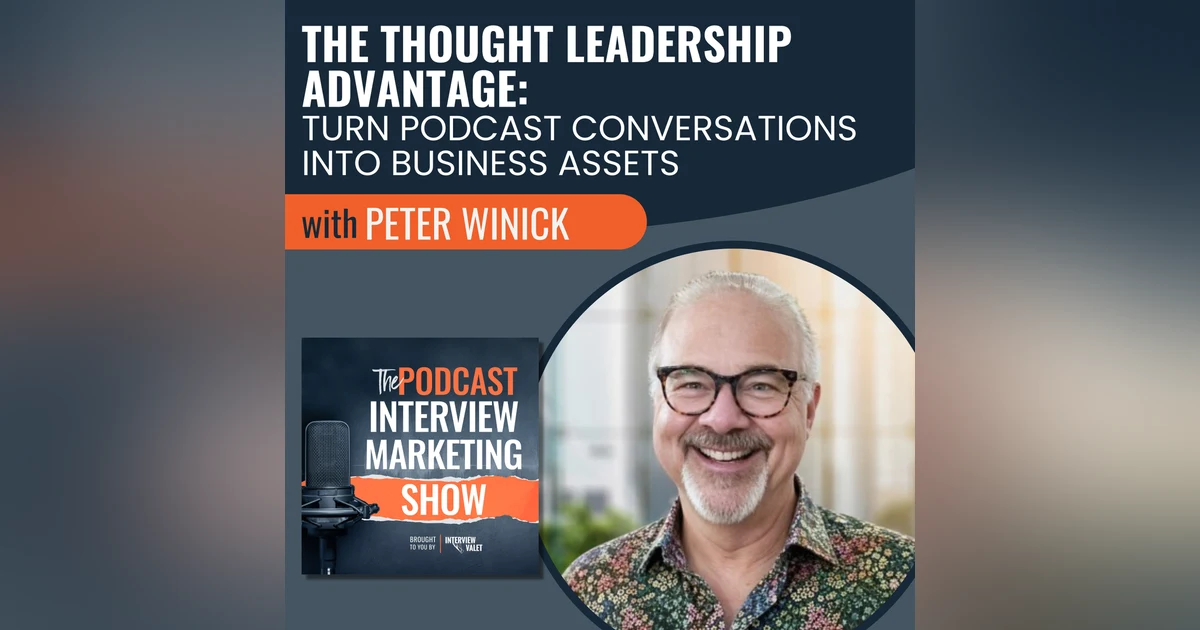
The Thought Leadership Advantage with Peter Winick

 Apple Podcasts
 Spotify
 YouTube
 What if your next podcast interview became more than content? Peter Winick, host of the Thought Leadership Leverage podcast and co-author of The Thought Leadership Handbook, says it can be the start of a real intellectual property asset.
With host Tom Schwab, Peter unpacks how conversations compound into brand equity. The surprising origin story of turning 725 podcast episodes into a book using AI as a research assistant, breaks down his hobby-practice-business framework for evaluating thought leadership, and explains why every expert has a "duty to speak." They also cover the five Thought Leader avatars and how to shape a core idea that's short, generous, and distinctive.
Timestamps From This Episode
[04:32] The 725 podcast episodes that became the book
[11:03] The framework: thought leadership as hobby, practice, or business
[18:34] Crafting a short, generous, distinctive core idea
[27:27] Five thought leader avatars, from CEO to legend
Resources From This Episode
ThoughtLeadershipHandbook.com
LinkedIn.com/in/peterwinick
PodcastInterivewMarketing.com
InterviewValet.com
Looking For More?
Here are some resources to help you get started with a Podcast Interview Marketing strategy to grow your brand or business.
 |  |  |
00:00
Peter Winick
If you're thinking about Thought Leadership, just start. You know, good Thought Leadership could be as simple as leaving thoughtful comments on something like a LinkedIn post where people that matter to you are hanging out. It could be something like being a guest on a podcast in front of the right audiences to get your ideas out. It doesn't need to be net new, right? So some of it could be getting in front of the right people and showing what you do and exhibiting what you do by doing it. Welcome to the Podcast Interview Marketing show, where we explore big ideas with leading experts on how to grow your brand and business with targeted podcast interviews.
00:43
Tom Schwab
What if your next podcast interview wasn't just another piece of content, but the beginning of an intellectual property asset that could build your brand, grow your business, and create impact for years? Today, I'm talking with my friend Peter Winick. Now, Peter is the host of the Thought Leadership Leverage podcast, and he's also author, co author of a recent book called the Thought Leadership Handbook. Peter has spent decades helping experts turn what they know into ideas, frameworks, and business models that scale. Now, one of the biggest mistakes I see podcast guests making is treating the interview like an isolated event. They show up, tell their stories, answer questions, and then they move on. But Peter offers a much more powerful perspective. You see, when a host and guest have a meaningful conversation, they create Thought Leadership together.
01:44
Tom Schwab
That conversation can reveal your core idea, clarify who you serve, and become the raw material for articles, videos, presentations, training, and future interviews. In this episode, you'll learn how to determine whether your Thought Leadership is a hobby, a practice, or a business. Why? Every expert has a duty to share their best ideas and how to communicate those ideas in a way that is short, distinctive, proactive, and generous. Let's get started. Peter, I am so excited to have you here and to talk about this book. I have recommended it so many times since I first read it, and this should be like, required reading for anybody that's going on podcast interviews. So tell me more about, like, what was the reason that you wrote Thought Leadership Handbook? What's the problem that you were trying to solve there?
02:44
Peter Winick
Yeah, so I'll give you two pieces to that. One is the origin story. But let me start with your question, which is really the why did we write this book? We wrote this book because more and more people, individuals, Thought leaders, keynote speakers, large organizations, whatever, are throwing around this terminology, this Thought Leadership thing. And it's if you and I, maybe we're not finance people, but if were to have a conversation around finance, because there's Language, definitions, models. I might say to you, hey, Tom, how's business? And you might say, oh, it's good, but account receivables are backing, you know, backing up to an unhealthy level. Okay, I know what that means. Right? Or we might say, my invoicing system is a pain in the neck and I've decided to change it to integrate with my finances, whatever it is.
03:32
Peter Winick
But I know what you mean, and I know what you're talking about. I don't need an MBA in finance. The problem that I see in Thought Leadership is we're having a conversation on Thought Leadership. But you might be talking about content marketing, and I might be talking about a motivational speaker. So we're not having a conversation around Thought Leadership. So what we decided to do was take years and years of models, methods and frameworks and put them out in a book so that more and more people could be exposed to these ideas that we know are helpful because we're not academics. We didn't develop this, like, in isolation on a big government grant. Like, we did it from 20 years of working in the field with real clients every day.
04:08
Tom Schwab
And the real clients. I was looking through the endorsements at the beginning. It's like a who's who of Thought leaders. Right? And. Well, and I know a lot of those come from the podcast. And really, you're summarizing everything you've been learning through your decades of work and the podcast. So can you maybe dig into the backstory of, like, backstory is going to.
04:32
Peter Winick
Hit on the podcast. So you're going to love this. So here's the backstory. So it's a couple of years ago, two years ago, ish, whatever. It's like a rainy Saturday. And I decide, like everybody else, I gotta figure out this chat thing. Like, everybody else is talking about LLMs and Claude and ChatGPT, whatever. And I had used it intermittently. I'm like, okay, it's kind of clever, it's interesting, whatever. But I never really rolled up my sleeve and jumped in. And, you know, you and I have been around long enough where we've seen different technologies come and go, and some stick and some have been transformative. You know, we've lived through the Internet. We lived through the fax machine. We lived through all these different things. So I said, you know, as. As a. As a business owner, I gotta.
05:08
Peter Winick
I gotta get my hands dirty. I gotta figure out what. What's all this buzz about? And also, you know, from an investment standpoint, like, okay, this is clearly A thing. It's not some, you know, freaky thing that a couple of geeks are talking about. This is real. So what I knew was I knew a couple of things or I Thought I knew a couple of things. Number one, I never wanted to write a book. I don't like writing. I'm not a great writer. At best, I'm mediocre. This is my. This is my jam. I could talk all day. Sometimes I actually say something interesting. Usually not, but, like, this is really easy for me. But I knew. So I never Thought a book was the right container for our stuff because our market is really, really niche.
05:46
Peter Winick
And I know better than most what it takes to put out a book because that's what my clients do, right? So I'm thinking and I'm playing with chat. And what I knew is we had two things going for us other than my charm. One is we've got the models and the methods and the frameworks that Bill Sherman and I developed over 20 years working with clients. And we had 650 episodes of the podcast in the can. We had transcriptions on all of those. But in the pre LLM world, having transcripts weren't particularly helpful. I mean, we did the best we could. We had spreadsheets with hashtags and this and that. So if I were talking to someone and they said, you know, what do you think about traditional publishing versus hybrid?
06:26
Peter Winick
I can go through those files and say, well, here's seven episodes you should listen to. So what I did is I took 30 of the transcripts that were tagged in a similar fashion, so it wasn't just random. And I threw it into chat and I started beating it up and asking it questions. And I was blown away. Right. So if you were to say to me, hey, Peter, what were your. What were the most insightful comments or insights or whatever someone might have learned from your podcast? I might come up with three or four. But if you asked me that same question three days later, I might answer another three or four based on the recency bias. Based on did I remember where my car keys are, whatever.
06:59
Peter Winick
So this really started to give me some interesting patterns that it was able to see because I didn't, you know, who remembers how many, you know, a conversation from eight years ago? Like, I just don't, Right? So then I do what every CEO with a touch of ADD and is like a big picture guy does. I call on that Monday. Bill, Bill Sherman, my coo, who's the detail guy Who's. Who's the more analytic, the more thoughtful, the more deliberate. And I said, all right, I got an idea, Bill. And he gives me this. He says, now only two people in the world do that to me. One is various therapists over my life. Which means our. For, you know, our hour is over. It's 45 minutes. I'll see you next Tuesday and we'll figure this thing out. Or not.
07:39
Peter Winick
And then Bill, which I'll think about it. I'm not committing. So what I said was, this will be really easy. We've got all the models and methods and frameworks which nobody would read that book. That's an IKEA manual. And I've cracked the code on chat. Like, you know, I spent four hours on a Saturday. I'm a genius. I figured this out. How long could this take to write a book? A month, maybe two. This is a no brainer. We could do this right? Well, fast forward a bit. I call my friend Naran Ariel, who's the founder and publisher at Amplify. And I said, you know, I think I'm going to write a book. And he said, well, of course you're calling me like, I'm your favorite publisher friend.
08:10
Peter Winick
I'm like, well, you're one of my favorite publisher friends, but I want to do it with you one condition. And I think he Thought the condition was a really low price because he's a hybrid publisher or a book that glows in the dark or something ridiculous. Ink that changes colors, something magical. And he said, all right, what's the condition? And I said, I want you to write it with us. And he was like, oh. So anyway, fast forward. If you want to know, we now have 725 episodes in the cans. When we started this process, we had 650 episodes. It was 2.3 million words. It's a lot of words. The average business book is about 50,000. So to get value from that, there's no chat slop in this.
08:50
Peter Winick
It was basically like having 10 research assistants for free for, you know, do all this amazing work for us.
08:57
Tom Schwab
Yeah. And I compliment you because I'm like, you, right? I. I've written a lot of blogs in my life, but they feel like homework assignments. So when I first heard about the book and we had talked about it, I'm like, oh, I've got to get that on audible. And then I'm like, it's not on audible. I've actually got to read one. And once I started getting into it's like I was Glad that it wasn't just audible because I was, you know, highlighting, making notes. It was more like studying there. And the other thing is that I have read books by podcasters that are sort of summaries. Right. I can remember one Christmas, big fan of Tim Ferriss, love his work.
09:38
Tom Schwab
So somebody for Christmas got me the book that he put out, which was, you know, an 800 page book, like summarizing all the different guests.
09:49
Peter Winick
And I'm like, there's no value in that.
09:51
Tom Schwab
That was a whole assignment.
09:53
Peter Winick
Right, right.
09:53
Tom Schwab
I, I don't have the time nor the patience to go through and find out those pearls of wisdom. And so I love how you structured it and said, here are the big points, supported it with stories, but it's not like so many books. I say it should be an article in a magazine and they turn it into a 200 page book. Right. Because there's so much fluff in it. No, yours is, here's the big idea, here's the frameworks, and here's the actionable.
10:21
Peter Winick
To do's and it's wrapped in story. Right. Because the frameworks by themselves are really good and really valuable. But you know, reading a story on a framework, unless you're an actuary or an engineer, like that doesn't do it. It's the stories that bring it to life that line up with the models and methods and frameworks that say, now I get it. Right.
10:41
Tom Schwab
One of the things that you put words to something that I've always, you know, Thought, right. There's people that are doing it as a hobby, a practice or a business. Yeah, can you unpack that a little bit? Because too many times I see people that are doing it as a hobby and then saying, where's my roi? And I'm like, your ROI is like from your golf game right now.
11:03
Peter Winick
Yeah, exactly. So the framework there, again, this comes from working with hundreds of Thought leaders over the years is we see patterns. Bill and I see patterns. So we said there's three types of Thought leaders. When you think about where would you put them in a bucket, relative to business, whatever. So one is hobby. And oftentimes most Thought leaders, it starts out as a hobby. They don't get hired to be the Thought leader to do the thing. Right. So a hobby is like anything else. You might have a hobby that is, I don't know, making candles like that might be a hobby of yours. Right. It doesn't mean you're going to give up your day job and open A candle shop in Vermont. Maybe you will. But you need to be convinced that you love it. You're good enough at it.
11:43
Peter Winick
There's a market for it, whatever. Maybe you're just doing it for the joy of making candles. So I think a lot of people just start, like, I'm intrigued by this thing. I'm curious about this. I did some work, I talked to some people, I wrote some stuff. Let me start to share it. And then it gets sticky. Like, you know, you actually have something to say. If you were a terrible candle maker, people would say, tom, like, I don't know, your candles are not fireproof. Like, this is not good. Or, you know, they smell poorly. Like most people like candles that have a nice fragrance. Yours your smell like trash. Like, this is not good. You should find another hobby.
12:15
Tom Schwab
They're different, right?
12:16
Peter Winick
Yeah. Right.
12:16
Tom Schwab
They smell like trash and they. They burn black.
12:19
Peter Winick
Exactly, exactly. So, you know, so for many people, it starts out as a hobby and then they don't even, you know, it's the unknown boxes. What else could I do with this thing? Because my day job is X or my career is X. And now all of a sudden, someone invited me to speak at a conference or be on a podcast or do this, and they. Someone threw a term at me called fall. Like, huh, Is there something bigger than this? Right. So, you know, if your hobby was playing the guitar, it might be you and three buddies start decide to play at the local pub. Right, Whatever. So that's a hobby. The next thing is you move to the next step where it's a practice. A practice now is a business model. That's all that is. Right.
12:58
Peter Winick
And attorneys have business models, Accountants have business models. Doctors have business models. The shorthand for it is you need to be in the room or in the zoom in order to do what you do, in order to exchange ideas and in order for dollars to be exchanged. So in the world of Thought Leadership, this is things like your coaching. You're speaking, you're an advisor, right? So you're delivering webinars, whatever it is. But you are not only the creator of the Thought Leadership, you're the delivery vehicle. And just constraints of reality are, if I'm delivering a keynote today in Miami at 10 in the morning, I can't do one at noon in Seattle. It defies the laws of it just cannot happen. Yeah, yeah. So that can't happen. And some people, a practice might be fine. They might say, listen, this is great.
13:43
Peter Winick
I did the thing where I had 500 people working for me. I don't have any direct reports. I'm accountable to no one. I'm making great money. Nobody feels bad for a keynote or making 50 grand a keynote. Flying first class and doing the thing that they do. And a workday is 45 minutes. Nobody feels bad for this, but it has limited impact. So the next step is a business. And you could go from hobby to practice to business or business to practice to hobby. It's, you know, it's not only one right answer. So a business is the core assets of the business is the Thought Leadership that you have and you are continuing to create. And by definition, an asset is something that pays dividends, that creates value. Right.
14:25
Peter Winick
And one of the delivery vehicles might be you, but it's not the exclusive delivery vehicle. So now we get into more scalable solutions. Licensing your intellectual property to large organizations, turning it into video based training, certification models. So things that have more scale, that therefore enable your ideas to have greater impact and therefore generate more income. So that's how we think about hobby, practice or business. And I, and I can tell you, Tom, that when we talk to people about that, they go, oh, that's where I am and that's where I want to be, or that's where I was and that's where I'd like to go. Which is. So it's help. I mean, a framework is only helpful if it gives somebody a, an insight or direction or something to respond to.
15:05
Tom Schwab
And I love that framework. Just like you said at the beginning, it gives you a common language to talk about. Right. Your goals as a hobbyist are different than your goals as a business. And if you measure them for the wrong one, you won't have the right scorecard. You'll think you're losing when you're actually, you know, making progress.
15:23
Peter Winick
Right. So if you went home and said to your wife, hey, I'm going to take all of our assets and buy a candle making machine because I'm really enjoying my candles. She's prob going to want to have an understanding of where that's coming from. Right. And is that a wise move and is that really an investment that's worth making or is it a hobby that you fund with a small percentage of your overall assets?
15:46
Tom Schwab
The other one that really struck me in the book you were talking about this duty to speak, and I've heard so many people where I'll talk with them. And we did a study years ago and about 2/3 of our clients that podcast guests were introverts and they're like, a lot of them are like, well, I don't want to get up and speak, but I love how you said there's sort of a duty to speak when you're a leader.
16:10
Peter Winick
Yeah. The ideas don't speak for themselves. Right. So there is a duty to speak, there is a duty to share them. There. You know, a lot of people, why did they write the book they did, or, you know, invest in the Thought Leadership that they've created. You know, a lot of it is. Is what I call me search. You know, they've solved the problem that they needed solved for themselves. Right. When you think about whether it's an introvert, whether it's psychological safety and you can go on and on. Right. Resilience, there's tons of different things that a lot of the people that broke through in that field did it. I wouldn't say for selfish reasons, but for reasons that they themselves benefited from.
16:48
Peter Winick
And then once they realized, hey, this is how I transformed my life or saw things differently or whatever, now I have a duty to share it because I know it'll make somebody else's life better, easier, alleviate suffering, whatever the case may be.
17:01
Tom Schwab
Yeah. And the duty to share, you always tie that into the core idea. And that's something that I was really struck by because I've heard so many people saying, well, I just want to share my story, share the founder story.
17:15
Peter Winick
Right.
17:15
Tom Schwab
I saw somebody online the other day, I think they were 30 years old, and they were so proud that they had just finished their 500 page memoir. I'm like, Churchill's memoir was not 500 pages. Right. Ulysses S. Grant was just 500 pages. Yours doesn't need to be that for being 30 years old. Right. I really don't care about your personal story. I want that core idea, that key takeaway. So how do you focus on that? Because my sense is that most of the people that come to you have a lot of things that they can talk about. They have a lot of different ideas. And you've got to be known for something, not everything.
17:56
Peter Winick
Yeah. So there's a lot that you said there. So, number one, oftentimes when we're starting with a client, we'll say, who does your work benefit the most? Who does it help the most? And the range of answers that we get are from awful. Which would be, everybody could benefit from this. Oh, geez. Okay. The only thing that everybody uses is water and toilet paper. Right. So you're not that right. The market is not 9 billion people or whatever. So that's one. The other is they have a really specific definition. This is really good for newly minted managers in the technology world that are first generation immigrants in Silicon Valley. Okay, I got, now we all have a picture of what that is. And like, okay, you solved it.
18:34
Peter Winick
So you must really have a depth of insight to a particular type of psychographic, demographic, whatever. But a core idea, the way that we think about that is it's short. Now, that's counterintuitive to many because you ask an expert that spent 30 years of their life to tell you about their work, and God forbid they're an academic. If they're an academic, they can go on for days. You can go out to lunch, come back, have some, have an afternoon snack, go out for dinner, come back and then buy your second glass of wine after dinner. They're about a third of the way through their core idea. So a quarter idea has to be short, maybe 20 words or less. That's not easy. It's gotta be provocative, right?
19:11
Peter Winick
So if your core idea is the world is flat, that is no longer provocative at a moment in time that was. So you'd be like, yes, Peter, the world is flat and apples could be red. Like, what's the point there? It's gotta be generous. So that's interesting. So what do we mean by generous? Generous meaning I invested a lot to figure this out and I want to give that to you. I want to hand that to you. So there's a generosity there. And there's got to be distinctive statements that sort of grab your audience and get them out of a trance to go, tell me more. So when you think about it, you know, reading a book is a commitment. It's six hours, eight hours, whatever. Most of us, and we don't like, there's a lot of reasons.
19:54
Peter Winick
And whether it's good or bad isn't the point. It's just a fact. Less people are reading books and that stinks. That's whatever. I still read two books a week, whatever. So you have to think about the use case. How is someone getting exposed to your core idea? It's not the five day intensive training program that used to exist when you and I were coming up. That's not it. It's most likely to be, they're standing at Starbucks, they have 37 seconds between when they ordered their triple latte Dolce, whatever, and walking to the end of the aisle and picking it up. And they don't want to just walk for 37 seconds they're going to scroll during those 30 seconds to have something feed their mind. So we got to get them out of their trance and stop them and go, tell me more.
20:35
Peter Winick
So that's a core idea and there's.
20:38
Tom Schwab
A lot in that answer there.
20:40
Peter Winick
Right.
20:41
Tom Schwab
And one of the things I want to dig into is generous, because generous puts it on the audience there. And so many times people will focus on, you know, I want that 22nd hook so I can get them back, tease them and then they've got to buy everything to do that. Yeah, and you always talk about generous and I think that's something that really sets you apart on that. Can you unpack that a little bit? How can you be generous in 20 seconds or 30 seconds?
21:13
Peter Winick
Well, you can be generous in 20 seconds or 30 second by giving the right person the right thing that gets them to go, wow, that's insightful. Right, so I'll give, I'll. And I'll give you two longer answers and we could shorten them. Number one, there's a great story that we tell in the book from Stephen M R. Covey. His father was Stephen M. Covey, who wrote the Seven Habits of Highly Successful People, by the way, that went on to become one of the greatest selling business books in history. I think it sold 30, it could be 40 million copies by now. What, like a sick amount of copies. And Stephen Mr. Tells the story that there was conflict inside of the organization when his father was writing the book. And the conflict was the business side of the house.
21:49
Peter Winick
And they brought in external consultants, said, no, no, no, don't give it all away because we charge a lot of money to be the consultants to help people do this. And if you give it all away in a book for a couple of bucks, that wouldn't make sense. And his father was insistent, no, we're giving it all away. We're giving it all away. And it was a huge debate inside. Right? So when you think about it, when you buy the seven habits, it's not here's five, but the really good ones, six and seven, you know, send your cash or money order to 1-800-you know, sixth habit.com or something like that, it's there. So we felt the same way about the book, you know, that there's zillions of dollars worth of experience, blood, sweat, tears in there in our models and methods and frameworks.
22:29
Peter Winick
And I mean, it's not free. I mean you can get a lot of them online and there's Tools that we've got, whatever, for 30 bucks, like it's a bargain, right? But to me, I know intuitively there's a subset of the market that will buy the book that will never engage with us because they don't have the money. They can't, they're not interested. They'll do it yourself. That's, that's amazing. That's fine. Good luck, God bless. Use it, you know, tell us your stories after. That would be insightful to us. But net, I think it makes the pie bigger for those that can use our services down the road. Maybe they tried it on their own, it didn't work. Maybe they just read and go, wow, there's more here than I Thought. Maybe I should hire an expert.
23:00
Peter Winick
Whatever, whatever it is, net, it will make the ultimate pie bigger. And there's a generosity there going, listen, for that 90% of people that won't work with us or whatever, they can do this themselves and do it better, quicker, faster, easier. That's amazing.
23:15
Tom Schwab
You know, as you told that story, it reminded me, you know, 7 Habits. Awesome book.
23:21
Peter Winick
Sure.
23:21
Tom Schwab
But the one that his son wrote I like even more, he wrote the street of Speed of Trust. And what you described there is the speed of trust, right?
23:29
Peter Winick
Yes.
23:29
Tom Schwab
That if you go and are generous, you give all that value, you're not holding back. It builds that trust, which makes people think, oh, now I'm going to hire them for the next thing, I'm going to hire them for a keynote, something like that. Because you built that trust.
23:48
Peter Winick
After you read the book where you now, you weren't even thinking about it when you read the book, but now you're in a Leadership position and say, wow, this organization lacks trust. I need to be bringing the best people I know to develop that and get people to think about it differently. I'm calling up the Covey organization. So it's not, you know, there's a short term, a midterm and a long term way that we measure roi.
24:10
Tom Schwab
So let's dig into that sometimes, because looking at roi, right. If you've got a business, it's probably easier to measure that.
24:19
Peter Winick
Right.
24:20
Tom Schwab
Because you've got all of these products there. But how do you look at it at the different areas? Like when you're a hobbyist or a practitioner, what factors are you looking for on are you making progress and what is really the return on investment?
24:37
Peter Winick
Yeah. So that's not a question that you can answer unless you have a strategy, period, full stop. Right. Or you're already in a business and all the business does is sell X and you're looking to sell more of X. Okay, so then it's just an accelerant to sales. But I think for most Thought leaders, most of the time, in the absence of a strategy, you don't know what that ROI is. Are you doing this to build your brand? Are you doing this to raise awareness? Are you doing this to get invited to bigger stages, to get access to different RFPs, to monetize new modalities of your Thought Leadership? I don't know. Those are strategy questions. Once you have clarity on that, then you could effectively prioritize and come up with some hypotheses.
25:16
Peter Winick
So for me, for example, now my co author, Naran, the publisher hates when I say this, but the ROI on this book will never be number of units sold times some profit number per book. That will never be an adequate roi. Given the amount of energy, time and money that we've invested in this, it just won't be right. It has to be other things, Net new clients, different places that we can go, different things that we can do with our work. For Naran, it's probably the ability to find new clients that want to publish with amplify, which is great, but it's not number of units sold, which makes books in and of themselves a really odd product. Right. Because your business is straightforward. Right. You're helping people be guests on podcast. The more of that you do, the more you get paid. Great.
26:02
Peter Winick
It isn't like, okay, once they become guests on the podcast, your compensation is a percentage of the downloads or fraction of the advertising revenue. Like, it's not secondary or tertiary. It's pretty direct. You're going to do this and deliver. Why, as most businesses are, publishing is a little weird.
26:18
Tom Schwab
And I would even push back on that a little bit because, you know, I always say when I'm first talking to prospective new clients, why do you want to do podcast interviews?
26:27
Peter Winick
Yes.
26:27
Tom Schwab
Right. Because so many people, I just. I just want to be on interviews. Well, that's a hobby. That's an activity. Right. If that's what you want, good luck. Right. What do you want to come out?
26:38
Peter Winick
They might say it's a hobby. That's really important to me, Tom, and I'm willing to invest in it because it means that much to me. And as long as you're here, then you say, that's great because then we're not going to have a disconnect conversation in three months about roi. Right. That's an impact conversation.
26:52
Tom Schwab
Right. The objective of what's this supposed to look like afterwards? You know, if it's just getting on? If it's what if it's just publishing a book? You know, you can do that overnight in on Amazon, you know.
27:04
Peter Winick
Right.
27:05
Tom Schwab
But it's that kind of book. You just want to get on random interviews. What's the goal for that at the end? And you talk about the different types of Thought leaders. I Thought that was interesting too. Right. The one that I resonated with most was like the busy Thought leader on the run. How do you think about that? And maybe you could unpack those first of the different buckets you sort of put people in.
27:27
Peter Winick
So again, we built this in the reverse way that most academics build something. We didn't start with a hypothesis and say, let's validate the hypothesis that these are the five types of avatars. What we did over the years is Bill and I said, wow, there's a pattern. That new client we had reminds me a lot of the guy we worked with last year. And that guy reminded me of this guy. What do they have in common? And this one, when we talk about their goals, sounds like that other lady that we worked with last year. So we started to put these out and play with it. And Bill's a model and method and framework geek, which is a great thing. So the five avatars, so we call them avatars. So number one, there's the growth minded CEO.
28:06
Peter Winick
So that's the CEO could be a small business, a big business, et cetera, that wants to strategically use Thought Leadership to grow the business cost effectively. That makes sense. Right. There's the Impact and legacy executive. Those are interesting. So those are folks that have already made their mark. They tend to have a little bit of gray hair. They might have been the CEO of a publicly traded company or they had an exit or whatever the case may be. And now they're moving into that next phase. And we're living in a really cool time because it used to be that next phase was you hit 62, you gotta watch and you were dead at 65. So you didn't have a lot of time to kill. Like now we have a good problem. Like we could have, God willing, 30 years of stuff to do.
28:43
Peter Winick
So it's not like learn shuffleboard three years and then get your affairs in order. So that impact and legacy executive says, I know this is true. Here's a way that you work with a team, here's a way that you do this, here's a way that you do that. And I'd like To think about how I can spend some of my time in this next chapter doing that. So if you think about Doug Conant, former CEO of Campbell Soup, he started a company called Conant Leadership. He didn't need the money, right? It's about the impact. You know, Alan Mulally, former CEO of Ford, is writing Leadership books. Bill George, former CEO of Medtronic. So there's a lot of people that are impact and legacy executives. Now.
29:19
Peter Winick
It doesn't mean they don't keep score with some money, but it's really, they're in a legacy phase of their life. And whatever that Thought Leadership is critically important to them, right? The third is, and you talk about the Thought leader on the run, if were to map these out, you know, from a pie chart, it's the biggest. It's the biggest slice of the pie chart. When most people think of a Thought leader, they think of the Thought leader on the keynote or going from gig to place to place to interview, writing books and all that. And you know, they're usually solopreneurs. Maybe they've got some support and help and they need to be on the stage or in the room to exchange those ideas in bigger ways, right? And that's the classic.
29:57
Peter Winick
Now we have two types of Thought leader on the run clients actually, and we didn't break this apart in the book. One is the person that comes to us and says, Peter, make us a rock star. Make me the Thought leader on their own. Make me Tony Robbins or whatever. And we say, oh God, here we go. The smarter ones or the wiser ones or the more experienced ones come to us and say, you know what? Yeah, that avatar sounds like me. Make me irrelevant, right? Think about that, right? You spend your whole life on stage getting standing ovations. Your ego's probably larger than most. And it's like, make it not about me anymore. Like, that's really interesting, right? Fourth one is the in house expert. So this is someone inside of an organization doesn't need to be the CEO or the founder.
30:36
Peter Winick
Occasionally it is. It doesn't need to be. That's got this specific domain expertise. And the organization gives them the resources they need to evangelize these ideas so that there's a commercialization piece down the road. But if you think about someone like Marcus Buckingham, you think about Josh Burson. There's lots of folks that they started inside Chester Elton of an organization as the in house expert and then either stayed there or moved on. And last is the hall of Fame. Thinker which could have come from any of the four. But you mentioned, we talked about Stephen Covey earlier. That's a hall of fame thinker. That's someone whose book should be on everybody's shelves. It's like, what's the 20 best movies ever? What are the 20 best books ever? Or best thinkers ever?
31:22
Peter Winick
Or these are the Tom Peters of the world, these are the Jim Collins of the world, et cetera.
31:27
Tom Schwab
It's a great framework, and it changes the way I look at work people. I almost think it's like you've got the. The five avatars, and then you've got the business models that go along with it. Also, you know, the hobbyist, the practitioner or the business with that.
31:45
Peter Winick
And then the third level of that. What are all the different business models you can engage in? So it's a game of 3D chess. Right. Is how we think about the strategy there.
31:54
Tom Schwab
I, you know, what's ordinary to you is amazing to others. And I love this idea that, you know, you didn't use AI to write the book. You use it as the research assistant here. And we've done similar things in our organization. Right. You could have somebody listen to all those podcast interviews and they'd forget what they listened to a year ago by the time they got finished there. So it's a great tool to pull everything together.
32:22
Peter Winick
And this book would not exist without the podcast. It just wouldn't, period. Full stop. So when you think about why would you host a podcast or why would you be a guest on a podcast, you're creating Thought Leadership. Like, that's one of the things that you're doing. It's not. I just did a. You know, words matter. And if you say, oh, I was just a guest on a podcast, I think you frame that in a certain way. That's something I did once. And whatever. It's like, oh, I just had a great conversation with Tom and we together created Thought Leadership that we wasn't scripted. We had a good conversation. Hopefully others can benefit from it. We could slice and dice this and do other things with it.
32:58
Peter Winick
Maybe it'll inspire me to write an article on something or do a video on something or whatever. But it's this organic creation when the atomic crash of different ideas and different perspectives. That's where cool stuff happens.
33:12
Tom Schwab
Yeah. And it's. Humans create.
33:15
Peter Winick
Right.
33:15
Tom Schwab
And that's what we're doing here. And I love it that we can create in a way that's easiest for us and then repurpose in different ways. Right. To get more out of every conversation and amplify the impact.
33:27
Peter Winick
So I want to expand on that point that you said. So we can create in any way that we choose. Right? So there's a flip side of that's not so great, which is I believe that every Thought leader has a preferred canvas. Yours is a microphone, right? So you prefer to speak. I prefer to speak than to write. To someone else it might be infographics, to someone else, it might be a white paper. Like, whatever it is. And if you think about it, what are the things that you enjoy? What's the format that you use most often? Okay, that's cool. So now you have a default creation mode. Now what typically comes with that, and this is the downside, is you just assume everybody's like you, because why wouldn't they be? You're bright, you're charming, you're engaging, you're wise. Right?
34:08
Peter Winick
So everybody must love to read a white paper. Not so much. Everybody must love to read a 30 page article. Actually not. You need to get into the heads of your buyer psychographically and demographically and say, how do they consume content? And I can't tell you how many we'll call them somewhere between a debate and arguments we have with clients and say, listen, your writing is amazing. You get great reach on LinkedIn. You need to get on short term video, short form video. And they, oh my God, I hate the sound of my voice. I'm horrible at that. I'm like, okay, here's the data. 70% Of your market is looking at short form video. You don't show up there. You know, this would be like saying to, you know, I don't know, Lululemon. You shouldn't be at the malls.
34:48
Peter Winick
You don't, you know, because the founders said, we don't like malls. They're crowded and, you know, like, there's other stores there. And we want to only have freestanding stores next to a donut shop. Because then we'll get the people that feel bad about buying donuts, they'll buy Lululemons. And we're like, no, here's the data. 90% Of your demographics, whatever, are in malls like this. You should be in a mall. Like, no retailer would say, that's, you know, you're right. Malls are bad ideas. As long as the data support your type of customer is there.
35:12
Tom Schwab
And it goes back to what you said before about that duty to speak. Right where I, I don't like doing videos. Well, you've got a duty to speak, to share those Ideas because no one else is. That's part of Leadership.
35:23
Peter Winick
Yeah.
35:24
Tom Schwab
Well, Peter, this has been awesome. Any final words? Right. What do you want to say to people that are like, this is. This is interesting. It resonated with me. What's the next step?
35:37
Peter Winick
Yeah, that's a great question. I mean, the way I would think about that question is if you are a Thought leader, right? Whether it's a hobby, a practice, or a business, are you where you want to be or do you want to go somewhere else? Right. If you're thinking about Thought Leadership, just start. You know, good Thought Leadership could be as simple as leaving thoughtful comments on something like a LinkedIn post where people that matter to you are hanging out. It could be something like being a guest on a podcast in front of the right audiences to get your ideas out. It doesn't need to be net new, Right? So some of it could be getting in front of the right people and. And showing what you do and exhibiting what you do by doing it right.
36:19
Peter Winick
And your first attempt at Thought Leadership does not need to be writing a book. That would be like someone that hasn't run a mile saying, well, the marathon's in town. I think I'll sign up for a 26.2 mile run on Saturday. Oh, wait, do I even have a pair of sneakers? That just doesn't make any sense. So start where you are and get it in front of the people that matter most to you.
36:40
Tom Schwab
Peter, what's ordinary to you is amazing to others. I highly recommend Thought Leadership Handbook. And it is a Handbook. It's not just something to listen to and be entertained. It's something to study, to implement. Peter, thank you for being here today and for all you do.
36:57
Peter Winick
My pleasure. Thank you, Tom.
36:59
Tom Schwab
Peter reminds us, that podcast interview, it's not just simply something you appear on. It's something you create. And what you create can continue working long after the recording ends. The question is whether you're treating each conversation as just a temporary activity or as a valuable business asset. So before your next interview, take this one practical step. Write down your core idea in 20 words or less. Make it clear enough that the right listener immediately understands why you matter. Make it distinctive enough to interrupt their thinking, and most importantly, make it generous. Give the audience an insight that they can use, even if they never buy something from you. Then ask yourself where that idea can go next. Could the conversation become an article, a short video, a keynote story, a framework, or even the foundation for a book?
38:00
Tom Schwab
You don't need to start by writing a book. Start by where you are. Use the canvas you're most comfortable with. Get your strongest ideas in front of the people who need to hear them most, and use every interview to test, refine and amplify it. Because what's ordinary to you is amazing to others, but only if you're willing to share it.