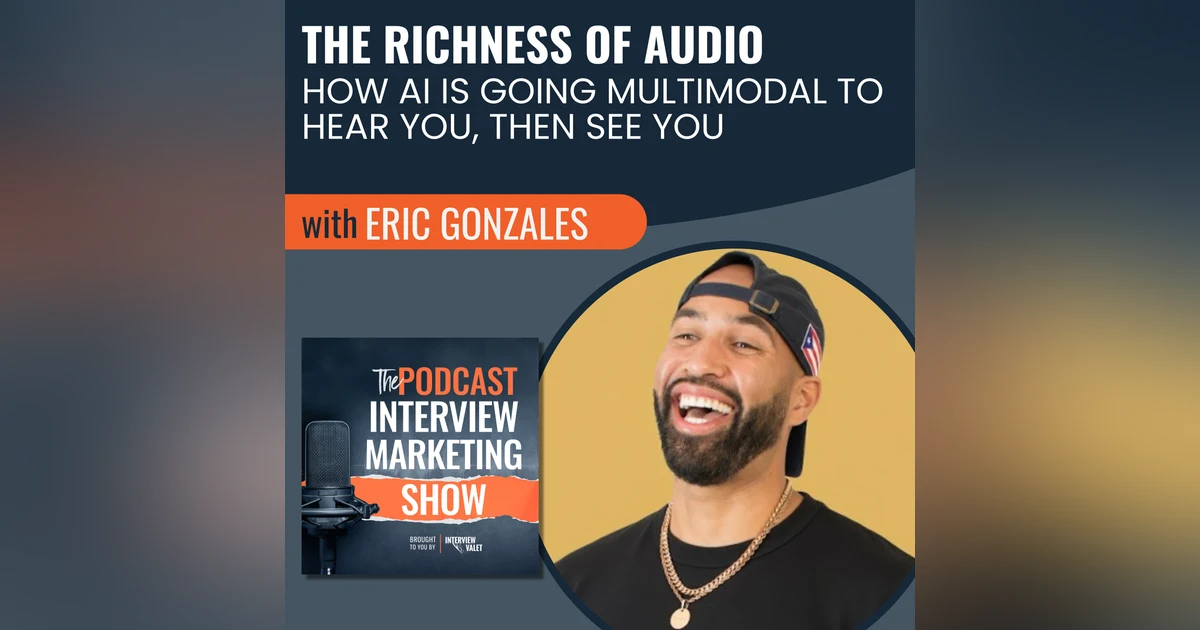
The Richness of Audio with Eric Gonzales

 Apple Podcasts
 Spotify
 YouTube
 AI is no longer just reading your words it's learning to hear them. Eric Gonzales, co-founder of Tenur AI, says that voice-first AI is reshaping relationship building. With host Tom Schwab, Eric explains why transcripts miss the tone, emotion, and context that voice carries, and how this shift from "2D data" to multimodal understanding is changing CRM, networking, and even AI assistants themselves.
They dig into why context, not more data, builds trust, and why feeling "understood" is the real win behind every great AI interaction. A must-listen for anyone who believes relationships, not funnels, drive business growth.
Timestamps From This Episode:
[02:30] The age of context
[10:43] From data collection to context capture
[18:31] The evolution from 2D to 3D data
[23:06] Conversations over funnels
Resources From This Episode
Tenur.co
Linkedin.com/in/erictgonzalez
Linkedin.com/company/tenurai
Looking For More?
Here are some resources to help you get started with a Podcast Interview Marketing strategy to grow your brand or business.
 |  |  |
Eric Gonzales 00:00:00 If you think about any time, like you've had a moment where you really enjoy using a tool like, you know you're at a night out, you're talking about like you did this cool thing with AI. There's actually only one thing that happened. And the reason with it doesn't matter if you're a developer or marketer, you felt understood. Like that's the only thing that happened when you used AI in that moment where you felt good about it.
Tom Schwab 00:00:34 You've heard me say it before. You're not one funnel away. You're one conversation away. In today's conversation with Eric Gonzales, well, it may change the way you think about conversations forever. Eric and I met recently at military creator Con, and Eric said something that stopped me in my tracks. You see, AI isn't just reading text anymore. It's listening to conversation. It's going multimodal. That matters because a transcript well, that only captures the words, but it misses the tone, the emphasis, the excitement, the hesitations.
Tom Schwab 00:01:10 It misses all the context. And in business, content is king. But context is God. It's where the trust is built. Eric is the founder of tenure AI. Now they are the category leader in voice, first relationship, intelligent platform. It's built around a simple idea. The way you make relationships should be the same way you maintain them. Not with more data, not with another CRM full of empty fields, but with the right context at the right time for the right person from conversations. Now, if you're a coach, consultant, author, or business owner trying to grow your business, listen closely. This episode is about how your voice, your conversations, and your relationships may become your greatest competitive advantage. Eric. We had met at the Military Creator Con, and there are times where you hear something and you will forever remember where you were when you heard it and who told it to you. You said something that I want to unpack here today. This idea that AI is not just reading the text anymore.
Tom Schwab 00:02:24 It's listening to the conversation can welcome. And can you unpack this for us?
Eric Gonzales 00:02:30 Yeah, absolutely. If you haven't noticed and felt how you leverage AI already, you're seeing the frontier models. The OpenAI's, the Claude's are introducing voice everywhere, and you'll soon be in a world where we talk more than we type to our AI in many different ways, from casual conversations and using a ChatGPT to you're now even seeing this in the development tools like the Claude codes that have introduced boys for you to do actually complex development work. And there's a big reason for that. And we're moving towards this age of context where, if you think about what you type, you're likely typing about 20% of what you would talk if you just stream of consciousness, let it rip on the same exact topic, because you're not being as thoughtful with the words. And there's not a lot of resistance and friction that you know, is almost subconsciously introduced when you have to kind of put your fingers on a keyboard. you know, if you can just talk and you imagine yourself just having a conversation, as we are, if there's a recording device that we could feed to a language model, there's going to be a lot of language that we don't even recognize.
Eric Gonzales 00:03:44 We said that actually matters not just the words, but how we talk to the inflection of our voice, the tonality. Those are all very different signals that really are pretty much a fingerprint and how you communicate. I conserve to be equally as valuable to a language model to work with you just as much as like the no kidding words that you say.
Tom Schwab 00:04:06 It's. This idea of a transcript only gives some of the value to it, right? But if you can hear how somebody says it, their, their tone, their what they put the emphasis on that can tell a whole different story. And, you know, why couldn't I do this before? Why did it just go to transcripts?
Eric Gonzales 00:04:27 Yeah, it was when it was expensive. and, you know, to record that much audio and be able to want to understand tone and sentiment and then still transcribe that to words that, you know, that costs, you know, CPU and GPU costs that are very real and for, you know, small business or an everyday consumer, you're not going to be able to afford to capture that level of audio if you had to ultimately foot the bill, or if there wasn't Infrastructure that could find a way to do it much more efficiently.
Eric Gonzales 00:04:57 So a couple of things happened. The language models got a bit more mature and more efficient, and how they consume and understand unique elements like Eric with a C versus Eric with a K, or, you know, unique names and locations, tonality and, and how we dictate word and sentence structure has gotten a lot cleaner through a focus being placed on it by these frontier models. Recognizing that that's ultimately going to be the new shape of data that matters. So industries just put a lot of focus into understanding voice and transcribing unique elements. So if you notice, you can take a picture and the words are funky. But now we're capturing that exact spelling. There is no coincidence around that. You know, you humans are unique and, language models essentially, and how they were trained were trained on large data sets from, you know, the, the public internet think the Twitters and the X and and Reddit. But there's now a much more nuance in how we're communicating with these language models that, industry recognizes equally important.
Eric Gonzales 00:06:06 so the emphasis over the last 18 months has really been how do we capture context? But to capture context, you have to be able to measure and understand those unique elements.
Tom Schwab 00:06:16 And it's the whole idea of multimodal. I heard the word, but you made it real. And I think you're right, I my typing skills were always bad and they've gotten even worse. You know, things like whisper flow. And I think at some point people are going to go back and say how archaic that you had to go through and type everything out. It's almost as archaic as you had to learn Morse code in order to transmit that message. Why didn't you just talk?
Eric Gonzales 00:06:45 Exactly. And you think about where the industry is going. You're seeing hardware and wearables become a lot more prominent. And actually just at the conference we spent together, I saw a lot several folks that had a wearable device that they could push and passively capture their voice to then be transcribed and used later. Those, you know, were quickly moving past the days where we'll stare at a screen to communicate with the technology that we use today, and will become much more passive and interactive and will, you know, be wearing the meta glasses and communicating through the next iteration of AirPods that come out that will focus on essentially showcasing and surfacing what matters to you through just your voice.
Eric Gonzales 00:07:32 Kind of like that movie her. You know, we laugh about it all the time and we're building. We have moments in time. We're like, oh my goodness, this is getting really contextual. We're moving a lot closer to that world than we think.
Tom Schwab 00:07:44 It's great. And let's talk a little bit about Tenur, because I've been playing around with it now for two weeks and it's like everything else after that seems archaic, right? From a CRM standpoint. So can you explain the problem that you're trying to solve with tenure? CEO.
Eric Gonzales 00:08:03 Yeah, it started from, watching a superconductor, work. And if you think about like that term, it's kind of polarizing a superconductor in how I view it as the elite athlete of relationships and communications. They do a couple things really well. They remember the details, they communicate really effectively. They think in terms of how they can be in service to others. And I just fortunately happened to, date a superconductor and my partner and watched her get equally frustrated by only being able to serve a limited set of people that she could just remember here, because the tools that she were using were creating more work than they were solving a problem for her, but I'd watch her just simply build Relationships with her voice.
Eric Gonzales 00:08:50 And I recognized. Oh, well, there are, you know, units of work and all. Every relationship comes with you having to go and find them on LinkedIn and then figuring out what are you going to say and remembering what mattered so you can make that message, like, seem authentic, which if you think about like that experience, the best thing about that is we have the best intentions. But it was just there was a lot of friction in the way. So we drew and I my co-founder, we thought, well, the way you made the relationship is the way you should absolutely maintain it. This technology, your voice, this technology leverages your voice to allow you to one establish the basis of what matters to you. So how you and I met Tom, is something that I'm going to have a lot of excitement about. And I want that captured and recorded as opposed to just recognizing where you are in the world, which your LinkedIn company name is, etc.. That's not something I'm going to talk with you about daily.
Eric Gonzales 00:09:49 I want to talk with you about how we met and the amazing conversation we had in Arlington. And those are the moments that are going to build trust. And we recognized, oh, well, voice AI is something that we're really interested in, and it's something that can solve the problem in a very unique way. Given that the industry is moving in that direction, we feel like we can essentially center this problem that we're solving around using your voice and then automating everything else. So you just talked for 30s and we'll get grab everything else that would be helpful to you. the LinkedIn's the last name a picture of the face. You can put it to the name, but most importantly, we're building and coaching you to follow up with each individual that you meet based off of what you said, not just the words that you used, but how you set it to create and build a meaningful relationship.
Tom Schwab 00:10:43 And let me go from the fro to right the from to the two. So in the past right. we would meet down there and maybe I've got a business card.
Tom Schwab 00:10:56 Maybe I'd try to remember to put something in my CRM. Right, and type it in, and it'd be brief, it'd be misspelled. It would miss the vast majority of the things there. And, it's this idea of it's I don't need more data, right? I don't need to pull everything that ever was mentioned. Eric Gonzalez. Right. Because there's probably more than one. Right. And so more data is only going to confuse me. But when you were talking, I'm like, this is amazing. And I downloaded the, the app, Tenur, right away and you showed me how to use it. And afterwards it was like so easy to put in a 32nd, 62nd summary of what we talked about. Right. And the things that were most important to me, right? This idea of multimodal of of AI listening to us today, not just the text, even to the point where our common Navi background. Right. I did the math really quickly. I was a plank owner on Lincoln.
Tom Schwab 00:12:02 when they put the first set of fuel in, you were there for the second, gas up. So you can do the math real quick. Yeah, there's about a 25 year difference, but that's one of those common things that wouldn't. That was very important to me. And the relationship, that wouldn't be necessarily pulled out of our mutual LinkedIn profiles.
Eric Gonzales 00:12:25 That's exactly right. And that's what matters. That's what we're going to talk about. That's what we can equally reminisce on, to build something that's true to us and maintain our relationship. And, you know, as we think about, like, how we've built this, you know, that that from being almost, you know, every user that we've worked with has, has experienced a sense of guilt, like, oh, yeah, I, you know, I'm a little ashamed. I forgot I didn't remember I meant to. I absolutely, you know, was going to connect you with that individual. so it's never for a lack of like, intention.
Eric Gonzales 00:12:58 It's always just the, the process and the technology. just couldn't support, you know, that Dunbar's limit 150 relationships is is. And even that's pretty generous. But you hit on something really key in how we've designed and what we're working towards with Tenur. and it's really around the right context at the right time for the right person. we're not trying to surface every single piece of information that we could find on you, Tom, or anyone in your network. We're we're we're focused on what matters to the both of us. And, you know, what's going to build a relationship between you and I based off of what we've said with our voice. Everything else. Sure, it can be helpful, but it is not nearly as important as the conversation that we had.
Tom Schwab 00:13:44 And it's interesting. For years, technology was almost like a buffer between it. Right? Well, we've got to get the funnel. We've got to type. We've got to have AI. Go through the entire transcript to find out the key points, whereas I know what the key points are afterwards.
Tom Schwab 00:14:03 I just don't have the time to type all those out. And so now being able to summarize and interaction very quickly with voice and get all that rich data in there, as you say, it's not just about more content, it's not just about doing more. It's the context that goes along with that.
Eric Gonzales 00:14:23 Yes. Like that's the magic that creates the bond that allows you to send the meaningful message that, you know is not just, hey, coffee next week, it's Tom. I loved meeting you. Look, you know, amazing to chat about the Lincoln. Let's, you know, follow up and have a, you know, a conversation, about our journeys in the Navy. Those are the things that genuinely lit us up in the moment, that can continue to build a true relationship. One of the reasons we're doing this is if you think about where AI is going today, you've seen the open clause, the nano clause. This AI is now beginning to do things for you and do meaningful things.
Eric Gonzales 00:15:02 You know, access your calendar, schedule calls, you know, you know, pay bills, like, spend your money like this, this world where we are now, increasingly giving more, not just capability, but responsibility to AI on our behalf. no one stopped for a second and thought about, well, what actually matters to me as an individual? What does the AI know about me? My values, my thought, my relationships? So if it's going to schedule a dinner or book a flight and, you know, we're going somewhere, what does it know about my relationships, and how does it understand how I communicate to make sure it's operating in my best interest, as opposed to just almost accelerating down this really fast path with no context or understanding of who you are. And that's our fundamental baseline. Tanner understands you.
Tom Schwab 00:15:58 And this whole idea of voice first relationship intelligence. So it's not just context, but it's the intelligence beyond the relationships. And you know, we both were there learning from Christopher Lochhead and Mike damp out there.
Tom Schwab 00:16:14 And they talk about the difference capitals right. The relationship capital, the reputation capital. And it's amazing that the AI is now supporting us in there as opposed to, sort of battling us, of, of how can we get that to work together?
Eric Gonzales 00:16:31 That's right. Like, if you think about and like how I love to explain this is there's a real and a very valid fear, You know, everyone is kind of almost defaulting now to believing there's what they're seeing. And what they're seeing is AI generated content, AI generated videos, images, you know, etc. but if you've ever thought about, you know, if you've had an assistant or you've worked with a team and you have a friend or a partner, it's their birthday, maybe you ask your assistant to send flowers to your wife or to your husband on their birthday. The intent came from view. The execution just came from, you know, someone else. But and that's that's completely okay. That that is exactly. You know, how we're trying to show out to be the best versions of ourselves.
Eric Gonzales 00:17:15 And that's how we view AI as well. It should scale your best intentions, not be placed in the center, and translate away the unique elements of how we talk and how we connect with one another. We're trying to extend that leveraging AI.
Tom Schwab 00:17:30 Yeah, and as you were telling me about where you are and where you see the world going, it reminded me of the stories of Netflix right when Netflix started out. They sent all the the discs right via the mail because the bandwidth just didn't exist, right? They had the vision of where it was going. And like you said, compute now is. It's always expensive, right? There's a real cost to that. But the cost is going down. So in the past it was just indexing text. Right. But now they can do the voice. And I think that's so powerful for, you know, a conversation here. There's no doubt that AI knows that this is real because is that proof of life when we talk and they're not only indexing the words, they're indexing the the voice with that too.
Tom Schwab 00:18:24 Can you sort of share where you think the world's going to be going here in the future with this?
Eric Gonzales 00:18:31 Yeah, I would say, like if you think about what's in your home right now, you likely have. If you remember, maybe a decade ago, the Internet of Things was this like crazy concept. Oh my goodness, this speaker can like I can talk to it and it's going to like play my preference or my refrigerator now has a TV screen on it. And it's now understanding if my food's going stale and this, collection and almost a different shape of data, you know, not not reading a or scanning a grocery receipt, but actually looking at how you, you know, your nest, how you're moving in your space to adjust the temperature that, you know, immediately begin to move the shape of data from kind of this, what I call a 2D, you know, column and row infrastructure where you put in, you know, a name, and then you fill in that gap location and you'd fill in that gap.
Eric Gonzales 00:19:21 We see that being amplified and ultimately changed with AI very much kind of like that Internet of Things era where we're not going to be using or purchasing many different tools that don't serve a collection of purposes for us. I mean, you know, if you think about, what, Tenur does it. We'll schedule a call for you. We'll understand the context of your relationship. It'll send a message for you. It is in the service of a relationship. There's this umbrella of things that happen underneath that to really build and maintain a relationship. All the logistics. And that is where AI and kind of the software industry is going is it's this collection of services that is now understanding this new dimension of data that is not just a row in a column, it is quite literally 3D. And now even 4D with, you know, the robot, the humanoid robots that we're seeing in the world, we're going to begin to interact with these robots and, how they're essentially reacting, today with the intent to be proactive and what our needs are.
Eric Gonzales 00:20:31 you know, think about, you know, there's a world where not only will a humanoid robot be able to consume and understand your voice very semantically and understand if you're upset, if it didn't, you know, clean your laundry the right way or service your car in the right way. It will understand what good behavior looks like from you. So it is very much a relationship, and I often like share with clients that we work with in our users that this is one of the most important relationships you can establish. But most importantly, don't feel the pressure that you need to understand AI. It's actually the exact opposite. It's it's your responsibility to make sure that AI understands how to work with you, just as if you were hiring a new employee at your company.
Tom Schwab 00:21:17 What a what a paradigm shift, right? So it used to be that we had to understand the the black box, right? You had to code in order to get it. Now we just have to communicate and it is smart enough to understand us, but we've got to give it the context.
Tom Schwab 00:21:37 They're not just not just words that could be misinterpreted.
Eric Gonzales 00:21:42 Yes. Exactly right. Clarity of thought is going to become an exceptionally powerful skill set. If you think about and if you took on an intern today, you likely do several things with that individual. You introduce yourself and tell one what your role is, how you communicate, what you need from them, what right looks like, what wrong looks like, and then how autonomous they are. What decisions can they make versus where do you need to be involved? This is actually no different with AI. If you really kind of fundamentally think about how you should be using this tool, it's ultimately a relationship. So with that, there's not this, you know, we've kind of jumped into the world of AI where we treat it like a piece of software. All right. I got to see what the dropdown is. I've got to see what the settings are. No. Like, absolutely. You have to actually have a conversation and make sure. these really powerful language models understand fundamentally who you are and how you communicate.
Eric Gonzales 00:22:42 That way you can celebrate getting kind of the best use out of them, as opposed to kind of wrestling with the technology or a lot of a lot of folks feel like there's this you have to take a course to understand how to use the cloud code. Now you actually have to think about why you're using cloud code to begin with. Like, why are you even considering that tool? And what are what is the outcome that you're hoping to achieve? That's a far more powerful way to spend your time.
Tom Schwab 00:23:06 And it's I always used to reject that phrase where you're one funnel away. Right? it's so big in marketing, right? It's like you just need a funnel. You need an app, you need some kind of piece of software to put in there. And I always rejected that and said, no, it's one conversational way. Right. And then that goes in to the technology to make it easier there. But really, we're we're at that world now where it's all about conversations, not not the technology.
Eric Gonzales 00:23:40 Yeah, that that shape of data is, is absolutely where the industry is, is moving. But really because, you know, we're now at a place where we can focus on the nuances. And those signals are absolutely what's going to make the feeling of that's really important with leveraging AI. Like if, if you think about any time, like you've had a moment where you really enjoy using a tool like, you know, you're at a night out, you're talking about like you did this cool thing with AI, there's actually only one thing that happened. And the reason why it doesn't matter if you're a developer or marketer, you felt understood. Like that's the only thing that happened when you used AI in that moment where you felt good about it. It understood the assignment of what you wanted it to do for you, and it produced an outcome that may have been better than you would have done, but you ultimately just felt understood.
Tom Schwab 00:24:32 Wow. And isn't that the same thing? When you have a conversation with a person or you listen to a podcast? Right.
Tom Schwab 00:24:40 They understand me. They resonate with me. if. Because if not, it just becomes frustration. Just like if you're listening or working with a tool that you can't get to work that same frustration.
Eric Gonzales 00:24:52 Exactly, exactly. And that's you can accelerate that feeling of understanding by just those two mediums changing your mindset. And okay, it's the AI's responsibility to learn how I communicate. But what does it need to ask me? Like what questions? How do we need to talk to one another? And that and using your voice, you'll accelerate, you know, getting to a mutual understanding of one another, how the AI understands you and how you you understand the AI, but just having a conversation.
Tom Schwab 00:25:24 Eric, what's ordinary to you is It's amazing to others and I think we're recording this in 2026. Somebody I think in 2028 is going to listen to this. And it's like, oh yeah, I thought everybody knew that back then, right? Because it is it's obvious right? as much as streaming Netflix today seems as obvious, and the idea of sending a CD seems, you know, prehistoric on that.
Tom Schwab 00:25:49 So final thoughts here. You know, somebody is listening to this. How should they be thinking about where we are today and where we're going and what it means to them?
Eric Gonzales 00:26:01 Yeah, I would say the curse of, you know, FOMO here with AI, there's this immense pressure and a lot of folks that come to me that want to leverage AI. they feel like it's an obligation and a responsibility. Someone to the left, to the to the right of them or something that they read or listen to told them they absolutely have to leverage AI. And I think that's, you know, it's a bit dramatized. There is an absolute world. And I'm an optimist, like, in this space where I believe AI can help everyone. but really taking a second to fundamentally stop and think about what is like, how am I approaching to use this tool? Just like anything else I pay for? I pay for Netflix because I enjoy watching comedy. Or maybe not. Maybe it's I enjoy a specific show that's not on YouTube.
Eric Gonzales 00:26:51 That kind of thought process is the most valuable way that you can spend your time, in terms of understanding what you can actually use and why you should use AI. And the best part about it is you don't need to have an answer, like, you just need to tell, the AI to ask you simply, hey, I'm I'm unsure of, you know, there's a world for this in my life. You know, I have two jobs, or I have three companies, and I have a wife and I have two dogs. All of those things actually matter. Or, you know, my profession has been in, you know, design or, you know, those elements and having that conversation, you know, use the AI as a thought partner. And this is a lot what Chris Lochhead was kind of alluding to across the time that we spent with him is this is not something that does the work for you. It's something that helps you do the work together.
Tom Schwab 00:27:45 Well, Eric, thank you for sharing your insights, your wisdom.
Tom Schwab 00:27:50 is this whole idea of where the world's going? And we are one conversation away. How can people continue this conversation with you? Right. Where's that next step where they can find you?
Eric Gonzales 00:28:00 Yeah, I can find us on LinkedIn. Eric Gonzalez, you can also check out our company page. Tenur on LinkedIn. check out our product at Tenur Co. if interested in using the platform, we'd love to have you to help you have better conversations with each and every person in your life. you can find us. We're live on iOS. We're coming to Android for our Android users this summer, but just jump to our site, echo and join the waitlist or download the app. Everyone that comes to the platform gets a month free. We really just want you all to have better conversations and make sure in the world of AI, you're staying at the center of it.
Tom Schwab 00:28:42 And don't let AI or spell check it because they're going to spell tenure wrong. And I love it. When I saw this, it's like I'm an engineer, right? my team knows that, if there's not a typo in it or a grammatical error, I probably didn't send it.
Tom Schwab 00:28:58 So when I saw ten url.com and I'm like, I get it, that's Tenur.
Eric Gonzales 00:29:04 Yes, exactly. You know, it's very intentional. You know, the Tenur of a conversation. It's not about the dropdowns in the fields. It's about everything in between that creates the magic of the moment. And my mother was a school teacher. So it's also a play on tenure, as that's the ultimate lifelong commitment and goal. As you know, relationships are lifelong. you know, and at least that's how we should treat them to be in the best service of others.
Tom Schwab 00:29:31 Well, thank you so much, Eric.
Eric Gonzales 00:29:33 Yes, thank you for having me, Tom. Amazing to chat with you. And I will just say that I love that line. It's stayed with me from the moment you said it was ordinary to me. Is extraordinary to others. Like, it's. That's just so well said. And so I thank you for that, Jim.
Tom Schwab 00:29:48 What I appreciate about Eric's perspective is that he brought us back to what us always mattered, being understood.
Tom Schwab 00:29:56 Now, AI may be changing the tools, but it hasn't changed the strategy. People still want to work with those they know, like and trust. Podcasts, interviews work because your voice gets into the Tenur head and heart. They hear not just what you say, but how you say it. They feel your conviction. They they hear your emotion. They begin to trust you. The opportunity now is to become even more intentional with every conversation. After every interview, after every conference, after meaningful connections. Don't just collect a name or drop someone into a database. Capture that context. What mattered? What lit them up? What did you promise to follow up on? So here's your action step after your next podcast interview. Take 60s and record a voice note. Capture what was said, what mattered, and what the next step should be. Because relationships are not built on data. To build on contacts, trust, and conversations. That's always how it's been and it's always how it will be.