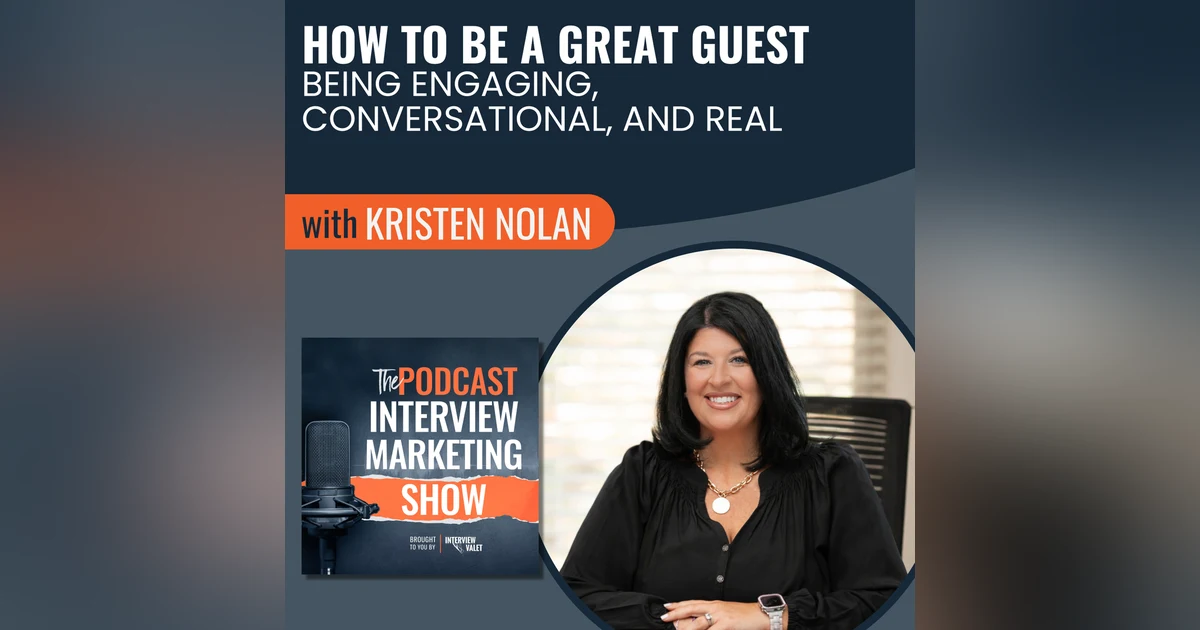
How to Be a Great Guest: Being Engaging, Conversational, and Real


 Apple Podcasts

 Spotify

 YouTube
Being a great podcast guest isn't about sounding polished. It's about sounding present. Kristen Nolan, Senior Client Success Strategist, explains the real difference between performing and connecting.
With host Tom Schwab, Kristen breaks down why over-preparing backfires, why "winging it" isn't a strategy, and how filler words can prove you're human in an AI-saturated content world. Plus, the most overlooked but powerful tip Kristen wants all guests to know – treat every conversation like a game film. Because the goal isn't to be a megaphone. It's to become a magnet, someone listeners want to hear more from, not someone selling at them.
Timestamps From This Episode
03:31 Over-preparing vs underpreparing: finding middle ground
09:04 Interview analysis: turning feedback into growth
15:54 Becoming a magnet, not a megaphone
27:54 Four questions to ask before your next interview
Resources From This Episode
InterviewValet.com/Kristen
PodcastInterviewMarketing.com
Looking For More?
Here are some resources to help you get started with a Podcast Interview Marketing strategy to grow your brand or business.
 |  |  |
00:00
Kristen Nolan
I think sometimes there is this overlap where we think we have, like, this one size fits all approach. I can show up as a guest on a podcast, much like I would as a keynote. And I, you know, I reject that because I believe that you have to be strategic in all things that you do. Welcome to the Podcast Interview Marketing show, where we explore big ideas with leading experts on how to grow your brand and business with targeted podcast interviews.
00:30
Tom Schwab
What makes a great podcast guest? Most people think it's having a polished story, the prepared answers, or those practice talking points. But as Kristen and I unpack in today's conversation, the best interviews, they don't sound like presentations. They feel like conversations that you wish you were part of. Because podcast interview marketing is not about performing, it's about connecting. Today we're talking about how to show up as a guest in a way that serves the host, the listener, and ultimately serves your brand and your business. Kristen shares why over preparing can actually work against you and why winging it. Well, that's not a strategy. It's how the best guests find that sweet spot between intentional and authentic. We'll also dig into something most people avoid, feedback, because we don't learn from our experiences. We learn from reflecting on our experiences.
01:35
Tom Schwab
If you want better results from every interview, you need to know what worked, what didn't, and how to improve the next time. So listen in and ask yourself, are your interviews building trust, creating connection, and moving listeners to action, or are they just polite conversations that end as soon as the recording stops? Kristen, I am so excited to dive deep into this. Right? It's this whole idea how to be a great guest on podcasts. And that really means being engaging and conversational. And we talk about this a lot. You talk a lot with your clients there. So can you unpack what that really means?
02:19
Kristen Nolan
Yeah, absolutely. You know, it. It really comes down to, you know, how do you show up as a guest, Right. What are you doing to prepare? And how do you make sure that you're showing up from a mindset of how can I come and help the listeners, how can I connect with the host, how can I connect with the listeners? And that's what really helps you show up in the right way.
02:41
Tom Schwab
Yeah. And I think, you know, people say, experience, we learned from our experiences, and I reject that. Right. We learn from reflecting on our experiences. So I hope as people are thinking about this, they're going to say, huh? How do my interviews stack up against this? Because one of the things that I hear from people, it's like, oh, that was a great interview. Right. Every. Every host says, oh, that was great. Your friends and family say, that was great. I loved it. They didn't even listen to it. Right.
03:10
Kristen Nolan
Yeah.
03:11
Tom Schwab
So let's. Let's get honest here of what makes a great guest and some things that people may want to. To really look at. And one of those is, you know, this idea of, well, I'm there, I've got my talking points, I'm going to present what, you know, what's that problem that people get in with that mindset.
03:31
Kristen Nolan
Yeah. I think what happens is people tend to. And maybe this is part of our imposter syndrome. Right. People tend to over prepare. Right. We have two ends of the spectrum. You're either over preparing or you're underpreparing. And I think that both of those are, so. Are not great for being a guest on a podcast. Right. If I over. If I over prepare, I sound scripted. I'm not as, you know, I'm not as comfortable. Right. So if I have the mindset of I'm sitting down at a coffee shop to have a conversation with a friend, it's going to be so much better than if you have the questions. You know, I often get clients who are like, I want all of the questions. Right. And I'm like, I actually am going to tell you that you don't want all the questions.
04:19
Kristen Nolan
I've been in that seat. Right. I had a host that sent me 25 questions. Right. I had them prepared. I was, like, so excited about it. We're five minutes in, and we're on question number three. And I'm like, I'm going to be here for three hours finishing these questions. And so rather than being in the moment and having the conversation, and I'm trying to think three steps ahead, and so I'm not in the moment. I'm not doing, you know, having the conversation, not connecting as I would if were just having a casual conversation.
04:50
Tom Schwab
Yeah. And sometimes the questions can be helpful. Right. If there's a question they always ask every, you know, every guest. Right. What did you learn from your first job? There may be times where you want to think about that beforehand, but this idea of scripting it out, and I know exactly what I'm going to say, that just trips people up, and it's this idea of presenting versus having a conversation. How do you see people forgetting that and starting to go into present mode?
05:20
Kristen Nolan
Yeah, I think it's, you know, it's normal. Right. When we, like, if we're a Keynote speaker. We do all of this preparation because we're right there in front of people, so it's important that you're, you know, polished and perfect, whereas with a podcast interview, we treat it a little differently. Right. It's not, you know, if you. If you make a mistake, you can tell the host, hey, would you mind just pulling out that. That quick thing that I said? I've done it before. I gave a. I gave a. A number, right? I. A podcast were talking about was Pay to Play. And I went to the host and I said, listen, can you please pull that out? Because I. I don't. You know, in five years, it could be totally different. I don't want to give inaccurate information. And they were like, absolutely. And.
06:01
Kristen Nolan
And so I think if we go in with the idea that connection is more important than what I would say, anything else. Connection and the strategy piece, then we're able to have a more casual conversation. We're able to connect a little more than if we're super polished and perfect. Because ultimately, that's not what people are looking for, right? They want, you know, they want to listen to someone that understands them and, you know, can provide them value.
06:29
Tom Schwab
Have you ever listened to the podcast that NotebookLM puts out? They're perfect, right? There's no filler words. There's no emotion. It's all fact. And it's the most boring thing, right? I would never choose to listen to that. Sometimes I might listen to it quick to get a quick synopsis of a book, but, boy, that's not engaging. That doesn't make it memorable. I would never say that. That would be a great podcast. Maybe an. A great summary, but not a great conversation.
07:01
Kristen Nolan
Yeah. When I listen to the Notebook, Ellen, like, I'll often be doing. Well, not often, but sometimes I'll do emails while I have it on there. And after about five minutes or so, I've got to get up and walk around because I'm like, this is a snooze fest and I'm going to go to sleep. So I'm, you know, I'm taking in the information, but it's. It's not something that I'm listening to and going, they get me. They understand me. They, you know, I want to learn more because I believe that the best conversations are when you feel like someone is talking directly to you, right? Like, you know, oh, this person gets me. And so you. You want to listen more, whereas if you're about to fall asleep, you're. You're turning it off versus turning it Up.
07:39
Tom Schwab
It's. It's definitely not a human experience for the listener there.
07:44
Kristen Nolan
100.
07:45
Tom Schwab
Let's talk about. There's. To me, there's like a spectrum, right. You've got the keynote presenter one side that says, well, I'm a. I give a great keynote, so I'll be a great guest. Right. And they just want to come in and present. The other one, like you said, may be the one that is a little bit concerned. They want all the questions before we've done the study before. Two thirds of our clients are introverts, right. They want to prepare for this. So how do they both get to the place in the middle that makes it a great conversation and engaging, not just a dump of information.
08:21
Kristen Nolan
Yeah. I think it comes from mixing self awareness and then finding a common ground in the middle. Right. Like we, you know, I think it's great when a host is willing to say, hey, this is the topic I would like to cover. Right. So then you're able, as a guest to prepare talking points or share stories that relate to that particular audience. But you're also not sitting there kind of like, you know, feeling like you're nervous and you're white knuckling things and you're like, okay, I got to get this and that and everything else. I will tell you if you look back at your, you know, your first interview or your second interview, and then maybe after you've done, you know, 12 or 15, which I have done that recently. Right.
09:04
Kristen Nolan
When I think about the person I was doing my first interview, and then, you know, I'll take and put my transcripts into some AI tools and I'll say, give me brutal feedback. Right? And it's brutal, you know, and we do something similar to that for guests, right. When we have, for our clients, when a client is on a podcast, we'll do an interview analysis. What worked well, what didn't, and how do we make that better? And so I think it is coming from a mindset of constantly learning and growing in how we show up and how we connect with the audience and how we strategize that.
09:42
Tom Schwab
Yeah. And those analysis of the interviews are so powerful. Right. You've done over a dozen interviews. I don't even know want to know how many hundreds I've done. But I still get the feedback from the team, and I think there's 21 points that you look at there. And it's interesting because everybody says, oh, that's a great interview. And then I get the report back and it's like 10 time you talked 20% faster than the host. Right. You may want to slow down. Well, when people tell me I talk too fast, my first reaction is, no, I don't. But when there's a number there, it's like, that's hard to deny. Or your longest monologue was 4 minutes and 37 seconds. Right.
10:26
Tom Schwab
Might want to shorten up those true false questions or even little things like uses jargon in this podcast, you may want to explain that or you told that great story, but you never told the moral of the story afterwards. Right. So all of those things that can become very actionable. And I think that's how people get better. Right. With that honest feedback that they get from it.
10:52
Kristen Nolan
Yeah, it comes from self awareness too. I know on my reports I often get, you use like and a lot. And so for me, there we go. I'm more self aware of it so I can show up better for the audience and for the host because I have those talking points and I have those tools to help me make sure that I'm, you know, showing up in a way that, you know, connects with people.
11:20
Tom Schwab
I think that the filler words, if you will, those can be proof of life. Right. So many things now are AI people are looking, is this person engaging? Isn't this a conversation or is this just AI? And I think that passion that comes through sometimes thinking about answers, even the filler words, can prove that you're human. There's times where you can hear somebody doing a keynote and you can see that they have practiced this a hundred times. Right. I've gone to people's keynotes before and I've seen it once and then I'll see it at a different event and I check out because it's like, I know what every word's going to be. I even know the actions they're going to make. It's like, okay, now they're going to walk to the center of the stage, whatever it is.
12:12
Tom Schwab
So it seems more like a performance. And I think the word interview on a podcast interview is almost a misnomer. Right? Nobody's interviewing you. It's a podcast conversation that people want to listen in on.
12:25
Kristen Nolan
Yeah, absolutely. I, I, it's funny that you mentioned the word interview because I had a client email me and say, is this a pre call or is this, you know, the actual recording? Because they're used to verbiage of a recording versus an interview. So it was very confusing for them. But I think that, you know, having the idea that you don't have to be perfect, you don't have to be completely polished, that no one is perfect. And so if you show up authentically, you and are working to connect, I think, you know, even those, you know, those filler words or taking, you know, taking a bulk of the conversation can be helpful because you're not scripted. It doesn't sound like you're, you know, an AI person having a conversation. And I think that, you know, in today's age, people want that authenticity.
13:14
Kristen Nolan
They want to see people that are like them. They want to see, you know, that you're using those filler words. So I will even tell clients, like, when I'm going over the. The interview analysis with them, like, you know, be mindful of these filler words, but be authentic. Right? We don't have to, you know, make sure we say zero of them, but maybe instead of saying 20 next time you say 15 and the next time you say 10, so you're always getting better.
13:36
Tom Schwab
And I think that's even. AI now is indexing podcast interviews, right? Because they're looking for that human content. And with what, 60 to 70% of the Internet being created by AI, they're trying to find human content because when AI trains on AI, it gets worse and worse. It's like, make a copy of a copy. So they're looking for human content, and they know that we talk over each other every now and then. We don't talk in full sentences. I drop my G's right on ing. But that is human content, and that's that idea of. It's not a synopsis of everything that's already known out there. It's really a viewpoint, a strong point of view on what the future is going to look like.
14:23
Kristen Nolan
Absolutely. And I think, you know, you mentioned this before, like, with. With introverts, right. As we show up and we. We treat it as just a conversation. I believe that the best podcast interviews that I listen to are ones where, and I may sound a little crazy saying this, where I'm sitting in a coffee shop listening to two people talking, and, you know, I'm learning from them. And so, you know, that to me, if you kind of have that mindset of like, I don't have to be perfect, I don't have to be scripted, I can use some filler words, but I'm showing up as my, you know, confident, authentic self, that's what people want to see. They don't want to see this, like, perfectly polished, you know, production. They Want to see someone real.
15:07
Tom Schwab
Yeah. And that I love the coffee shop analysis. Right. Because sometimes that podcast is recorded at 8am at a coffee shop. Other times, depending on the podcast, is recorded at, you know, 2:00am after the bars close. Right?
15:21
Kristen Nolan
Yes.
15:21
Tom Schwab
But it's still this conversation that you're listening into. And I wish I could remember the woman I learned this from. She's in Europe. But she always talks about before any conversation, she says, you want to make sure, what do I want the other person to know? What do I want them to feel? What do I want them to believe? What do I want them to do afterwards? And to me, that those are much better preparation questions than, you know, hey, give me the questions. Give me the script that I'm supposed to follow. The key words, the tricky phrases.
15:54
Kristen Nolan
Yeah. Cause I believe that, you know, if you show up as your authentic self and you are coming from a mindset of service to others, that you become a magnet to people. They want to learn more, they want to listen to you more, they want to find you on other podcasts because they're like, I find Tom fascinating. Right. So it becomes less about trying to sell something and it becomes more about trying to share and educate. And that's really where the sweet spot is, I believe.
16:23
Tom Schwab
Yeah. And I would flip that too. There's some people that would say Tom is an idiot. Right. That's fine. Right. Some people call me an idiot savant. I always say other people don't know what a savant is, so they just say idiot. But it doesn't matter because it's who I am. And from that magnet standpoint, you want to attract the right people and repel the wrong ones. Right. You go back to, you know, where do you learn from how to win friends and influence people. Right. That came around a long time before the Internet or podcasts, but it's still this idea of being interesting in other people asking questions. Right. Not just giving the talking points. And it's interesting that with a conversation, the guests should not always be answering questions. They can ask follow up questions to the host also. Right.
17:21
Tom Schwab
Does that make sense to you or what's your experience with this? And it makes it for much better conversation and building that relationship not only with the audience, but. But with the host.
17:33
Kristen Nolan
Absolutely. And I, you know, you make a great point about asking those questions because I, I know that's something that I personally need to better at, but I think it is when we're able to sort of relax and feel less scripted, it genuinely becomes A conversation, right. When we're polished and perfect, it is that back and forth, question and answer. And so that's why if we're able to get into that mindset of like, hey, Tom, you mentioned, you know, you mentioned that, you know, introverts do best on podcasts. You know, what have. What has been your experience with that? Right. So if I'm able to flip that, it's a conversation, not a. Not a Q and A session.
18:12
Tom Schwab
Yeah. And that feedback that we get, right. Everybody's got a opinion on things, but the data really tells us, and that's one of the things I love, is that every interview we're analyzing, right. We're listening to it, we're putting it through the grading scale there so we can see how you're getting better over time or if there's a thread that's going through and, like, you really need to address this one or even how you compare to other guests. Right. And it's very interesting because we all have opinions, but when you have the data on there, that's very interesting. You know, if you can say, how many questions did you ask compared to the average guess. Right. Because if you're not asking questions, you're probably having truly an interview and not a meaningful conversation.
19:07
Kristen Nolan
Yeah. And I, and I believe when I've looked at the analysis, it'll also give you some additional. Hey, these are additional topics you could discuss in the future based on what you're already sharing. So not only is it giving you analysis of what you're doing right now, but it's saying, here is some strategic information that can help you in the future be an even better guest, which I think is. Is awesome in some ways.
19:32
Tom Schwab
I think of it as like watching game film in sports. Right. So many people are like, oh, I don't. I don't like to listen to my interviews. I don't like to watch my golf swing in. In a camera either, because in my mind, it looks a lot more like Tiger woods than what I see on the video. But it helps you me improve with that. And so we really believe that's an important part of getting better results with podcast interviews, is doing better interviews. And that comes from feedback there. And it's interesting as we do our, you know, discovery calls with clients that want to come on board, we'll always talk about the feedback. And it's a great almost litmus test. If you ask them, would you value this feedback? Would you appreciate this feedback? Right. The people that Say, no, I've got everything.
20:26
Tom Schwab
They're not going to be a great guest. Right. They're the ones that, when they say, so tell us about yourself, that's the only question the host ever gets to ask. Right. They just go into that. But those people that say, oh, yeah, I want to learn to better, I would appreciate this, those are the ones that have the heart that comes to have the engaging conversation that makes them a great guest there.
20:49
Kristen Nolan
Absolutely. And, you know, with that feedback, there is intentionality. Right. One of the things that I often talk with clients about is what are you doing from a repurposing angle? And so if I just ask that question casually in a call, they probably, you know, they may forget about it. Right. It's not their frame of mind. But if we're telling them, you know, hey, your longest monologue was five minutes. It's very difficult to pull a key clip from a five minute monologue versus, you know, trying to talk more. So in a minute to a minute and a half, where we can kind of pull those great things that you can repurpose and share later. So I think that, you know, we're not only giving you feedback, we're also giving the strategy behind that feedback and making you more self aware.
21:36
Tom Schwab
Yeah. And it's. That is a skill to talk in sound bites, right? And it can be a skill, but it also can be a problem. I think of Morgan Wright. If you ever watch national news, he's probably on there three or three times a week, right. And this gentleman can answer any question in under 30 seconds with the perfect answer. He, he is so tight from coming with television and he always said, because I might have four minutes on a segment, right. And the host is going to talk too, and I've got two minutes to talk. Well, he got onto podcast interviews and like you said, they had a list of 12 questions, and they were five minutes into the podcast and he had answered all 12 of those. And it was like, Morgan, you need to talk in stories. Expand that.
22:25
Tom Schwab
And he really enjoyed that. But in that same way, as we start to repurpose this for other content, having someone else look at it and say, Tom, you know, this was a great thought, but this sound bite, you could tighten up and take some words out. And I've seen that in the feedback that comes back and I'm like, oh, that's much more to the point. And so it's this idea of having somebody from the outside look at your interviews. So that you can craft that message so that you can communicate better and engage better, not only on the interview, but on all the other places those interviews are going to be seen.
23:02
Kristen Nolan
Yeah. And, you know, I've had clients that will come to us and say, I'm doing these, you know, in preparation to be a keynote speaker. And I think it's such a great opportunity to sort of diversify your talking points, diversify how you're looking at things. Right. Because you're going to have a different mindset as a keynote speaker than you are as a podcast guest. And I think sometimes there is this overlap where we think we have, like, this one size fits all approach. I can show up as a guest on a podcast, much like I would as a keynote. And, and I, you know, I reject that because I believe that you have to be strategic in all things that you do. And so if we're being strategic and having that conversation, I think that's where we really find that sweet spot.
23:44
Tom Schwab
Yeah. And I love the word, you know, strategic. Intentional. It's really. Even following that thread and not going off on all kinds of tangents. Remember what you're there to talk about, what the topic is, because as you know, conversations can go in so many different places.
24:01
Kristen Nolan
Yes. I was on a, I was a guest on a podcast, and we were talking about podcast interview marketing, and the host made like a very quick pivot and was like, so tell me, I see you have dogs. Tell me about your dogs. And I was like, wait, what? And so it was just, it was like a very abrupt thing, and it, you know, we tied it back together. But I was just like, okay, you know, I'm running in this direction. But it was great because then it allowed us to sort of recalibrate and me go, okay, I'm talking about this now. And then we kind of went back to. Was a little jarring in the moment. But I, you know, the.
24:32
Tom Schwab
And that's how conversations are. Right. They take different turns. But as a guest, you always want to sort of keep that thread going there of who, you know, thinking about that first question when they ask you. So, Kristen, tell us about yourself. Right. What the question really is. Who are you? Why are you here? Why should I listen to you? Right. That's what people are listening to, deciding whether or not they're going to stick around for the interview.
25:00
Kristen Nolan
Absolutely. And you know, I tell my clients, like, it's almost like a. I wouldn't say like an elevator speech necessarily, but it's similar, too. And I always kind of, especially as I have new clients, I will help them craft. What does that look like? And how do we customize that to the audience? So maybe you have your key talking points, but your story that you share is. Is specific to that particular audience. So we're able to really customize what we're talking about to the audience and not just having, like, this generic, you know, story or generic, you know, conversation that we're having. It's. Each interview is an opportunity to have a very different conversation about different topics.
25:40
Tom Schwab
It's the idea of thinking before you talk. And it's this idea of having the strategy of knowing what you want to say, why you're there, what you're trying to accomplish with it, all of that strategy. Because too often people just jump on a podcast and like, oh, if I just tell my story, magic will happen. If you think it's all about just telling your story, then, you know, go out to Times Square and start talking to random people or go talk to a tree, right? It may help, but hope is not a strategy 100%.
26:16
Kristen Nolan
And I think, you know, that. That sounds to me like that's the winging it principle, where people just are like, you know what? I'm just gonna wing it. And I'll tell you, I had. I had a client previously, and he had his own podcast. He had done many interviews, and he. He was just winging it, right? He was just like, I got this. I know what I'm doing. And I remember getting an email and him saying, you know, because clients will. Will email me after and say, hey, the interview went great, or whatever. And he was like, that one really threw me for a loop. Like, it, you know, and it sort of recalibrated him because each host has their own way of doing things.
26:49
Kristen Nolan
And so it sort of, like, gave him an insight into, like, maybe winging it isn't the best way to do things. And so then there was more preparation that started as a result of that.
26:59
Tom Schwab
And if you're doing it at hobby winging, it is fine, right? Do I watch my golf swing on. On video? No. Do I take a lot of lessons? Do I spend time at the range? No. I just sort of go out there, have fun, and wing it. Right? There's also a reason that my score looks the way it does, right? So don't say that's, you know, golfing or don't compare yourself. How come I don't get paid as much as Tiger woods, right? You're not doing the work you're not doing, that preparation, you're not being intentional like that. So to be really honest with yourself on that.
27:34
Kristen Nolan
Yep, absolutely.
27:35
Tom Schwab
So as we wrap up here, what would you say to someone that has been doing guesting, right. And people say, oh, you're great. I love it. What should they really be asking themselves to get better?
27:50
Kristen Nolan
Yeah, absolutely. So I think the first question is, you know, who am I doing this for? Right? You. You have to understand, you know, what is your purpose and what is. What is it that, you know, you're trying to accomplish as a guest? Right. Like you mentioned, if you're a hobbyist, that's great. Be a hobbyist. If you're doing this for something specific, you need to be really focused on that. And I think, you know, sometimes clients will come and. Or guests will come and. And they, you know, have that imposter syndrome. And so I think it's so important that we sort of flip the script and say, you know, when you. When you show up on a podcast, you have to have the mindset of, you know, not, what am I getting from this? But, you know, how. How am I impacting the listeners?
28:36
Kristen Nolan
Right. We. We don't want to show up overly polished. We don't want to kind of audition. We want to be authentic and show up as our true selves. So I think, you know, before you hit record, I think you have to ask, you know, your, you know, a very specific question, right? Who in that audience needs to hear what I have to say? Right? How do we. How do we connect? And then I think you. You name that person and you get specific, and then you take the conversation and you. You make it custom tailored towards that person.
29:07
Tom Schwab
Well, what's ordinary to you is amazing to others. You not only learn from your podcast interviews, but all of the clients you work with as a client success strategist. And that really is great, how you get the lessons from everyone and share that so that we can all get better. Thank you, Kristen.
29:26
Kristen Nolan
Thank you so much, Tom.
29:28
Tom Schwab
The big takeaway from today's conversation with Kristen is simple. A great podcast guest is not the one who sounds the most polished. It's the one who sounds most present. Your goal is to not deliver a keynote through someone else's microphone. Your goal is to have a meaningful conversation that helps the right listener. Say, this person gets me. I want to learn more. You attract them like a magnet. It takes preparation, but not scripting. It takes strategy, but not stiffness. Before your next interview, ask yourself these four questions. What do I want the listener to know? What do I want them to feel? What do I want them to believe? And then finally, what do I want them to do now, next, then after the interview, don't just move on to the next one. Review it like a game film. Did you talk too long?
30:30
Tom Schwab
Did you use jargon? Did you tell great stories but missed the lesson? Did you create moments that could be repurposed and shared? Hope is not a strategy. Better interviews come from intention, feedback, and action. Do that consistently and every podcast conversation becomes a chance to build trust, attract the right people, and grow your business.