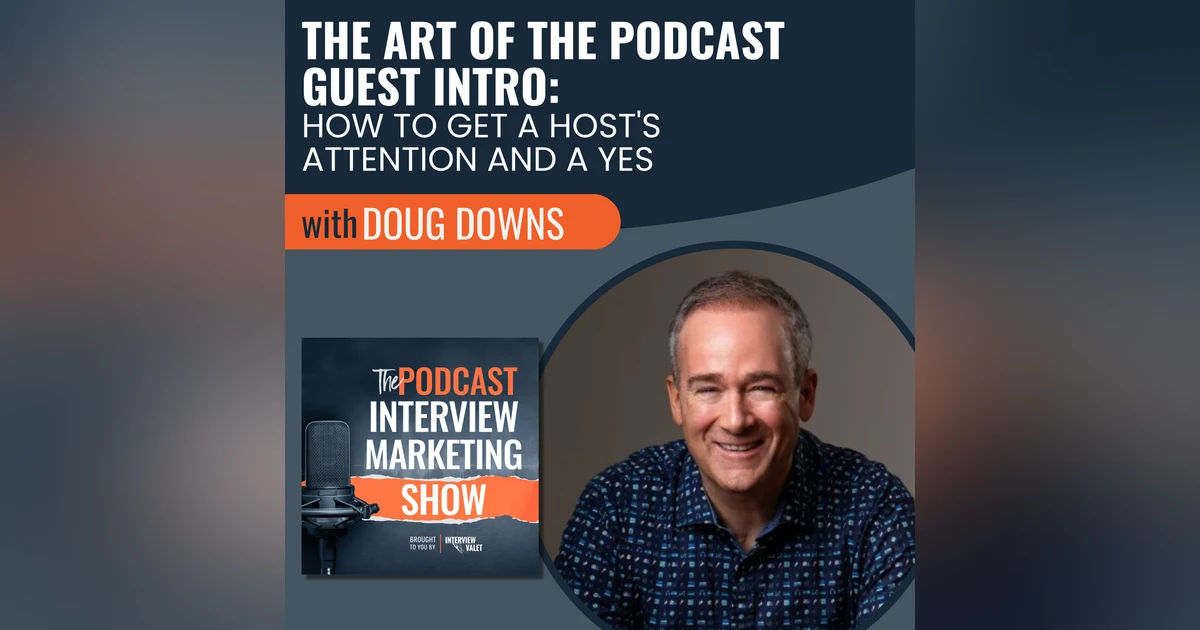
The Art of the Podcast Guest Intro: How to Get a Host's Attention and a Yes with Doug Downs


 Apple Podcasts

 Spotify

 YouTube
Most podcast pitches look the same, sound the same, and land in the delete pile fast. Doug Downs, host of Stories and Strategies and a podcast agency leader, filters hundreds of pitches weekly and knows exactly what separates a blue M&M from a red one.
In this episode, host Tom Schwab and Doug unpack the psychology behind what makes a host stop scrolling, why blasting 1,500 shows destroys your sender score and reputation, and how treating a podcast like a host's beloved puppy will completely change how you pitch. Build relationships, respect the ecosystem, and become impossible to ignore.
Timestamps From This Episode
[03:39] What earns attention past the delete button
[11:24] Why mass pitching damages your long-term reputation
[29:44] Reframing how guests should approach a host’s show
[33:17] Why post-episode amplification matters to hosts
Resources From This Episode
StoriesAndStrategies.ca
LinkedIn.com/in/DougDowns/
InterviewValet.com
PodcastInterviewMarketing.com
Looking For More?
Here are some resources to help you get started with a Podcast Interview Marketing strategy to grow your brand or business.
 |  |  |
Doug Downs 00:00:00 We need more humans in society. We're becoming increasingly resistant to anything we think is AI or automation, because we're rightfully afraid of it. We don't know exactly. I don't think AI is going to wipe us out or kill all the jobs. In marketing and communications, I think it'll actually be a bonanza and there will be more jobs than ever. But I get the threat. I totally get the threat. So right now we need more people.
Tom Schwab 00:00:39 Hey, it's Tom Schwab and welcome back to the podcast Interview Marketing Show.
Tom Schwab 00:00:44 If you've ever wondered why your podcast pitches aren't getting responses, I can tell you the answer in two words red M&Ms. You see, most podcasts pitches look the same, they sound the same, they feel the same, and the hosts, scrolling through 7 or 8 pitches a day, they're just another red M&M in a big bowl of red Eminem's.
Tom Schwab 00:01:08 Today I'm talking with Doug Downes. Now, Doug is the host of Stories and Strategy, and he's a podcast agency leader who sees a flood of pitches for his clients from the inside. He's the gatekeeper, the early filter, the guy whose finger is hovering over delete, and he shared something powerful. You've got about three seconds to prove your different, to prove your value. This episode isn't about templates. It's not about blasting 1500 shows. It's about understanding the psychology of the host, respecting the ecosystem of podcasting, and crafting an introduction that actually feels human. If you want more interviews, better interviews, and long term relationships with the host. Not just transactions. This conversation will change how you pitch forever. Let's talk about how to become that blue M&M. The one that stands out. Doug, I am so thrilled to have this conversation with you. It's one that we seem to have often between, hosts and guests. It's like, how do we come together and do better intros to serve both people? So you've got the viewpoint from the host side.
Tom Schwab 00:02:30 So tell me the problem that you're trying to solve here. The problem that on the receiving side that you have. Yeah.
Doug Downs 00:02:38 Well, I'm a podcast host. The podcast is Stories and Strategies. And on that podcast I probably get 7 or 8 pitches every day. I've got three this morning already that came through my inbox. But we're also a podcast agency with it fluctuates between 15 and 22 clients. So just do the math. My inbox is smothered in pitches all day, every day, and most of our guests use me as the first gate. If if I don't forward them everything that gets pitched. They trust me to say, forget it. That's not even getting through to them. So I am the early gate. The problem that I see is that everything is a red M&M in my bowl. I've got nothing. My inbox is a big fat bowl of red M&Ms. All the pitches look the same. All the pitches sound the same. It doesn't matter which podcast they're pitching to be on, they all look and feel like red M&Ms.
Doug Downs 00:03:39 And then every once in a while, I get an email that, at least in the first three seconds, appears to be a blue M&M. And if you can get me through that three second VAT because honestly, you're you may not even get that much from me If you can get me past that three seconds. Suddenly I'm putting my coffee down and I am reading your email with the other part of my brain that is maybe willing to commit some things to memory. So if you if you're the blue M&M from the outset, I might give you something beyond three seconds.
Tom Schwab 00:04:17 So let's talk more about that because as you're scrolling through your emails, write your fingers over the delete button. Maybe it's over the the spam button. Yeah. it's definitely not reading. And I'm going to forward this on to one of the hosts. What are you looking for to say quickly, this is a red M&M.
Doug Downs 00:04:38 Awesome.
Tom Schwab 00:04:38 Or that this is a blue M&M. This is something that I want to look at and consider.
Doug Downs 00:04:45 So a red M&M is an email pitch that without even reading any of the words, I kind of know it's a pitch, and maybe it's that I recognize the email signatory, which that's another issue is if you keep pitching me red M&Ms, eventually everything from you is a red M&M. And I'm even if you give me a smoking hot pitch, I may not even read it. I and usually it's hey, I caught your recent episode of Akasaka Akasaka podcast and it got me thinking. And then usually they, they, they clip something that they got from the show notes. Sometimes they've gone to the effort to block, copy the transcript, put it into ChatGPT and give a sentence that is unique. Well done, well done. Because you've probably stretched me. So it's a shade of red, a fleck of red in the blue M&M. But then they'll say, and from that episode, it got me thinking. And inevitably it got them thinking about their client that they're sitting there having to pitch or their own podcast that they're trying to pitch, and the connection between the two.
Doug Downs 00:05:53 Boy, you've got fractions of a second to convince me there's a connection. A connection should be. I don't, not, not. I say the same things or I have the same philosophy. I just did the episode on that. But I have an alternative to what was pitched. Read Eminem's and blew Eminem's be the Alternative. Or I have a continuation. I have blue M&Ms that have nuts inside of them, some sort of extension of it and show it to me really early. That's where you get flecks of red. The other is, I know your inbox is busy, but I'm reminding you. Or circling back to see just in case. If as soon as I see those reminding me or circling back things, it's gone. I already made my decision. However, subconsciously I may have made it. I made my decision and I trust myself. You're just telling me, please delete the email that I continue to send. So to me, what makes a blue M&M is if you know me a little better with me personally, and that's a personal thing with me personally, I'm big into cognitive neuroscience.
Doug Downs 00:07:07 If you talk about any aspect of the amygdala or the hippocampus or recent brain, science studies say, you got me past the three seconds and the way you find that out, either as you get to know me, I just have a look at the episodes on my podcast. It's kind of obvious I'm hooked on the brain or look at my ex handle. It's right in my ex handle that I'm a cognitive neuroscience nut. That's how you get to know it. I think the easiest way is the old fashioned get to know the person way. when you get block copy the last ten titles from my podcast episodes, block copy those, put them in ChatGPT and asked ChatGPT to run a theme check and if it gives you something solid, pitch the solid. But if it just gives you as it probably will, gives you something out of ChatGPT. Tell me openly in your email, I block copied the last ten titles of your podcast episodes. I've put them through ChatGPT or Claude, and here's what it told me.
Doug Downs 00:08:10 Well, that's. No one's ever done that. What did it say? What does yours say? Suddenly you've, you know, the fast and slow part of your brain, and you're trying to get me to use the slow part. Suddenly I'm using the slow part of my brain. Or pitch me someone and mention a name that I know. someone from your team. Liz Brooks pitched me on an episode with Roger Nairn, who is one of the founders of Jar Audio. I work as a podcast agency. I know Jar Audio. I've never had a chance to to sit with Roger. I would love to. And what better way than to bring Roger on my podcast. Treat him well. Give him some amplification. That's a perfect pitch. And along with that, Liz pitched someone else well. As soon as I was hooked on Roger. Roger was the blue M&M. Now suddenly that someone else has the potential to become a blue M for me.
Tom Schwab 00:09:07 As you were saying that it's like I heard somebody the other day refer to it as proof of life in your marketing or in your email, right? Prove to me that this isn't just AI.
Tom Schwab 00:09:20 And so often there's, you know, there's an agency out there that their big thing is that you could pitch 1500 podcasts in, the time it would take to pitch one. And I just look at that. It's like you can send 1500 more, as you would say, red M&Ms. Well, that doesn't help you. That doesn't help the host. You know, that whole idea that more is not better, Better is better. And, you know, we always look at it as in this age of automation, it's the personal touch that makes the difference. AI is trying to personalize it, but if everybody's using the same tool, they're all going to look like red M&Ms.
Doug Downs 00:10:03 You're right. My wife and I went to Vegas a year and a half ago for our anniversary. Right. It's not where we got married. We decided we decided to do Vegas on our 30th anniversary. And I don't know if you've been to Vegas, Tom, but there are so many signs. Like, I'm like, you're inundated with messaging, right? Eat here.
Doug Downs 00:10:22 Gamble here. Stay here. Do this, do that. People are approaching you. You just smoked with messaging is toward the dinner time. We were hungry, and I don't even know what hotel we were walking through. But we're walking through one of the one of the hotels, and my wife saw a sign for a restaurant that one of her friends had mentioned to her, Despite all the signs we'd seen earlier that day. The quantity, the quality was. A friend of ours said, hey, if you see this one, eat here. Well, guess where we ate, right? And I don't top of mind, I don't remember it. It was an Irish themed restaurant. The food, the food was fine. I didn't think it was anything, but I would recommend it. So you're right. Organic growth, or being the blue M&M on an individual basis has substantially more power in the eyes of the podcaster or in our case, the podcast agency. Making the choice. That volume thing.
Doug Downs 00:11:24 I'd love to. I wouldn't mind I wouldn't mind nudging back. yeah. On that a little bit.
Tom Schwab 00:11:31 There's there's this whole idea of, is it a numbers game? Is it a volume game? And what's your take on that? Because I think we've got, Probably different views, but probably have a lot in common here. So what? What's your take on that?
Doug Downs 00:11:50 My sense is I don't you would know more in the position you're in because you lead an agency that does a phenomenal job on helping guests get on podcasts. And you know that quality excels, and you know that your team knows how to put together a good pitch for good podcasts or good agencies. And that's where you and I completely agree. If if I use the metaphor of fishing, if I understand I'm going after trout, I don't fish. So I'm going to this is going to be weak. If I know I'm going after trout, there's going to be certain bait and certain hooks and certain lures that I'm supposed to you and I'm supposed to go at a certain time of day, and I'm supposed to make my lure behave in a certain kind of way.
Doug Downs 00:12:34 Right? And to actually bring the fish in, I'm supposed to have a certain kind of real behavior. Okay. All that makes sense. That's true, that's true. And you have a much better chance of catching trout by doing all of that. And that's why there are anglers who are far superior to most of us. But what if you just threw a million hooks in a lake where you had no idea if there was trout at all? You and I would both agree. Much weaker, much more expensive approach. But would you catch as much or more trout? You at. Mathematically, my argument is I think you would. So if you're willing to just spend money to smoke the area with with quantity, I think temporarily you can achieve some success. The danger is I'll stop in a second. The danger is, as I say, if Tom keeps sending me pitches that suck eventually. Tom, I'm not going to blacklist you, but you're. You're sort of Dark grey listed in my mind when I see your email because your pitches suck.
Doug Downs 00:13:45 So I you you get. You get a negative star for me for that.
Tom Schwab 00:13:49 I'm going to take it one step further. If you're throwing hooks in the water, I'm going to take a net in the water and I'm just going to drag it through that entire lake. Perfect. I'm going to, pull out every trout from there. And I would say, Will I get more fish than you will? Yes. Will I get arrested? Yes.
Doug Downs 00:14:11 Yes. Right.
Tom Schwab 00:14:12 Because it's it's bad for the the community. It's bad for the long term. for everyone. Right. There's. That's why they have laws against that. And just because you can do something I'm going to point out doesn't mean you should. And, you know, the doctors have the Hippocratic oath first, do no harm. And I think that marketers should do this, or at least people that are playing the long game in their business. Because while you say you give them a, you know, a a thumbs down. What I'm seeing more and more people talking about right now is they don't delete emails anymore.
Tom Schwab 00:14:52 They just mark them as spam. Right. And that will kill your sender score. And people will wonder, well, I'm sending all these emails and nobody's getting them. Well, once you have destroyed your sender score, I don't care if you send an email to your mom, it's going to her spam folder. And it's like, well, they want to get it. Well, yes, but you've been abusing the marketplace so bad that Google and all the rest of them are saying, we're not going to be a part of this anymore. And, you know, some people like, well, that's why we've got burner emails. All right. there's a way around it. But is it is it good? The other thing, too, is like I've heard people say, well, it's a numbers game, right? If I send out, a thousand, interviews or a thousand pitches. You know, I'm going to get some back. Well, I guess if you, like, made a mass proposal to a bunch of people online, I'm sure you're going to get some people that'll take up your marriage proposal.
Tom Schwab 00:15:55 Right? Are they the ones that you really want it? So is it, you know, is it just a a numbers game or are you looking for the effectiveness of that too? And the other thing that we've seen is that, there's so many of the emails that are basically black hole at. Right. And it never goes anywhere. Right. just fill out the form type thing and we'll have clients say, can you blind copy me on the emails to the host? And it's like, no, I don't BCC anybody because that's a trust thing. And a lot of times, you know, after you've worked with Liz a couple of times. Now all of a sudden you've got her start and it almost comes up automatically, or we've got some hosts that say, here's my personal email, right? Just send it to that. And it's like, no, we're not going to share that out with everyone. So I always look at it and our team knows that with every intro we refer to them as introductions, not pitches.
Tom Schwab 00:16:55 You're either going to raise the authority in the trust or you're going to destroy it. So Liz is going to think twice before she, you know, pitches the French mime to be on your podcast because he'd be such a great guest, right on a, on an audio only podcast because you do that and it's like, oh, she doesn't know me anymore. She's using abusing me. so it's like one of those things where it's like, are you playing the long game or are you just going for numbers today?
Doug Downs 00:17:23 I love your attention to the ecosystem of the podcast world, because your rights, you do damage to the ecosystem by just tossing a net into the water and grabbing as many fish as you can. You're 100% right. And proof of that is. I used to work in the media. I used to be a journalist. The erosion of trust for the media, which is that's universal. Like it's you don't have to divide party lines. you can. But the erosion of trust for traditional media is phenomenal.
Doug Downs 00:17:59 And part of the rise of podcasting. Your care for the ecosystem. Tom, I mean, clip that exchange out and show it to your clients, the ones that the ones that want to just toss a fish into the water, clip this part out and show it to them, because you have to care for the ecosystem.
Tom Schwab 00:18:15 And not get into politics. But, you know, I'm more of a libertarian, right? I don't want government regulation and everything. Right. But podcasting is still, you know, the the Wild West out there. There's not a lot of control. And I look at it as if if we don't control it ourselves, somebody else will. Or we're going to. We're going to mess it up for everyone. And I think marketers have a bad, bad reputation of that, right? We took billboards and we turned them into a site pollution. We took phone calls and we turned them into robocalls. We took email and turned it into spam. we don't want to do the same thing to podcast.
Doug Downs 00:18:54 And we dis inform as marketers. You know, there's there's a famous marketing slogan that 93% of all communication is nonverbal. Explain podcasts to me that it makes no sense that a podcast wouldn't be just looking at the at the episode art for for half an hour. That obviously that's nonsense. And there's never been a scientific study ever, that has yielded that result in the context that those marketers in the 70s put together. So you're being.
Tom Schwab 00:19:23 So let's let's go back to that though nonverbal. if you're just sending an email. How do you do something that's nonverbal or something that stands out? That I love your analogy there that causes you to stop from. It's another red M&M and stop and look at it. Is there anything that you've seen in there?
Doug Downs 00:19:46 So I'll get the I see emojis. And I had an abhorrence for emojis early on, and I've warmed up to them because the way I see emojis is okay. That's an appeal to the left and right side of the brain. The emoji is is clearly appealing to the the the nonverbal emotional side.
Doug Downs 00:20:02 I think that's my right side, the artistic side. Cool. This is someone who uses emojis. I'll get some emails that are a video pitch and it's it's just the pitcher who's recorded themselves for 20 30s. The negative is if I don't know them, I ain't watching it. There's nothing going to pull me into it. You're asking. It just feels like more of my time to watch the video. And they usually send it on loom or something like that. But if it's someone like if Liz sent to me, I may not watch it that day because I got stuff going on. But you know what? I'm not deleting it. I'm gonna go back and see what Liz has to say. And and that has a person. So video is possible. I don't, I don't know. I don't know, I'm so surrounded by red M&Ms. I it's hard for me to say these are the blue ones because they they break the pattern. They don't they don't have a pattern to them. They're it's something you need to.
Tom Schwab 00:21:02 It's like, as I listen to this, if somebody was actually listening to your interviews, the best email to you would start with subject line stop blue M&M. And the first thing under the hi first name would be a picture of a blue M&M, right? You're going to read the rest of that. And the thing is, is that somebody else would be like, I'm allergic to blue M&M. So I think some of it is knowing what the person is like. I can think of, you know, some people like, longer emails, some people like shorter emails.
Doug Downs 00:21:41 Who are those hunger email people? That's amazing.
Tom Schwab 00:21:45 Some of them like attachment. Some of them are scared to death to click on an attachment. Yeah. yeah.
Doug Downs 00:21:52 Yeah. No, I'd sold for me shorter, but I, I if it's bullets, I'm cool. That's my thinking. Yeah, but yeah, I guess there must be people who like long emails. I, I just, I probably don't hang around in those circles.
Doug Downs 00:22:06 But if everybody sent me a photo of a blue M&M, that would become the red M&M to me. Like as soon as you attach pattern to what I'm identifying as, as that unique pattern breaker, as soon as you attach pattern to it, it fits a pattern and I start resisting it. That's, you know, that's the ying in the yang.
Tom Schwab 00:22:26 And the other thing too, is it's, I think, tough sometimes when you're just reaching out, once it becomes a transaction. Right. I don't have the time to get to know you all the rest of this. and we always say we appreciate the no's as much as the yeses. Tell us where we miss the mark, because we can get better with that. And once you get to know someone more and more, you realize they don't like attachments. Or, I can think of one client, or he's a host to love him dearly. He's got ADHD and everything else, and he's told us, if you can ever ask me a question, ask me one question per email.
Tom Schwab 00:23:08 Or better yet, send me a text. But only one. So if you're introducing two two clients, I'm going to say yes and you won't know which one it was too right because I got confused in that. So trying to make it so it's easy for them to consume it.
Doug Downs 00:23:27 My mind is still spinning on how you can, how you can stand out the other in getting to know me. it's just reach out and say, hey, listen, I'm a podcast pitcher. I work for this agency. Rather than smoking your inbox. Do you have 15 minutes to zoom it? Just let me know. Or can I dip into your calendly to book a quick zoom? Ice broken because I will. I'm. I'm not someone who just says no, I will do that stuff because I appreciate or or even better, we work in podcasting. The whole idea behind podcasting is to give a gift to your listeners, and not necessarily ask for anything in exchange, other than their time. Well, what if I got emails from a podcast pitcher that didn't ask me for anything, just said, hey, I caught that episode you did with something not even associated with me that was really good.
Doug Downs 00:24:21 And and identify in exchange that I made, some sort of gift. We love. We love getting gifts. Some sort of gift that respects what I'm working on every day. And then if if, I mean if Liz or if you did that. And Tom just sends me little plaudits sometimes on LinkedIn, which is my preferred social media channel, or even just by email, or if Tom has my text, hey, thumbs up on that one. I'm much more likely to open Tom's email. He might be saying something nice to me, and that's that's.
Tom Schwab 00:24:55 One of the things that we found. Like we we were just at Pod Fest, going down there and actually meeting a podcaster takes it to an entirely new level. But the first thing you do is don't start with a pitch, right? Reach out, see what they're interested in, how they want to be, connected all the rest of that, and some of them will blow you off, but the vast majority of them will realize you're trying to help them start that conversation and try to add value.
Tom Schwab 00:25:23 There something we did years ago and we don't do it anymore because ratings and reviews are are not as. As important in the algorithm anymore.
Doug Downs 00:25:33 No.
Tom Schwab 00:25:34 You know. Right. It's, it's more bots now than anything, but we would, you know, we got 20 people on the team. Ten of us would listen to the podcast to leave a rating and review. People would recognize that before we started to reach out to them.
Doug Downs 00:25:48 I still think that has power. That's interesting that you didn't, because especially the review, because I'm going to know who the review came from, the rating, I might not I'll see a rating, but I won't know who it's from.
Tom Schwab 00:25:59 Yeah, the problem became and even Apple has said this, bots have gotten in there so much that, you know, you can go out and and hire a company to get you 200 reviews tomorrow, and they all look like bots. So, that one or like we've got it. So Liz is your person, right? We've got 20 people, but not everybody's reaching out to you.
Tom Schwab 00:26:21 So I can guarantee you that, there's probably a list of favorites on LinkedIn or something like that. And she's more likely to see your content, than other people. So it's that idea of how can you build that relationship with the host or the producer or something like that, and looking at it as the long game, and that that can be really tough if you just, you know, you're the marketing intern at the company. If one time you're going to reach out to them or you're trying to reach out yourself. Right. It's hard to do a long term relationship on, you know, one, one transaction real hard.
Doug Downs 00:27:01 And this this whole game hasn't changed that. This is how when I worked in the media, that this is how PR agencies and and PR people who already outnumbered us at the time when I was working in media 80s and 90s, They would try to take us out for lunch, you know, try to get to know us. Ask us about family. And that was cool.
Doug Downs 00:27:24 That is when they were genuine about it. When they were salesy about it, I was a bit more prickly than all that stuff. And don't. Don't tell me what? Because this happened to me in journalism. Don't tell me what the story should be. You know, make your pitch. But then once I'm saying, okay, I think we're going to do something on this, like, that's it. I now have editorial control and I'm going to take it where I take it. And and trying to control that part because I as a journalist, I had that happen numerous times. And that's a real fast backfire, especially because I got to the point where I was more veteran journalist, the younger journalist maybe can get away with it. That young marketing person, though? Yes, you're right, because their email comes across as cold. But the advantage they have is their youth dare. They're going to think of the blue M&M because as we get older, we fall into our patterns, our heuristics, right? To go back to brain science.
Doug Downs 00:28:24 And what are we familiar with? And I happen to subscribe to the philosophy that technically there is nothing new in this world, that it's all kind of been done before. Even the unique brand new never been done before ideas, actually. Yeah. They have. If somebody did that long time. Right. It's all just a wheel that keeps getting. But the young people will think of these ideas and they have an appeal, especially to the older pitchy podcast agency or podcaster, because they can ask more questions. And you're kind of you're either feeding the ego of that podcaster who maybe has some knowledge, or you're impressing upon that podcaster or agency leader that you have a genuine interest in what they do. And it's fair for you to ask these questions because you're newer to the industry that you are the sponge that's soaking this up. And old people like me. We adore that because we want to. You want to coach them to respect the ecosystem, that when someone says, let's just throw a fishing net in the water.
Doug Downs 00:29:34 Tom has to point out, yes, yes, that that'll pull in a lot of fish, but those fish won't be there next time and you're killing the ecosystem.
Tom Schwab 00:29:44 Well, you used an analogy of a podcast as a puppy, and I love that. Can we jump into that a little bit? Because I think if you if you start with that framework, you make better introductions. Gosh. Yeah.
Doug Downs 00:29:58 So I your podcast, if as a podcaster your podcast I'd say about a year in I think at first there's there's you know when you're first starting to build it, it probably doesn't have that personal resonance. Resonance. You're looking at it to say, what's it doing for me? But after about a year, and if you've had it for 4 or 5 years, it's what can I do for it? It's it's becomes I won't say my child because I have kids and I think there's a bit of holy ground there, but it's, it's, it's the next best thing. It's like my puppy.
Doug Downs 00:30:32 It's precious. It is sacred. It's like my child. And if you're pitching to be on my podcast, which I need guests, there's no doubt about it, but I can go find guests. But I do need good guests because I have an interview based podcast you're offering to feed my puppy. You're offering to look after my puppy while I'm at work. Who are you? What are you? What do you think you're feeding my puppy? How are you going to look after me? Have you looked after my puppy before? Do I know you? Why are you doing this? That you're going to get all those emotional reactions from any podcast, any podcaster. Even if financial analysis podcast that's supposed to be cold and dry, right? That's their puppy, man. It's deeply, deeply personal. And if you come on my podcast because I think there's a this is one for me because you have a good story, a good hook. And I'll tell you what I think the hook is, as you and I did before we started recording, you started explaining, you know, here's kind of where I want it to go.
Doug Downs 00:31:38 It's up to me to respect that as a guest. Otherwise, I'm feeding your puppy things that we didn't agree upon. And you will never, ever, ever trust me around your puppy again. And you will pull your puppy away mid episode and stop me from the episode will be shorter. You'll pull it away and keep me from doing that to your puppy. It's so sacred.
Tom Schwab 00:32:03 Or the recording will get lost, right? That that thing that people don't know and oh sorry I got lost. Never went live. I love that analogy because I think so many people like to use your analogy there, you know, dear First name. I just wrote a book. Have a new product, something like that. I would like to use an abuse your puppy. Oh my god. Here, here's the link.
Doug Downs 00:32:29 Can you.
Tom Schwab 00:32:30 Imagine?
Doug Downs 00:32:31 I've just created this new dog chow. You know, it really hasn't been out on the market very long and it's not government approved or anything, but I'd like to feed it to your dog.
Tom Schwab 00:32:40 Yeah. And or even that. and going with the analogy again, how did you treat the last podcast that you were on. Right. Because you look at the databases. Right. And if you were, if you've been on four podcasts, you did the same interview on each one and you didn't promote any of those. Well, right. If you didn't respect their puppy, what makes you think you're going to respect my puppy? And the flip side is, is if you if you did a great job there, guess what. Podcast host no podcast host. And they're going to tell them about it.
Doug Downs 00:33:17 That promotion thing is a big deal. I should have mentioned that if subsequent to the podcast publishing, please don't just repost the link to to my LinkedIn posts that tagged you. Don't just repost that and say, yeah, this was good. This was fun. That's not what I'm looking for. We'll give you the materials, create a unique post to your audience. It could well be that part of the reason I had you on my podcast was, I think you have audience that I want to reach, right? That's that's a business exchange.
Doug Downs 00:33:49 So I do have some guests, not podcast pictures necessarily, but guests who I repeatedly come back to because they post more than once. Can you imagine, Tom, more than once about their guest appearance on my podcast? Yeah. And it's it's unique individual stuff. They put it in their newsletter and it's not enough to just do that stuff. They have to tag me so I can see it. You got to pop it. You got a proof of performance. It.
Tom Schwab 00:34:18 I love that, and it's like this whole thing of everything you said there's about being more human, right? Treat your podcast as a puppy. Give me what I want. The blue M&Ms. Not the red M&Ms.
Doug Downs 00:34:30 We need more humans in society. We're becoming increasingly resistant to anything we think is AI or automation because we're rightfully afraid of it. We don't know exactly. I don't think AI is going to wipe us out or kill all the jobs in marketing and communications. I think it'll actually be a bonanza and there will be more jobs than ever.
Doug Downs 00:34:50 But I get the threat. I totally get the threat. So right now we need more people.
Tom Schwab 00:34:58 You have to prove that in every interaction. I think that's why conversations like this are so powerful.
Doug Downs 00:35:04 Yeah, yeah. I still love your take on the ecosystem. That's my takeaway here. That's my human takeaway.
Tom Schwab 00:35:10 Excellent. Well, Doug, where could people find you? Like, what's the next step if they want more of Doug in the wisdom.
Doug Downs 00:35:18 Stories and strategies, if you look up strategies and stories, we may not come up in Google, but just stories and strategies. If you Google that and punch in podcast and you're guaranteed to get to us, that's the quickest way.
Tom Schwab 00:35:32 Well, I appreciate you. What's ordinary to you is amazing to others. I hope people got a whole lot of wisdom from this.
Doug Downs 00:35:39 I hope you and I stay in touch and you look you up on LinkedIn, Tom, and make sure that you and I are connected.
Tom Schwab 00:35:45 Definitely.
Tom Schwab 00:35:46 Thanks, Doug.
Doug Downs 00:35:47 Thank you.
Tom Schwab 00:35:49 If your pitch feels transactional, automated or mass produced, you're just another red M&M in a bowl of red M&Ms. But when you show that you've done the work that you understand their show, their audience, their themes and that you offer something that genuinely extends or even challenges the conversation. You become that blue Eminem that stands out. So here's your action before your next pitch. Instead of asking how can I get on more podcasts, ask how can I serve this specific host and their audience? Listen to a few episodes. Look at the platform. Find the angle they haven't explored yet and show them quickly why you're the continuation, not the repetition. Podcast interview marketing works best when it's relational, not transactional. Respect the ecosystem. Respect the podcast. Protect the puppy. Be human. That's how you get invited and invite it back.