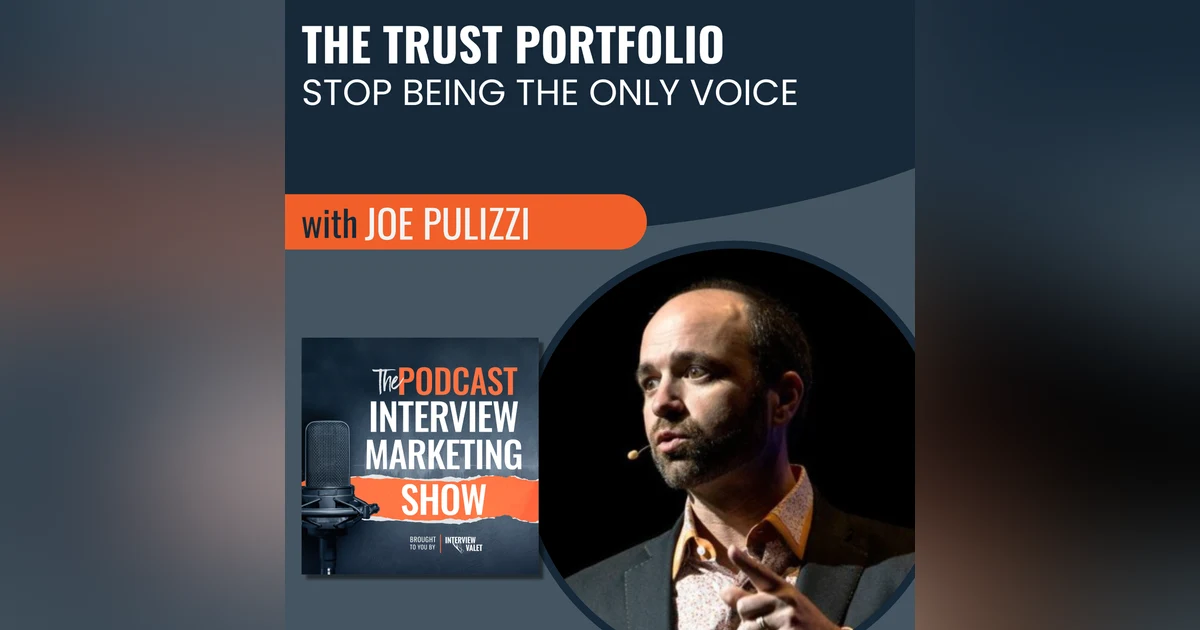
The Trust Portfolio with Joe Pulizzi

 Apple Podcasts
 Spotify
 YouTube
 Content is infinite now, making trust scarce. Joe Pulizzi, founder of Content Marketing Institute, joins Tom Schwab to unpack "the trust portfolio": a framework for diversifying your brand's voice instead of relying on one founder or spokesperson.
Joe explains why the top podcasts and newsletters come from people, not companies, and how spreading trust across several credible voices protects a business from a single point of failure. He shares how Content Marketing Institute built out voices and why that diversification made the company more sellable. Joe also explains why AI-generated content, built on "most probable" outputs, can't replace real human differentiation.
Timestamps From This Episode:
[06:31] The trust portfolio concept
[12:26] How to choose your trust portfolio voices
[21:38] Leading vs. managing a diversified voice strategy
[34:02] Why AI can’t replicate human differentiation
Resources From This Episode:
TheTilt.com
PodcastInterviewMarketing.com
InterviewValet.com
Looking For More?
Here are some resources to help you get started with a Podcast Interview Marketing strategy to grow your brand or business.
 |  |  |
00:00
Joe Pulizzi
Whatever's the most probable response to a question, the response From Whether you ChatGPT or Claude or Gemini or whatever, it's whatever the most probable is, it's the. In the middle, right? It's. To your analogy, it's the warm water, not the hot or the cold. So the odds of you breaking out and differentiating yourself through the most probable response are slim and none you want. The fringes. Welcome to the Podcast Interview Marketing show, where we explore big ideas with leading experts on how to grow your brand and business with targeted podcast interviews.
00:39
Tom Schwab
What happens when content becomes infinite? Well, trust becomes scarce. That was a statement Joe Pelosi recently made, and it stopped me in my tracks. Because right now, AI can help almost anyone create more content, create it faster and cheaper than ever before. But more content doesn't necessarily mean more connection, and it certainly doesn't guarantee more trust or more business. This month, we've been talking about moving from a soloist to acquire. And Joe's idea of the trust portfolio, well, that may be the best framework I've ever heard for doing exactly that. Too many founders and experts are still the single voice of their company. Every podcast, every presentation, every big idea comes through them. Now, that may build their personal brand, but it also creates a single point of failure. Joe challenges us to think differently.
01:42
Tom Schwab
What if you developed multiple trusted voices, each speaking to a different part of your market? In this conversation, we'll explore how to identify those voices, make small bets on them, support them without controlling them, and use their humanity to stand out in a world increasingly filled with average, forgettable content. Because today, being forgettable is fatal. Well, Joe, were there in Denver, and you were talking about the trust portfolio, one of the best speeches or talks there at the Build a Better Agency Summit. And I was so glad that Drew brought you there. But you said. Said something that stopped me and, like, stopped me in my tracks when you said that. When content becomes infinite, trust becomes scarce. Can you unpack that a little bit by what you meant by.
02:39
Joe Pulizzi
Well, thank you. First of all, Tom, it's great to be here. I mean, we've had too much content probably since the dawn of the printing press, right? So let's put a little perspective around this. And I'm talking now, today, with all the, if you want to call it AI slop, synthetic content. There's more and more content being generated by human beings and robots than ever before, and it's incredibly difficult to break through. So I'm in a position here. You're in a position of, like, okay, well, how do we break through and how do we build trust? And we know that in order to sell the things we want to sell, in order to generate revenue, in order to do all the things we want to do in life, we have to build trust with at least one person, hopefully with a larger audience.
03:27
Joe Pulizzi
And so I'm, like, critically focused on how to do that. And historically, I mean, I've been talking, as you know, Tom, I've been talking about content marketing for 25 years. Historically, that has come from the brand or one person within the brand, a founder, a chief marketing officer, maybe some expertise in the expert in the organization. But it's like, okay, we're going to launch a magazine, we're going to do a podcast, we're going to do a newsletter, and it's come from the organization. And when content wasn't infinite, when there wasn't all this competition out there, it worked like Red Bull. Media House did really well, focusing on all this crazy extracurricular athletic content that was out there. Procter and Gamble did great. When there were, you know, just soap operas out there, you know, like, it was fine. It worked great.
04:25
Joe Pulizzi
But now we're at this point where we've got to think a little bit differently about it, because you've got people that are more audience members, that are more suspect of all the content going on around right now, and they have infinite choices to choose from if you don't get their attention right away. Good luck with that. And. And I think one of the things that sort of surprised me in my research over the past couple years, if you look at, let's say, the charts on Spotify of all the top podcasts, you know this because you're a podcaster. I've been podcasting for a long time. The leading podcasts in the world, doesn't matter what industry it is, come from people, individuals, human beings. They don't come from companies. The same thing is going on now with newsletters.
05:09
Joe Pulizzi
People are subscribing to newsletters from people, not from companies. But what scares me and my work with a lot of small and large brands out there, they still say, we want to do this big program. It's going to be a big podcast, it's going to be a newsletter, and it's going to come from our company. Well, first of all, you got Snoozer Alert on, because it's a lot of sales content. It's not really differentiated. People don't really want to get it. So you've got that, and it's coming from the brand. So immediately an individual is turned off by that. They're like, I, I, I don't want to get something from Red Bull or I want to get something from Tom. I'm going to build a relationship with Tom. So we build our trust first and foremost with individuals, secondarily with companies.
05:59
Joe Pulizzi
But our marketing is still shifted towards. And I get it. Right, you get it. We were building a brand. Oh, we want our brand to be trusted. We want our organization people to think our organization will deliver the right products and services to them at the right time. But that's secondary. First we have to figure out how do we focus on getting these human beings involved in conversations with our customers? And then so we think about marketing. And that's where, you know, if we want to get into the details of the trust portfolio, that's kind of how it came into being.
06:31
Joe Pulizzi
Where I really started looking at it as, okay, what we're doing with marketing right now, and we have been for a long time, but now it's definitely not going to work, is we're going to have a stock portfolio and we put everything into one stock. Like, just like, put it all on Nvidia, put it all on Intuit, put it all on Cisco Systems, whatever it is. And we're taking such a huge risk by doing that. But if we step back a little bit and say, no, no, it's not all gonna be put into one stock. It's not all gonna come from our brand. We're going to diversify our communication. We're going to have it be Susie and John and Tom and Rick and all these people with wonderful expertise in our organization.
07:19
Joe Pulizzi
And we're gonna use our marketing team not just to deliver the message, but to support them like a media company would. Let's give Tom and Rick and Jim and Susie the resources so that they can build trusted relationships with our customers. And so we're going to diversify that risk and we're going to build little audiences all over the place. And by doing that, we're going to have this halo of trust around our organization where if something happens to one of them, that's great. We've got all these little initiatives going on, and we have a better opportunity to actually get noticed because it's coming from an individual. And what does AI have right now that, I mean, you could make a case that there's a lot of people following synthetic AI avatars, if you will,.
08:10
Tom Schwab
Whether they know it or not.
08:12
Joe Pulizzi
Whether they know it or not. But I still believe, especially in businesses where we still have in person communications, and we can still call somebody on the phone, and we can still talk to people. That is where the opportunity is at. Over the next year and a half, two years, where everybody's kind of leaning into a. And I'm not saying there's anything wrong with AI content, but I'm saying you got a lot more companies leaning into that. And if we just lean into our people and their expertise and what makes them human and interesting, I think we have a much greater opportunity to build an audience and actually sell things in the long run.
08:45
Tom Schwab
And I would agree with you. And if you look at different people out there, and one that I always point to is Dave Ramsey, right? He is aging out. There's a lot of people that would look at him and say, okay, Boomer. And that's a lot of his audience. So he can't speak to them. So he's got to bring younger people in, you know, his daughter and other people to speak to it. I look at it at myself. Before went from, you know, soloist to choir, we almost shut down our health and wellness division, right? Imagine this. Joe, I am not the face of health and wellness. But when we got Chloe on there, who runs that pod, right, she could speak to it. And we're all singing from the same hymnal, if you will, right?
09:28
Tom Schwab
We're all evangelizing it, but she did it in a different way. And within 90 days, that turned around that division. So I think there's better benefits in that, not only from diversifying your risk, but playing to people's talents there, too.
09:45
Joe Pulizzi
Absolutely. I mean, I was in the same position when were building Content Marketing Institute. So we started building that in 2007. We started to get some momentum in 2010, 2011. But I was the face of everything. I was the face on the research. I was the face of the blog. You'd go to an event, content marketing world event, and I was the host, and it was the Joe Show. And then I'm like, this is not. This is not very efficient. This is not going to last very long if it's just. Everything's up to me. And so we made some specific decisions and said, okay, well, everything on the blog, that's gonna be Michelle. Michelle is the voice of the blog. Everything in the research, that's Lisa. Lisa is everything around research is Lisa. Consulting and strategy, that's Robert Rose.
10:28
Joe Pulizzi
Robert Rose is gonna be the person around that. And slowly I started to back away, which, by the way, that's what enabled us to be able to sell the company because by what. What I. Not that everybody listening to this wants to sell the company. But if you do that, it's a really good. If you're going to do that, it's a good strategy. Because I could come to the table with the person that wanted to acquire us and they'd say, hey, what happens, Joe? If you leave? It's like nothing. Nothing happens because Lisa's there and Michelle's there and Robert's there and everybody else is there. Now, from a marketing standpoint, it worked brilliantly, but also from a succession standpoint, which you're talking about as well. It was just very smart.
11:05
Joe Pulizzi
And I think the problem is you have a lot of communications out there coming from. From founders, coming from owner, and there's nothing wrong with that. I see it all the time. You got the founder doing the thing on LinkedIn, you got the founder doing the thing on the Facebook business page or the YouTube channel or whatever, and that's great. But if that's all you're doing, you're not diversifying yourself enough. You're putting way too much risk one person in the organization or one message in the organization. When if you said to your point, here's the overall mission, here's what we stand for, but here's how we can communicate with those different pockets because we've got wonderful experts in our organization. Let's shine a light on them. And by doing that, you'll 10x the opportunities that you have to build these audiences.
11:55
Joe Pulizzi
And I think that in the short period of time, we have to sort of fight against the swamp that is artificial intelligence content, we have an opportunity there to stand out as real human beings.
12:06
Tom Schwab
Let's dig into that. Because in the military we had this phrase, it was called one is none.
12:10
Joe Pulizzi
Right.
12:10
Tom Schwab
If only one guy knows how to use the radio, we're into trouble there.
12:15
Joe Pulizzi
Right.
12:15
Tom Schwab
If something happens to him. So how do you pick the people that you're going to bring in to your portfolio there or the choir that you're going to have out there evangelizing?
12:26
Joe Pulizzi
So there's what's. What's interesting that's going on right now. Actually, there is a article that came out recently about Gap and the retailer and their. They've got an employee communications program and anyone can do it and you can sign up and you can start promoting your information on TikTok and Instagram and all that stuff. And it's working great for them. But I actually think for most companies that's the wrong way to do it. Because they're just. It's like open tryouts. It's like, hey, let's go. Most of us can't afford to do that. Most of us don't have the training. We don't have the budget, we don't have the time. We don't have thousands and thousands of people out there to choose from. We have a smaller organization of experts.
13:10
Joe Pulizzi
So the first thing I want to start with is I don't necessarily just want to go tom because Tom can be great on a podcast. I want to go to. What do we want to be known for? Like, what do we want to be known and trusted for? And then who's the specific audience we're targeting? We have an audience as a brand, but we have many different audiences. Usually have 5, 6, 7 different types of audiences we have, whether it's in an organization at C level or as a plant manager or whatever, or it's different industries that we cover. So what I want to do say, okay, well, who's the who? And then who in our organization could be the trusted expert? So hopefully you can create a short list of that. Oh, there's. There's two or three people. Or it's the plant matter.
13:52
Joe Pulizzi
It's our. It's a head of engineering, or it's the janitor. I don't care who has that expertise. Who is that human? And then you can find out whether they have the chops. Like, it's. For example, you might say, oh, I need a new point guard, but the point guard can't shoot. It doesn't help me any. So you create this short list and you say, okay, well, can this person write a little bit? Is this person already creating content on their own social channels? Which is a great litmus test, if you could do it. Does this person really have the expertise? You probably already know the answers to that. If not, you can do a little bit of digging on their social channels and find out.
14:30
Joe Pulizzi
And then when you get to that point, then you approach them and you say, here's what we're trying to do. Maybe you already have an idea. You've already done the math and said, this is where a podcast really makes sense. We would think that this kind of a solo podcast, or it could be. It could be, hey, we want you to interview some of our customers. Kind of a podcast. We don't know yet what it is, but it's going to be Tom that's going to sort of be the person in that group to that audience. Great. We're going to start that. And that's part of this diversification practice. Then you might have something over here. It's like, oh, here's a whole different audience, here's a whole different area of communication that they need to know about.
15:06
Joe Pulizzi
They need to understand how radio frequency identification tags work. And that'll be really important to our industry. I don't know, but that's what Michelle knows that really well. She's going to. Oh, good. The thing is she already writes really well on LinkedIn and she has a writing background, so she can do this. Let's go talk to her, see if maybe she's interested. So you're not going to do this free for all?
15:31
Tom Schwab
I don't want.
15:31
Joe Pulizzi
I want to put that light. That's kind of what I'm saying is like Gap does, It's like, hey, anybody who is in the company, you can create content for us. I want to be more strategic and say, this is what we want to be known for. Here's the two or three people that we think that could do that job. Here's the audience we want to communicate with. And then you're going to say, what does that look like then? What does that look like? Is that a podcast? Is it a newsletter? Is it a YouTube channel? Is it a TikTok series? What is, what's the show going to be within that? And I think that's the more strategic way to go about it.
16:00
Tom Schwab
Well, and you also, I love the analogy of the portfolio, right? From the. I think all business owners can understand that you're not going all in on these three or five people, right? You're starting to test it out with small bets. If they work out, then you double down on the bets and give it more publicity, more gas on that. And if it doesn't, that's fine. You've learned something from it.
16:25
Joe Pulizzi
So, so yeah, let's go back to the analogy. So when you look at a stock portfolio, this is the way that I was taught to like. You wanna make sure that you have between five or ten stocks at least in a portfolio, something that you know something about. You don't put all your money into those five to 10 stocks immediately. You put a little bit, you see how it goes. If the stock's doing really well, or maybe it comes down a little bit, you, dollar cost average, you add a little bit more and that's exactly what you're talking about. We're not gonna, we're gonna, we got the podcast here, we got a newsletter Here, we got an series here. So we got three little bets going on. We're going to test these out.
17:04
Joe Pulizzi
We're going to do little pilots, we're going to, oh, let's do the podcast. We're going to do five episodes here. We're going to do two workshops over here. We're going to do, we're going to commit to three months of weekly newsletter articles that we can send out through the email. We're going to work, we're going to check the, we're going to talk to the audience about it. We've got our listening posts out there. We're going to get feedback. We're going to say, is it working or not? It's like, oh, the podcast over here, it seems to be resonating. We don't have a lot of downloads yet. We don't have a lot of subscribers yet. But you know what? We got some really good qualitative feedback in from our customers. And, and we've got four customers for sure that are already listening to it.
17:40
Joe Pulizzi
We've, I've heard from them, I've called them. They love the show. Great. We're going to sign up for another, like, it's almost like you sign up for another episode, a Year of TED Lasso or something like that. We're gonna, we're gonna have another episode, 10 episodes suite of that one. We're gonna set up for the newsletter's working. We're gonna do more than that. You know what I mean? In person workshop didn't work so well. Let's see if maybe we got the right person, but not the right format, we could do something else. So that way, ultimately, if this works out really well, you probably have, let's say you're a small company, you have three to five to seven of these things.
18:15
Joe Pulizzi
So if I go back to my situation when were at Content Marketing Institute, we had the in person event, which we would do. That was our big show. We had monthly in person workshop events that we do. That's another bet that we're taking. We had monthly online webinars. That's another bet that were taking. All these had different leaders to them. We had a quarterly magazine that we sent, print magazine that we sent out. That was another bet. We had a weekly podcast that we did, which is still going today. We have another bet there. We've got a weekly newsletter. We've got another bet there. So we ended up having seven to eight bets going out there. And those are the ones that worked there. Were a lot that didn't. That we had to kill. We ultimately had to kill the print magazine.
18:57
Joe Pulizzi
It just wasn't financially feasible for us to do that. We didn't see enough impact in the business. We had to up killing that. So you can do those types of things and then get a feel for it. Where you're not saying we're not putting all our eggs into one basket, which is the bad investment portfolio approach. We're going to get your five to seven to ten. And I think if you're smart, you do like one every three to six months. Like I'm going to do one every three to six. I'm going to start one over here. And by the time you get to two to three years, you've got your five to six to seven. You've probably stopped one or two that weren't working well. You probably added another one or two in replace of that.
19:34
Joe Pulizzi
And you've really got a nice feel here where you've got different peer, different groups of your audience that now trust you. They know you for something. And what's best is you've. You've created superstars out of your employees. They are like in certain areas, certain. You might go to a trade show where they like to walk the floor and they become a rock star because their podcast really did well, or you get another person writing fan mail into the newsletter because they absolutely love this. This is what wonderful when it works out really well. And by the way, because you get the question all the time, what if the person leaves? Like, what. What do we do? And I'm. And I. This is how I believe it. And this actually, from my experience, has worked really well.
20:20
Joe Pulizzi
If you give somebody in your organization this ability to communicate and you give them the resources to do these types of things, they will not want to leave because you are giving them this creative freedom that they can't get most other places. So. And of course there are snafus, right? You're going to have like, I'm a Cleveland Browns fan every once in a while. You're going to get a desean Watson. What do I do with that? You know, I don't know. You're going to have to make a tough decision. But you hired them, so obviously you feel they're already part of your team. You already feel that they represent your brand and your mission and whatever.
20:55
Joe Pulizzi
So have a little belief and confidence that you've already made that right decision and you're going to just take that up another level and put them and say, oh, you're doing a really good job. Tom, I love this message. You can really make an impact on our customer base. We want you to do this. And you're raising it up and all of a sudden you've got six and seven and eight and nine employees that are up here and they just talk about your company like it's the greatest thing ever. They couldn't ever think of leaving because of all these intangibles. And as we know, it's not usually about the money. It's just about how they feel about going to work.
21:29
Joe Pulizzi
If they feel like they're a productive person in the organization, like they're making a difference in the world, those are the things that make all the difference and why people want to stay.
21:38
Tom Schwab
So I know there's somebody right now that says, this sounds like herding a pack of cats. Right? How do you keep them all in line with the brand messaging? Right. That whole command and control idea of this is the brand and this is what we're going to do this year. How did you look at that? Making sure that everybody was singing from the same hymnal and aligned on that.
22:02
Joe Pulizzi
Well, so there's a couple things. First of all, there's no command and control. These are human beings. Sometimes they're going to make mistakes like we all do, and you have to give them the freedom to be themselves. That's one of the reasons why this will work, because it's really human and it's very hard for AI to replicate this. So let them be human. If you're doing a good job communicating, here's what the mission is, here's what we stand for. Every one of these initiatives are going to have, here's the goal of this thing, here's what we want you to do. You know, those types of. And then add your own humanity to it. So you're going to want to make sure you do that. But your job is not to necessarily as your marketing department, to just be the communicator.
22:42
Joe Pulizzi
Your job is to support them. So hopefully you have somebody on your marketing team as sort of a project manager, as working with. Like, for years we had somebody helping out with our podcast, to take the podcast, to cut it up, to distribute it the right way to do those things. That's not the. That person's job to do that. You're not saying, oh, you're going to have to know the ins and outs of how to publish this thing and distribute and whatever. That's the job of what the media company does. That's the job of your marketing department to do those types of things, to give them support. They're like the on air talent, if you will let them be the on air talent. Just like you see in newscasts that's going around or you see in your favorite episodes of television or whatever.
23:27
Joe Pulizzi
Sometimes the honor of talent works, sometimes it doesn't. But they've got really good direction. Your job is just to be the director. And I think the biggest thing, when I see people fall down, they're just not given good direction. It usually doesn't come from the individual. It's usually because somebody really doesn't know, oh, this is the mission. This is what we stand for. This is what we want to be known for and trusted for. So if you do that as the C level entity, as the founder, as the marketing lead and you, they know like it's in front of them, oh, here's what our brand stands for. Here's what we want our audience to know about us every time those types of things. And then be yourself. We trust you.
24:06
Joe Pulizzi
Now, if you don't trust your employees to do that, this might not be for you. You might want to try command and control. Just, this is, it's my way of the highway. This is how we're going to communicate. And, but I have to warn you, if you do that, you're probably not going to break through all the other content out there. It's probably going to be very hard. The reason why this works is because there is a human behind it that is a little quirky, that is a little weird, and that's okay. Let them be a little bit weird, a little bit quirky. There's a lot of brands that I'm sure you've worked with, Tom, that don't want to be quirky. They want to be this, they want to be, you know, they want to be, you know, there's no guesswork in it.
24:48
Joe Pulizzi
This is what the brand stands for. And we're not going to divert outside of that. Well, then you might just want a newsletter coming from your brand that might not get a very good open rate and you're not going to see a lot of new opportunities out there. I think that, and that's where I think that we're going. And this is kind of the, we're coming up with a diversification plan to survive what's going on with the artificial intelligence onslaught that we're going to see. And how do we survive that? But I think we survive it by being as human as we possibly can.
25:21
Tom Schwab
Be you had said something also, being forgettable is fatal. And what you were talking about there, if you're just generic, right? I mess up quotes all the time and you shouldn't do it from scripture. But there's one that's like, be hot or be cold. If you're warm, you just get spit out. And it's the same thing. If you just want to be generic, nobody's going to remember you. The other thing that I heard in there is that you talked about the difference between leading and managing, right? If you want to just control command and control, that's managing. But when you were talking about it was leadership, right? If you're a leader of an organization, right, Building these people up, giving them the feedback of, hey, that was really great.
26:06
Tom Schwab
Hey, have you ever thought about, you know, this was a little bit outside the guidelines. Could you bring it in and that communication to actually lead them and develop your team? What a great way to do that.
26:20
Joe Pulizzi
I think a lot of the founders and marketing leads think it's their job and their job alone to be the communicator, like to be the guy or the gal or the person communicating this. And there may have been a time for that, but I think now the time is your job is to say, this is what we stand for, this is what we really believe. And then you pound that message into them and then let them spread that gospel. And I think that's where I think the opportunity lies instead. And if you haven't.
26:54
Joe Pulizzi
I mean, I think you said before, like, if you have an army of people out there that's on the same page, generally on the same page, but, you know, still individuals, what an opportunity you have over somebody else that's trying to compete with you against a corporate newsletter or a corporate podcast that nobody listens to. I mean, let's just. Let's just be frank about it. Most of the content out there is not being engaged with people are not building audiences, they're not breaking through. And that's why a level a lot of people are going to AI because they're like, oh man, the stuff we're doing stinks. We can't get any traction at all. Maybe the computers will help us, but I think that which it can for strategy and a lot of other things.
27:34
Joe Pulizzi
But I think when it comes to just being real human beings, the flawed creatures that we are, but being really interesting, that's. That's where I want to put my bets. That's where I want to see the opportunity going. So I think you're right. I think there's a real opportunity here to be a leader and say, wow, I believe in my organization so much. I'm not just going to let them work here and work a part of the team. I'm going to let them be visible part of the team, wherever we can possibly do it. And by doing that, wow, you just have so much flexibility. You're creating all these marketing rock stars everywhere. And if you have six, seven, eight, nine people against somebody else that has one, I'll put my money on the nine or 10 people to succeed.
28:17
Tom Schwab
I don't know how big Content Marketing Institute was, but it looked huge with all of the speakers out there. I remember years ago telling somebody at that time, I think we had a dozen employees, and he looked at me, goes, oh, I thought it was just you and your wife in the basement. Right. And I corrected him, no, we've got a dozen people, and where I live, we don't have basements. But from what you saw publicly, how would you ever know differently? Right. And so just, you know, use the leverage that you have there.
28:50
Joe Pulizzi
Yep. And, and, and trust your. You have to be trustful yourself. So we're talking about a trust portfolio. Our goal is to have a bunch of people out there that our customers and audiences want to trust. And if we do this right, and how do they trust? They deliver consistently valuable communication over a long period of time, and that's how we build that trust. But you, as a leader, it has to start with you. You have to trust them to do their job and be part of this. And the more and more we're seeing this, we feel that somebody gets hired for whatever job they're doing. But as we know, like, we're in marketing, we know that everybody that we hire is also a marketer. Actually, they're probably our best marketers or our employees. But most organizations don't believe that and don't do it.
29:36
Joe Pulizzi
They're like, oh, okay, your job is to do this. You have to put that widget into that hole. Why? Why? When? When? If you, if you create somebody that can do that job, but also can represent the company in new and different ways to an audience that you may not have been had a good relationship with before. Wow. What, what an opportunity that is. It's just like a real quick case study on how this works. If you look at. And I got nothing against a Chick Fil A or I have no proponent of Staples necessarily, but they took two different routes to this. You had somebody at Chick Fil A that was creating content the company didn't sponsor. They were just creating content and they were building an audience.
30:19
Joe Pulizzi
Well, the company didn't want to have that happen outside their purview that employee left and is now making millions of dollars on their own. Outside of Chick Fil A, that's fine. That's Chick Fil A's decision. They wanted that. They're more of the command and control. This is what we want. They have great employees, but they didn't want their employees necessarily to be creating podcasts and stuff. Stuff. Then you have Staples. Staples had the same thing happen. But instead of saying, oh, you can't do that, they said, hey, will you help train our other retail assistants to do the same thing? And so now she's leading trading. It's so who am I going to put my money on from a marketing communication standpoint? Don't look at the product, just say what the process is.
31:03
Joe Pulizzi
I'm probably going to look at the one that trusts their employees to communicate. But yeah, they didn't just say, oh, go ahead. They said, we like what you do. Maybe, maybe you say, hey, here's the brand statement. We still be yourself, but also, can you then train a bunch of other people to do this as well? But I'm interested to see what Staples does with that now that they've sort of said, hey, we like this. Instead of saying, you know, I'm going to shut that down. So there are opportunities and there's different ways to approach it, but I like one way or over the other right now.
31:31
Tom Schwab
You know, it'll be interesting too, to see how their customers respond to that too, because like you said, you know, people like working with people.
31:43
Joe Pulizzi
That's right. I mean, who. It's funny if you look at the staples. I mean, people are coming in. She's. She basically started doing a lot of content around printers. Like, it's very sexy. Oh, I'm gonna talk about all the different things these printers do. And now people are coming in, asking for her personally or whatever. And like, it actually created a lot more traffic to the store. Sales are up. It's just like. It's just weird. But these things work. And if you look at the videos coming, it's. You would never expect somebody like this to work at a Staples. It's just a very different kind of approach. So maybe we have already had all these preconceived notions of how we're supposed to market.
32:25
Joe Pulizzi
And maybe all along it's was we really are supposed to market through our employees and lean into their differences and that's the opportunity.
32:34
Tom Schwab
I have been on sales calls before where I introduce myself as the founder and one of their questions is, do you get to work with Liz or Kristen or Chloe who they've heard on the podcast? And I'm like, yes, I do get to work with them. And if you work with us, you might have the opportunity to also. And to them, that's the rock star that they first heard that brought them to the company. Not the old guy, that's the founder longer.
33:02
Joe Pulizzi
It's, it's, you know what? And it just, it's common sense, right? Instead of, you probably got to that point, you're like, of course. But getting to that of course stage is it takes a lot of years and a lot of trust in your employees to do that. But now you're at that point where you have all this flexibility and you, you probably can go on vacation for a couple months and everybody else is going to sort of run the ship because it's not just you, right? So.
33:29
Tom Schwab
I can prove that with a six week sabbatical hiking the Camino.
33:33
Joe Pulizzi
There you go, There you go. I love it. I love it.
33:37
Tom Schwab
Final question here. Somebody's listening to this, right? They're a founder, they're the owner. Maybe they're B2B or B2C, but they just got pitched this great idea of AI and with one button and one click they can put all this massive stuff out there. And now they're hearing this podcast and saying maybe there's a different way to do it. What would you say to them?
34:02
Joe Pulizzi
Well, you got to remember that whenever A and this is right now. So what we know right now, the output that AI gives you is the most probable. Whatever's the most probable response to a question, write this article. What's this strategy? The response From Whether you're ChatGPT or Claude or Gemini or whatever the most probable is, that means it's the most popular as well. It's the most used, it's the average, it's the in the middle, right? It's to your analogy, it's the warm water, not the hot or the cold. So the odds of you breaking out and differentiating yourself through the most probable response are slim and none. You want the fringes, you want what's the story not being told that needs to be told. AI is not going to give you that right now.
34:59
Joe Pulizzi
Now, can AI help you think about some strategies and you put a lot of data into that and maybe it can get out and distill some work. Like, I can give it a transcript and I can say I need to know the top five things that were talked about in this transcript and then I can talk back to it. Like those types of things. I love AI for that. I think it's very valuable. But when it's. I need an IDE for an article this week for my newsletter. What should I write about that's a little dangerous because it's going to give you the most probable and I'm just sad to say it probably is not going to do much anything.
35:37
Joe Pulizzi
So you can use it for all the other things, but if you just use it for your content creation, I'm sure it'll be a very competent article. Is it going to break through, make an impact, make a customer cry, make a customer behave differently? No, probably not. So that's the concern and the problem right now. Now.
35:56
Tom Schwab
And as you said, forgettable is fatal.
35:59
Joe Pulizzi
Absolutely is.
36:01
Tom Schwab
Well, Joe, thank you so much. What's ordinary to you is amazing to others. How can people get in touch with you? What's the next step?
36:09
Joe Pulizzi
So I write a weekly newsletter called the Tilt. If you would go to thetilt.com and you could sign up. And when you do that, you get my book, Burn the Playbook for Free, the digital book. So if you sign up, you'll get the link to the book. And Burn the Playbook is for anybody who's a little bit stuck in their careers right now, whether you're 20 years old or 80 years old, and you want to know what's next for you. That's what I wrote it for. So it's helping a lot of people and you can get it for free. And yeah, right now I'm just enjoying talking about these things with you and spreading the message and hopefully one or two people will see opportunities and change other people's lives in the process.
36:50
Tom Schwab
Well, I highly recommend that newsletter. I was going to say if you were signed up for the newsletter, you'd be saying, oh, yeah, I read that article on the trust portfolio six months ago when you were just starting to think through it.
37:04
Joe Pulizzi
So, yeah, you read it. You read it before I even put the presentation together. So I'm like, oh, this is interesting. And then I'm like, okay, I'll. I'll do a presentation on it. So.
37:13
Tom Schwab
Well, thank you, Joe.
37:14
Joe Pulizzi
Thanks a lot, Tom. I appreciate it.
37:16
Tom Schwab
Joe's challenge is simple, but it takes courage to act on it. Stop trying to make one person carry the entire brand. Your customers don't build trust with logos, they build trust with people. So here's your action step. Look around your organization and ask two questions. What do we want to be known for and trusted for? And who else can could credibly carry part of that message? Maybe it's someone in sales or marketing. Maybe it's your head of operations. Maybe it's a subject matter expert, a promising performer or a customer facing team member who understands one segment of your audience better than you ever will. Then make a small bet. Don't hand them a giant content strategy. Find one all audience, one message and one opportunity to test their voice.
38:13
Tom Schwab
A podcast interview is a great place to start because they don't have to have an audience of their own. They can go where the audience already is and have real human conversations. You give them the hymnal, but you don't tell them exactly how to sing. That's how you move from being a soloist to a choir. And in a world drowning in content, a choir of trusted human voices may be one of your greatest competitive advantages.