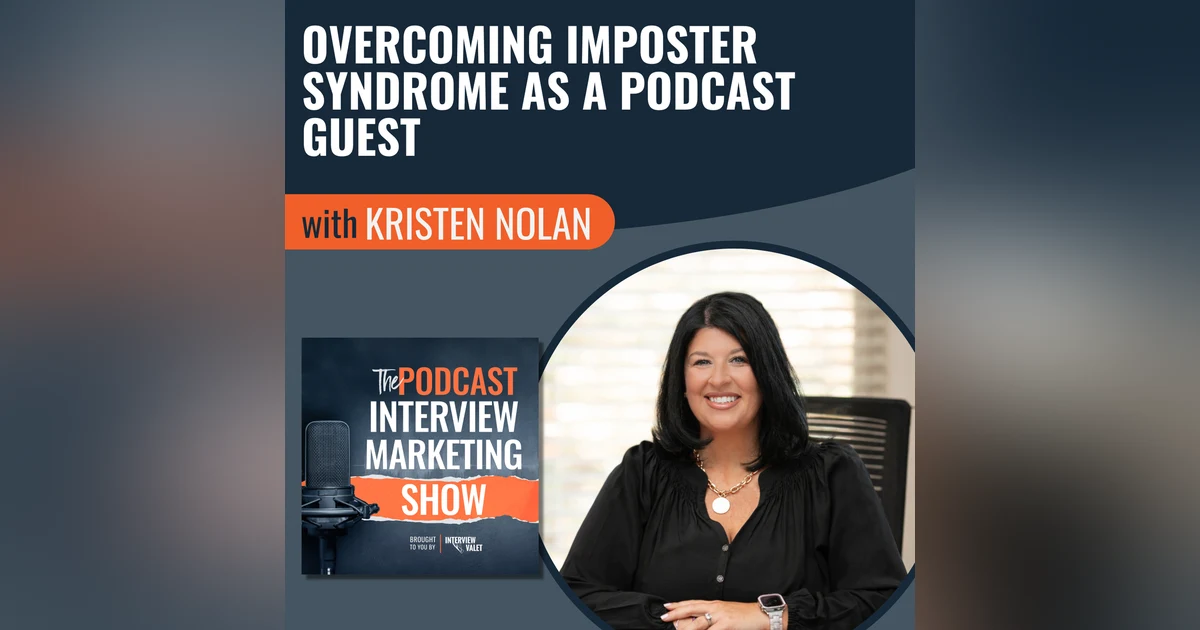
Overcoming Imposter Syndrome as a Podcast Guest


 Apple Podcasts
 Spotify
 YouTube
 Even the most accomplished experts - founders, authors, CEOs - often feel a flicker of "who am I to talk about this?" before a podcast interview. Tom Schwab sits down with Kristen Nolan, senior client account manager at Interview Valet, to address imposter syndrome in podcast guesting.
Kristen explains why nervous guests often outperform overconfident ones, how shifting from ego to empathy transforms an interview, and the prep-document strategy she uses to help clients show up with clarity instead of a script. You don't have to be fearless to be a great guest, just intentional.
Timestamps From This Episode:
[03:23] Nervous guests vs ego-driven guests
[06:05] Reframing the real issue
[12:52] Replace scripts with prep documents
[20:16] How to handle questions you can’t answer live
Resources From This Episode
InterviewValet.com/Kristen
PodcastInterviewMarketing.com
Looking For More?
Here are some resources to help you get started with a Podcast Interview Marketing strategy to grow your brand or business.
 |  |  |
00:00
Kristen Nolan
We don't want to be everything to everyone because we're going to fall short a million times that way. Whereas if we're looking at it and going, okay, what are the. What are the ways that I can connect with my ideal client? And where are the places that I can connect with them? And that's really where the. What I would. What I would say. The magic happens. Welcome to the Podcast Interview Marketing show, where we explore big ideas with leading experts on how to grow your brand and business with targeted podcast interviews.
00:30
Tom Schwab
Have you ever been invited onto a podcast and thought, who am I to talk about this? Congratulations. You're in good company? Some of the smartest experts, coaches, authors, and business leaders I know still feel that tension before interviews. They've got the experience, the results, heck, maybe even the letters behind their name. But when that microphone turns on, there's that little voice that asks each one of us, am I interesting enough? Do I really have anything worth saying? Well, today, Kristen Nolan, one of our senior client account managers, and I, we sit down to talk about overcoming imposter syndrome. And here's the good news. This nervousness, it may not be a weakness. It may be a sign that you actually care. The best guests don't show up with ego. They show up with empathy. They don't try to impress everyone.
01:26
Tom Schwab
They come prepared to serve the right someone. In this conversation, we'll talk about how to move from fear to focus, from just winging it to being intentional, and from trying to prove yourself to helping the listeners. Because podcast Interview Marketing, it's not about being perfect. It's about being human. Human. It's about being clear. It's about being useful. Let's get into it. Kristen, every day you're working with incredible experts, right? People that have written books, that have had life experience, they got initials behind their names. And then they get almost intimidated going on a podcast, right? They worry, what do I have to say? Right? And so we're going to dig down into that today. But with that, I mean, what do you think is the core reason behind that? That they think they're not interesting enough, they don't have enough to offer.
02:25
Tom Schwab
And how does that actually show up? Some people call it imposter syndrome.
02:30
Kristen Nolan
Yeah, absolutely. I, you know, I will see people who are, you know, as you've mentioned, they have letters behind their name, their founders, their CEOs, their authors, and they show up and they kind of have what I would. What I would call kind of stage fright, Right? And so what I do with them is I You know, we talk through what does that look like? And what is the apprehension there? And then we're able to sort of have conversations that will coach them through how to show up as a great guest and how to have a great interview.
03:01
Tom Schwab
And I love it because I tell them that's a good sign. The people that come up and say, oh, no problem, I can wing this, or I have five keynotes, I'll just give one of those. It's like, no, that's not a conversation. So often I'll tell people, you know, if you're worried, that's a good sign, Right. That means you're taking it seriously here.
03:23
Kristen Nolan
Yeah. And I think you really hit it on the head. The people that show up and they're like, I got this, right? Those people tend to lead more with their ego, whereas people that are, you know, a little bit more nervous or a little bit, you know, more apprehensive, they're the ones that really show up with the value because they don't look at it as like, I got this. You know, the host is doing me a favor by inviting me on. You know, they're able to have, you know, a conversation and provide value.
03:49
Tom Schwab
Yeah. We even did that study after Matthew Pollard from the Introverts Edge introduced me to that idea. And we surveyed our clients and the majority of them were introverts. Right. And I, after I saw that, I'm like, oh, that's perfect. Right? They're great at having one one conversations. They're great at having deep, thoughtful conversations. They just don't show up and want to be the carnival barker.
04:18
Kristen Nolan
Yeah. Well, and I think we talk about this often where we talk about, you know, podcast interview marketing is not a megaphone. Right. We're not shouting. We're not like, here I am. See what I can do. Look at me. It, it becomes, what value can I provide? And so you become more of a magnet versus, you know, just someone shouting, look at me into, you know, things.
04:39
Tom Schwab
Yeah. And I love how you talk about, you know, that shift from ego to empathy, Right. That difference between just being a good guest and a great guest. How do you see that showing up there? Can you explain that a bit?
04:52
Kristen Nolan
Yeah. So when we, when you had mentioned, you know, the people that sort of show up with their ego, they sort of wing it, Right. They don't have a plan, they don't have a strategy. They just show up and, you know, they may have a conversation, they probably make it about themselves, what they've done. What value they have? Well, when I'm talking to my clients and I'm coaching them on how to show up and, you know, be great guests, it really comes from a place of, you know, we identify the. The key target audience, so we make sure that you're in a room with your people. Right. We're not just shouting at 10,000 people and hoping that maybe we get a handful of them. That could be our ideal client.
05:29
Kristen Nolan
We are getting clients in front of the people that they serve, their ideal target audience. And then we're going to talk about the strategy, Right. What does that look like? Are we showing up and talking about ourselves? Absolutely not. We're going to show up, we're going to name a problem, we're going to share a story that aligns with that problem, and we're going to show the audience a way that they can see themselves in the problem. And then the solution that you. That you offer as. As a, you know, as a business owner or an author or whatever. So it really shifts from this mindset of me, me, and it shifts into a mindset of how can I help others and how can I serve others.
06:05
Tom Schwab
Yeah. And you. You talked about a framework there, right. And I think you went through it quickly because it's ordinary to you. So what you are teaching and what we have seen works is that you focus on the problem, right? The problem that people are having. Then you tell a point of view with that, and then you tell the story to support that, which is so much different than what most people are out there saying of, oh, just tell your story. Right? And just tell your story, tell it often, tell it loud, and magic will happen. The order that you put that in is totally different.
06:41
Kristen Nolan
Yeah, I, you know, when I'm having these conversations with clients and I, When I first started as a podcast guest myself, you know, and I, I say about 95% of the time, the host is going to say, tell us about yourself. And I'm sure we've all tuned into a podcast where the guest goes into, I did this in middle school, I did this in high school. And you're like, for the love of God, please just can we move on to something else? Right? It's boring. You want to turn them off versus turn them up. And so we. When you tell a, you know, a story where the audience is able to see themselves in that, they. They turn you up, they want to listen, they want to. They want to get to know you better, Right? You. You.
07:20
Kristen Nolan
I, I can't tell you how many times I've listened to podcasts and been like, this person is speaking directly to me. And if you have the ability to do that, everything else, it just flows so much better because people want to listen to you. You become that magnetic.
07:34
Tom Schwab
And it's not a documentary, right. I think of. There's. I watched two of them recently, right? Billy Joel, great documentary of his life. Right? He's got, I don't know, five, six decades of performing. That's interesting. People want to know the story behind that. Mel Brooks turns 100. All right, when you turn 100, you can do a story of your life there. But when somebody invites you on a podcast and they say, you know, Kristen, tell us about yourself, right? Too many people go into their cv, right. Their resume, and really what the host is asking, what the audience is listening for is, who are you? Why are you here? Why should I listen to you? That's the foundational question.
08:18
Kristen Nolan
Absolutely. And I think, you know, sometimes people will come to me. And I mean, I even did this one when we had the conversation about, you know, a couple of us, you know, being guests on behalf of Interview Valet. And I thought, well, I'm not a founder, I'm not a CEO, like, who wants to listen to me? But I really believe that it comes from identifying who you are and what value that you bring. And if you can come from a mindset of, you know, not how do I sell my product, but how do I. How do I serve others, how do I educate, how do I share what I. What I know? Because we all have. We all have our own specific talents and, you know, things that we're really good at.
08:58
Kristen Nolan
And so if we can really hone in on those things, it's just a conversation between two people. And so it's so much less pressure. And as I always say, you know, I. Sometimes people will come to me and I'm like, just pull the band aid off. Right? Like, your first interview is probably going to be messy. That's okay. That's why, you know, with my clients, I try to be strategic, right. And if I know that they don't have a background in podcasting or they've never been a guest, I'm going to find them and try to pair them with a host that does a pre call, right? So they can have the ability to have a conversation beforehand, feel really comfortable with the host, understand more of their personality, and then dive into the interview.
09:39
Tom Schwab
Yeah, it's when we talked with people that are interested in working with us, right? They're interviewing us, we're interviewing them. And it's a great sign when somebody says, you know, I haven't done a lot of these. I'd like to work my way up. You know, they're happy that we do that walkthrough interview that shows that they've got a good sense of self and where they're going. Right. As opposed to the people that start with, well, I'd like to start with Joe Rogan and Diary of a CEO. Right. And they don't realize that even, you know, big name Broadway actors, they always start off of Broadway. Right. You don't want your first interview, your first performance to be on that big stage because you got one shot at. Right. So make sure that you're working your way up there.
10:27
Tom Schwab
Now, you know, you mentioned something about winging it versus preparing, and I think it's like a, a spectrum there's certain people that want to wing it and that doesn't work. And then there's other ones that want to over prepare and that doesn't work. So how do you think about that?
10:49
Kristen Nolan
Yeah, so I think we have to be sort of in that middle piece, right? Like winging it. I don't suggest. I mean, I've had a, I had a previous client and he had his own podcast. He was very, he had been a guest many times. And he shared with me. It was probably his, like, 20th podcast with us. And he was like, wow, that one really threw me for a loop. And, you know, he's a seasoned guy, you know, kind of was going into it, winging it, and he, you know, it forced him to relook at the way that he prepares for podcasts. So on the other side of the spectrum, I've also had clients that, you know, they want, right? Give me all the questions you're going to answer or you're going to ask me, and, you know, I'm going to be prepared.
11:31
Kristen Nolan
And I think we have to fall somewhere in between because at the end of the day, I always say the best podcasts are the ones that feel like you're in a coffee shop listening to two people have a conversation and they're just sitting next to you, right? So that's how I believe that we have to look at it. So it eliminates some of that pressure, right? Where we, you know, some people think, why have to show up perfect, right? I have to show up perfect and everything has to be, you know, whatever. But I, I would disagree with that. You know, as we're in the age of, of AI and things like that, people don't want perfect. They want you to show up as yourself to talk about things that you're an expert in and provide them value.
12:10
Tom Schwab
I would say perfect is sort of that red flag right now. Right. If I speak in complete sentences and never make a mistake, never use a filler word, never drop the g off ings, people are going to go, that's not Tom. That's not human. Right. And I think it's like you don't want to wing it. You don't want to be over scripted. Right. But what you're saying there is. You want to be intentional. Right. You want to know why you're there, what you're trying to accomplish, you know, what you want people to know, feel all that afterwards. So it's not just a conversation, but you actually get some results from it too.
12:52
Kristen Nolan
Absolutely. And with a lot of my clients, especially ones that may not be as seasoned, I will put together what I call a podcast prep document. And that's really a document that I put together specifically for that podcast based on their information or their book on what is most important to the audience and how that's going to resonate. So it'll give them sort of a framework and a starting point. Right. It's not the questions. It doesn't feel rehearsed, it doesn't feel like scripted or. But it gives them, you know, this is the listener of that particular podcast. This is what they're interested in. These are their pain points, and it helps frame out that first foundational question. So, and we also, you know, pair that with what we have internally as a brief sheet. Right.
13:37
Kristen Nolan
Information on the particular podcast and, you know, how to find the host. I think another thing that a lot of people don't do well is, you know, they go into an interview and they believe that, you know, once you stop hitting record, like that's it. I' sit back and wait for the leads to roll in. And I reject that. Right. I think that the more that you do to promote the episode, it provides you more visibility. And I see it happen as a guest myself. Right. I have a, I have a host that I was a guest on his podcast probably nine months ago, about once every other month. He still sends me like an asset, like, hey, and the content that we have is evergreen, so I'm able to share it. So I'm sharing it still. He's sharing it still.
14:20
Kristen Nolan
It's a mutually beneficial thing that we do with each other. And so it doesn't stop when the recording stops.
14:27
Tom Schwab
Yeah. And I think if you go in with the right intentions, you can calm the nerves there too of what the purpose of this is. Right. It's a conversation there and the preparation before it. And often, I think, you know, Covid was a blessing and a curse from the standpoint. We all got comfortable on Zoom, but the curse was we all got comfortable on Zoom. And I see people come in, they'll say, well, I'll just show up two minutes before the interview and totally cold. And it's like, no, you're missing an opportunity. You would not walk out onto a stage. Right. Kristen, if you invited me to your event that you're putting down in Tampa, we'd love to give you a keynote. Well, I wouldn't show up at 8:58 for the 9:00 keynote and say, I'm going to wing it. Right.
15:22
Tom Schwab
No, I would be prepared. I'd be in the right mindset. I would look good, I would sound good. I'd reach out to the host beforehand, tell them how excited I was, and then like you said, after I finished my keynote or my discussion there, it's not like I dropped the mic and walk off the stage. No, I would engage with the audience. And I think too many times we focus on the word podcast and don't focus enough on the word being a guest. Right. If your guest invited over to somebody's house, invited to talk to a small group or something like that, they invited you for a reason. Right. They believe in you, so you don't have to prove yourself. You should have the confidence. Because they had the confidence to invite you.
16:11
Kristen Nolan
Absolutely. And I, you know, this is another thing that I will often sort of highlight for my clients is, you know, if you're a guest on a podcast and you know that host, you know, has your ideal target audience, they're also a great partner for you. Right. So the more you can foster that relationship, the better. And I had a client that she was a guest on a podcast, and the host loved her energy and what she spoke about, that he invited her to a keynote speech later on at an event that he was planning. So I feel like a very underrated, you know, other thing that people aren't doing a lot of is really that connection with the host. Right.
16:48
Kristen Nolan
If you're able to connect with that host and they know five people that could be your ideal clients, that's a great opportunity to network with them and partner with them on future things. So I think when we look at it from a lens of like, I'm going on a podcast, I'm doing this interview, and then I'm going on to something else. You are missing so many other pieces within that part of it.
17:11
Tom Schwab
Yeah, I know the clients you're talking about there. And she was nervous going on the podcast and then she got invited to speak to the live event and it's like she was even more nervous, but she delivered on both of them. It did great and did great results with that. It's this idea of that her authenticity came through. She knew what to say. And the other thing too, it's the conversation. Right. If I, if I give a 45 minute keynote, geez, I need slides for that, I need stories, I need an arc, I need to practice this, I need to time it. All the rest of that's tough. But to sit down and have a conversation like as Marcus Sheridan said, you know, he wrote a book called they ask, you answer. That was his marketing strategy. And really that's what podcast interviews are.
18:01
Kristen Nolan
Yeah. And I, you know, I always say, you know, rip the band aid off. Right. If you're feeling like you're, you know, nervous about it. I think, you know, ripping the band aid off and doing your first podcast and having that conversation and you get more comfortable. I mean, if I look back at, you know, we had, I think it was one of our very first interviews on the podcast interview marketing show. I had interviewed Kate deleo and I will be very honest with you, I had to reschedule with her three times. Like, I was a mess. Thank God I had the relationship with her. I. But I was a mess. I had my setup because I needed to be, you know, hardwired into my, to my router.
18:42
Kristen Nolan
And I'm like sitting in front of these, like very hot lights and I'm thinking like, I'm going to look crazy on camera because I'm sweating because I was so nervous. But now when I'm a guest, I don't feel that those same things. So if you just rip the band aid off and go, okay, I'm doing this and I'm looking at it from a lens of not what can I sell or what can I get from this? But, you know, what am I depriving the world of by not showing up and not sharing, you know, my product or my service or my expertise?
19:14
Tom Schwab
That's, you know, that first one will be the worst because you're always going to get better after that. And that's part of the reason that we do the walkthrough interview. Right. So that you can learn and get, you know, more comfortable and confident and really ready to convert on every interview.
19:30
Kristen Nolan
Absolutely. And I, you know, I even, I have clients that, you know, are high level CEOs and we'll do mock interviews. Right. I'm always like, hey, if any service that I can help to get you on camera and feeling great, let's do it. You know, the more we practice and the more we feel confident in, you know, what we can talk about in our expertise, the better we're going to sound. Right. And I think that, you know, if we need to do, you know, a walkthrough and a mock interview, you know, that's also a great opportunity to just sort of hone in on those skills a little more as well.
20:04
Tom Schwab
So many people, their imposter syndrome comes up when they say, what if someone asked me a question I don't know the answer to? What if somebody stumps me? How should they be thinking about that?
20:16
Kristen Nolan
Yeah, so I actually just had this conversation with a client the other day, so I would say probably 95 plus percent and I'm just throwing that out there. You may have a better idea of that. But are not live, right. So they're pre recorded. And I will tell you, I have been on a podcast and I threw out a dollar amount and I, at the end of the podcast, I said, hey, would you mind just taking that out? You know, because we always talk about, you know, we don't want someone listening to it, you know, 10 years down the road and being like, well, Kristen said that this amount, and so, you know, it's very easily removed now if you're live, that's obviously a little different.
20:53
Kristen Nolan
And so, but when they're prerecorded, you, you have the opportunity to say, you know, I don't feel comfortable answering that. And they can just pull it out. Or, you know, you can say like, I have. I know a client. And they'll say, as they're thinking of answer, they'll say, that's a great question. And then they'll, that'll give them a few extra seconds to, you know, think of what they want to say. So, you know, there's all, there's all the opportunity to, you know, be flexible in that if you're kind of Thrown off or you need to reset. I've done it.
21:25
Tom Schwab
And it's not a gotcha interview. Right. This is not 60 minutes with the lights, and they're trying to get a gotcha clip. Right. I've done probably over a thousand interviews, and I can only think of one gotcha question. And I thought it was a rude question there. Right. But that's okay. Right. Like you said, we've had clients before. I remember one that reached out and he said a number that he shouldn't have said because it was covered by an NDA. And he reached out to us afterwards, and he's like, I think I said a number that I wasn't supposed to. You know, what do I do? And I'm like, just call the host. Right? Asked them to pull that. I said, if they've got a problem with it, I'll give them a call.
22:08
Tom Schwab
I knew the host, but he called him and said, yeah, that's no problem. Right. It's not a big thing there. And, you know, there are times where somebody asked me a question that I hadn't thought about before, and I love those. And I will typically say, you know, that's a great question. I've never really thought about that before. But let's think this through. Right? And you can think that through right there. Right. And the same way you would do in a conversation. Right. Often you look at conversations, somebody's going to bring something to you, and you don't have the boilerplate answer, but you think through it with them. And to me, those are the better answers. Because now you're asking questions to the host and you're creating something right there. Right. Because you're creating the future.
23:00
Tom Schwab
If it's just, you know, if somebody wants a historical answer, they don't need to listen to a podcast, right? Ask ChatGPT, ask Claude. They'll give you the answer quicker. But how you think about something is important. The other thing, too, is that you're invited there for a reason. Right. Nobody's going to ask me my opinion on microeconomic banking policies. Right. That's not my expertise. Right. I. I don't even have opinions on that. So they know what you're there for. And, you know, if you've. If you've gone to school to study, if you've worked in a field for years, heck, if you're the founder of a company, you have expertise there to share.
23:45
Kristen Nolan
Absolutely. You know, and I think, you know, as we talk about those type of questions or, like, being thrown off or different things, like That I think sometimes, you know, as you're thinking through those people see that authenticity, and they know, like, who you are, and as they're seeing you work through that problem, they're going, that's how. I didn't think about it that way. That's really cool. Let me. Let me have a conversation. Right? So I feel like all of these things that we get nervous about are things that make us, you know, more authentic to the listener, right? We're not perfect. We don't have to be super polished. You know, we want to be professional, obviously.
24:24
Kristen Nolan
But I think as we sort of highlight the things that we're probably most concerned about sharing, those are the things that really people are, like, drawn to. And I don't think we look at it from that lens.
24:37
Tom Schwab
That's a great way to look at it, you know, to be intentional, be human, be thinking, and not just be robotic.
24:45
Kristen Nolan
Yeah, yeah. I mean, I'll tell you, like, people right now, I feel like, are craving that. That human connection that, you know, they want to know that you're a real person. They want to know what you believe. Why do you believe that? And so when we're able to voice that and be confident in those answers, right, we're going to attract our people. And so that's what I also think is so important. Like, we don't want to be everything to everyone because we're gonna fall short a million times that way. Whereas if we're looking at it and going, okay, what are the ways that I can connect with my ideal client? And where are the places that I can connect with them? And that's really where the. What I would. What I would say, the magic happens.
25:24
Tom Schwab
And even that imposter syndrome of where somebody will say, well, what if they don't like me? That's okay, right? You're not for everyone, right? We talk about, you want to have people turn you up or turn you off, but not ignore you, right? Not everybody loves Velveeta cheese, right? Which is a great example from the book Super Consumers by Eddie Yoon. Right? But the super consumers are the ones that buy everything and tell everyone else about it, right? So those are the people you want to talk to. And to be very clear with that, too, because now with AI indexing every podcast interview, right, they're not just giving a list of, hey, here's 20 people to discover. No, they're giving one or two to recommend. And with that, you've got to be very clear of, here's what I believe, here's what I Reject.
26:19
Tom Schwab
Here's how I see the world. And from that standpoint, you know, you don't have to be an imposter about that. That's who you are. And people will be drawn to that or repelled from that. And at the end of the day, that's what we're trying to do in podcast interview marketing. Right. Not just make noise, but to build trust and to attract the right people.
26:41
Kristen Nolan
Yeah. And I think that goes back to the strategy piece also, you know, really being strategic with, you know, what you're talking about, who you're talking to, and different things like that. You know, the strategy piece, I think, is really key. And what differentiates, you know, just being a guest on podcasts and podcast interview marketing.
26:59
Tom Schwab
Yeah. Well, I know you've helped a lot of clients get over this imposter syndrome. Help them think through that. They. They've told me about that. And what's the mindset shift that you would tell somebody that was listening here today? They're like, yeah, I've got that. I'm worried. How should they be thinking about that?
27:20
Kristen Nolan
Well, I would say, you know, put yourself out there, right?
27:23
Tom Schwab
The.
27:24
Kristen Nolan
I. I can't think of the exact quote, but it's, you know, we grow in uncomfortable situations. And so, you know, maybe that first podcast feels a little uncomfortable, but do it anyway, because if you are not out there sharing what you have to offer the world, you're depriving the world of that. And so, you know, really making it about less about you and, you know, that imposter syndrome and more about what do I have to offer people? I think flipping that is really key, and I think just being strategic going into it and, you know, taking it a step further. Right. It doesn't stop when. When the interview stops, you continue to foster that relationship, and you come from a place of service and education. I think that's really where, you know, you should start.
28:10
Kristen Nolan
And, you know, I believe that everyone out there, we all have our own innate talents and our own expertise, and so, you know, go out there and share that with the world.
28:20
Tom Schwab
Well, Kristen, thank you. It's ordinary to you, is amazing to others, and I hope this helped people realize to get out there, share your brilliance with the world.
28:30
Kristen Nolan
Absolutely. Thank you, Tom.
28:32
Tom Schwab
What I hope you heard today is this. You don't have to be fearless to be a great podcast guest. You just have to be intentional. Now, Kristen reminded us that the best interviews, they're not performances, they're conversations. You're not walking into some gotcha interview. You're being invited to a trusted space because the host believes that you have something valuable to share with their audience. That means your job is not to prove you belong or show how smart you are. Your job is to serve the listeners. So here's the next step before your next interview. Don't start by asking, what should I say about myself? Start by asking, what's the problem that the audience is already facing? And what point of view, what stories can I share that will help them see a different future, a better way forward? That one shift changes everything.
29:32
Tom Schwab
It moves you from ego to empathy, from anxiety to service, from being just another guest to being the trusted voice. And remember, what's ordinary to you is amazing to others. Don't deprive the world of your expertise, your perspective, and your hard won wisdom. Stay strong. The world needs to hear you now more than ever.