From Book to Business: How Relationship-Centered Podcasting Builds Brand and Impact


 Apple Podcasts
 Spotify
 YouTube
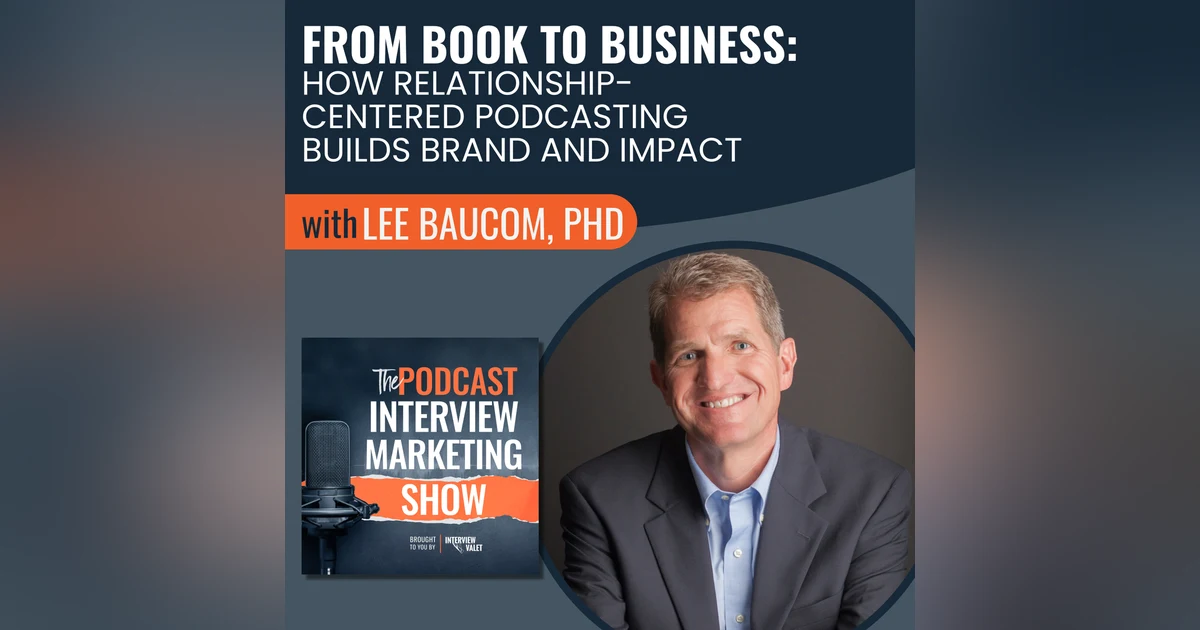
 What is your book really building? Organizational business consultant and author of Book To Business Blueprint, Lee Baucom, PhD, explores how non-fiction authors can turn a published book into a lasting business asset. Lee helps authors think beyond the finish line of writing a book, and challenge the smarter question they should be asking themselves: “How do I use this book to serve people, to solve problems, and build something sustainable?”
Talking with Tom Schwab, Lee shares his Book to Business Blueprint, a framework for connecting your message to the right audience, offer, and ongoing relationships. A plan that helps every podcast interview generate profitable momentum, not just exposure.
Timestamps From This Episode:
[02:22] Writing a book isn’t enough
[04:31] Building your business on relationships, not transactions
[19:43] The Book to Business Blueprint: framework, audience, and offer
[22:24] Build a business that fits your temperament, not someone else's
[29:34] The book is a milestone, not the mission
Resources From This Episode:
BookToBusinessBlueprint.com
LeeBaucom.com
PodcastInterviewMarketing.com
InterviewValet.com
Looking For More?
Here are some resources to help you get started with a Podcast Interview Marketing strategy to grow your brand or business.
 |  |  |
Tom Schwab (0:00): Multiple books I've written by getting up at, five in the morning and writing for one hour. If I was in the middle of a sentence, that's where it stopped, but for one hour. And I've talked to people and they're like, that sounds miserable. And my response is, don't do it that way. I mean, you can do it your way, but you need a way that fits your temperament.
Tom Schwab (0:19): You need your your business to fit your temperament too.
Lee Balcombe (0:23): Welcome to the podcast interview marketing show where we explore big ideas with leading experts on how to grow your brand and business with targeted podcast interviews.
Tom Schwab (0:34): I'm Tom Schwab, and today, we're digging into a question every nonfiction author should ask before they chase that next interview or want more exposure or even book sales. What is this really building? Because a book by itself is not the business. It's the conversation starter. It's the trust builder.
Tom Schwab (0:57): It's the proof of authority, But the real opportunity, well, comes when you know how to turn that message into a business asset, one that creates relationships, open doors, and leads people to a meaningful next step. That's why I'm so excited for this conversation with my friend Lee Balcombe. Now Lee has helped authors think beyond the finish line of I wrote the book and start asking the smarter question of how do I use this book to serve people, to solve problems, and build something very sustainable. You'll hear us talk about his book to business blueprint, and more importantly, how authors can get far better return on every podcast interview by connecting the book to a framework, an audience, and an offer. If you want your podcast interviews to do more than create exposure, if you want them to create profitable momentum, then this episode is for you.
Tom Schwab (2:01): Leah, I'm so excited to talk with you. You know, we go way back to the Morgan James day, and when I found out what you were doing with the book to business blueprint, it's like, oh, we gotta talk about this on the show. So welcome first. And can you give us sort of a the 30,000 foot view of what problem it is you're trying to solve here?
Tom Schwab (2:22): Yeah, Tom, thanks for having me. You're right. We do go way back. And in fact, it's way back that this started. It was at a Morgan James event that I was having a conversation with an author.
Tom Schwab (2:31): And I think this will get us to what this is about. And I was reading the book. We were there. I was helping put on this event just as a volunteer. So they handed me the books of the people who were going to be there.
Tom Schwab (2:42): And I read this book, I'm like, oh gosh, this is a great book. So I'm sitting down right before, and I'm like, So what next? Know, like, What are you going do with this book? And he looked at me with this completely blank look and said, What do you mean? I wrote the book.
Tom Schwab (2:54): I'm like, Yeah, but what comes after that? And there was nothing. He was like, I figured the book sells. And book sales are rarely the way for riches for any author. And so then at the end, when we were at dinner, he came over and he sat down with me and he said, What were you talking about?
Tom Schwab (3:15): And so we started talking about how a book can build a business. It's not the book as the business, but a book can build a business, and how that allows you to have this tool to start the conversation to build a relationship with the reader that then leads to something else. So what I've done is created a program to help people take one action per week to build that business.
Unknown Speaker (3:40): And I love how you're starting with the end in mind there, because it's the same conversation I have with people when they're like, I wanna be on a podcast. Well, why?
Unknown Speaker (3:49): For what reason?
Tom Schwab (3:50): Yeah. That's a hobby, and it gets old really quick. What are you trying to get out of that? Or even with a book. Right?
Tom Schwab (3:58): We do lots of non fiction books where always there's a business behind it. If there's just a book and you're trying to make a couple dollars from it, that's a transaction, not a relationship, and you really don't need a podcast to explain that. So talk more about the relationship side of that because, you know, you come from the the marriage coach, and I love how you tie in the relationships in a marriage with business and with clients. Why do you look at everything as a relationship here?
Tom Schwab (4:31): Because everything is a relationship here. You want anybody to move, it is a relationship. So if we back up, what happened to me in that relationship space was I built a business by accident. So back in 1999, so last century, I put a podcast, I mean a website up. And that website had an e book.
Tom Schwab (4:53): Back then there was no Google or really not much of anything else. So Amazon wasn't talking about e books. And so I put up this PDF. And so that started selling surprisingly to me. I didn't believe the person who said, You ought to do this while you're waiting to publish this.
Tom Schwab (5:11): And by the way, I never published it because it was working well with this. And so then I started getting these phone calls from people who had built a relationship with me, unbeknownst to me, by reading my work and were interested in working further with me. And I just thought it was this sad thing. I actually thought that the book sales would be a sad thing to my clinical practice. And then people started asking for coaching from around the world.
Tom Schwab (5:39): And at first I'm like, I'll talk to that person, I'll talk to this person. And I finally went, wait, there's a business here. And so for me, it accidentally built. And then I, about two or three years in, went, I've built a business. I need to be intentional about this, which means that I made some mistakes along the way that I hope others don't have to make.
Tom Schwab (6:02): And it's how they use that tool. So why relationship? Because a book opens up a relationship. It's like a podcast too, right? I mean, what I like about a podcast is you're in the ear of somebody.
Tom Schwab (6:17): That's a place you can't get to too many people as strangers. I mean, I went up to somebody on the street and just for half an hour whispered into their ear as they're walking along, I would be arrested. But I can do that on a podcast all day long. And the same with a book. How else can I cozy up somebody's lap as they're sitting there reading it and they're hearing me and they're getting this message and they're building a relationship?
Tom Schwab (6:41): And then the question at the end is, What now? So back to my guy at that conference, I was asking him, What now? Like, these books have these messages in them that can be life changing. Everybody has a story about some book that changed their viewpoint or changed their life in some way, And we're creating these messages that then end at the end of the book. And for me that's like the start.
Tom Schwab (7:09): Like you opened up a conversation point, and if somebody has connected with that, they want to know what now. And if the answer is period, the end, that's it, they have lost an opportunity, but so has the author for expanding their message into the world.
Tom Schwab (7:28): And isn't it the great book that you finish it and you're disappointed? It's like, I wanna keep reading this. I wanna keep learning. So there has to be that next step with it. I I think there's very few people that could write a book and solve a problem completely in whatever it is, the 100 or 200 pages there.
Unknown Speaker (7:48): There has to be that next step for people.
Tom Schwab (7:50): Isn't that the delusion of authorship, though, that you think you can solve it in the book, like your book has solved it? And that's the first delusion I often have to challenge people on is you don't solve the problem fully in a book. You open up the problem, you discuss the problem, you can point to it, but most people, if they really have that problem, need the next step. So I have a pet belief that every business is solving a problem. Authors think they are solving a problem.
Tom Schwab (8:21): We are now in the same world, right, of how do you help them truly solve that problem? How do you do that through the business?
Tom Schwab (8:28): Yeah, as you were saying that, I thought of Dan Miller, right, from forty eight Days to Work You Love, great, And great he he talked about that, that he was teaching it at at church and printing it off at Kinko's. And then he went from that to a book. And he said his entire career, he was teaching that book. People would come to the sanctuary there in Franklin, Tennessee, and they'd come for courses on it. People would pay for one day events just to hang out with them.
Tom Schwab (9:04): And he said, I'd explain to him what was in the book. So there's always that next step from it. And I love how you're helping people think through that. Now, when do you find that people need this or are most open to it? Is it after the book comes out and then they think what's next?
Tom Schwab (9:25): Or are people looking at it strategically of, all right, I'm gonna give birth to the book and then what's following after that?
Tom Schwab (9:34): So it's yes, that's the answer. But many times people are so invested in getting a book done. I mean, is one of the biggest things that when I ask people, what do you want to do? I want to write a book. So we know that that is out there, and many people jump into the book not really having thought about what would be next.
Tom Schwab (9:54): Better than that would be thinking about the next as you're creating the book, because then you make strategic choices about what's going in the book. The fact is though, when I encounter people just like at that conference, the book is done. You talked about Dan. That was one of my joys of being at those events is getting to know Dan and watching how he thought through what are the business slices that you could create. And that's the approach that I see with people of going, Okay, where do you start?
Tom Schwab (10:23): It's not where you end, but how does that book start a conversation? So I'll go back to my accidental book thing. The start was I was doing coaching. That was just a slight extension of what I did with people clinically. Now this was been about 2,000 when this was happening, and so I was still answering a phone on my desk like the ones you had to pick up.
Tom Schwab (10:46): It was wireless, but it was like you picked it up and you didn't carry it, right? You pick it up and I would talk with people around the world. I had to figure out some ways of doing that. And that was in the infancy of voice over IP, so I had an early version of that. And I had to figure out how to charge people.
Tom Schwab (11:04): It's much easier now, but I had to figure that out. So piece by piece, I was doing this coaching. And then one day I went, wait, these people are asking for the same question over and over. If I just created that, that's like a course, but more than that, it helps me be more effective in my coaching. So these pieces would augment the coaching, and then they became freestanding pieces, separate courses that people could do.
Tom Schwab (11:30): Then I realized that people sometimes wanted community attached to that, and so I created an online community for people who wanted to be a part of that. And that was because I just saw a need and filled it. So what we're basically doing is creating something that fits for what people are asking for, that fits how I would want to do it. And that brings up kind of another lesson that I think is important for people to ask, what is the signal I'm getting from my book versus what is the noise that I get from my book that often throws people off?
Tom Schwab (12:06): Yeah, and it's interesting because, like you said, today it's easier than ever to do it, right? With the tools that we have. But I would also push back that the speed that the customers expected from you has increased so much. Will they be willing to stick around to have you figure it out over the years and all the rest of that? Or is there a momentum there that after they find out about the book, after they've become a fan, an advocate of it, you've gotta keep them going there.
Tom Schwab (12:40): And without a blueprint, it's almost it's tougher than writing your first book. At least when you've when you've written a book, you've probably read a few beforehand. Right? But so many times you don't see what the back end is with people. You've never seen a blueprint.
Tom Schwab (12:58): Yeah. And and you're right. It is moving faster and faster. And what are opportunities now were not true before. So then there's the risk of that too, right?
Tom Schwab (13:07): Because the more opportunities, the more ease there is, the more noise there is out there that is getting in the way of the reader. And so books still are a great way. As I point out to many people, authority is what you're building with somebody. And the first part of authority is author. We still see the author as being the expert.
Tom Schwab (13:29): I had a person who he had a very niche kind of approach to how he did consulting. And there were a few people who did his kind of thing, but there were really him and one other person that were really kind of competing for the contracts. And he told me about how he was in the office of a president, and the president was trying to negotiate down the cost. And the way he did it was saying, well, I've got this other person who's got this proposal for me. Why should I choose you over this other person?
Tom Schwab (13:57): So, he was trying to get the cost as low as possible. My person didn't want to lower the price, and so he said, Well, and he reached in his satchel and pulled out his book and said, Because I wrote the book on this, and if you're interested in talking with me, let me know. And he left. He wrote the book on that with a lot of authority, and he got the contract.
Tom Schwab (14:17): It's this whole idea of when you wrote the book on it, you become the only choice, not one of the choices. And, yeah, it's like that, the other people that, you're, you're competing with, they've read your book and are quoting it. Right? You you wrote it. You are the authority
Unknown Speaker (14:37): on it. Yeah. Yeah. Yeah. It gives you standing.
Tom Schwab (14:40): And so therefore, it gives you opportunity in both ways. So you have readers who read your book, like your message, and want to follow-up. And then like this guy, he was using it as the tool to drive his business. So it's not a one or the other, it's both. When speakers get engaged in a speech because they wrote a book, and then while they're there they have everybody have a copy of their book, they've done both.
Tom Schwab (15:07): They've gotten in because of that, and then they've engaged with everybody because of that. The book has served both purposes.
Tom Schwab (15:15): Yeah. And I think of when you give the keynote speech, you bring along a box of your books. Some of them will, read it. Other ones will just have
Tom Schwab (15:23): it on their desk being reminded of of what they heard. Which is far more than a business card. Business cards I would collect business cards conferences, I would come home, and I would show my wife the stack. And then they would go in the nice metal container where all the other trash went. And then I had people who handed me books, and they're still behind me, some of those books.
Tom Schwab (15:47): If I'm thinking, who was that person? I can grab their book and find their contact information. And as you say that, I've got a whole shelf of books here. And you know the ones that I will never give away or definitely throw away are the ones that have been signed by the authority, right, by
Tom Schwab (16:09): the author there. It's almost personalized. And it's like you talk about a relationship with a thought leader. If you've got their book that's signed to you, man, that is so powerful.
Unknown Speaker (16:22): Tom, your book is, like, right back there. You gave it to me. I still got it.
Tom Schwab (16:29): What do you think of audiobooks now? Because when we were talking years ago and somebody brought up the idea of an audiobook, it's like, I live in Kalamazoo, Michigan. I would have to go to Nashville to a studio, record this. And, you know, thank God technology has has come up to speed and I could do it remotely. But what is your sense on the printed version versus an audio version?
Tom Schwab (16:58): I think they broaden your capacity. So for myself, I'm dyslexic. So reading is not a fun thing for me. It is a chore. But I listen to a lot of audiobooks that are not a chore, and I take in the information.
Tom Schwab (17:14): So it gives you another avenue, and not just for dyslexia, but for people who are busy on commutes and things like that. You can get the information and you're correct. Back to history, it would have been either a poorly constructed audiobook or me finding a time. But I have got one of my books that I did right here using a pretty easy to set up. It went through Amazon's own process, the AMX that they have.
Tom Schwab (17:45): And so they do check it. And it's not like they'll take bad audio. My audio was up to their standards. And so I was able to record it kind of as I wanted to, rather than having to run through it in a studio. So it's easy for authors to do.
Tom Schwab (18:02): And it does nothing but open up a market. It doesn't mean that if you don't do it, if you don't go to that trouble, you're done. But it is another avenue for contacting people, for them finding you, just because that's another format.
Tom Schwab (18:18): And it's something about the relationship there too. After you've heard somebody, and that's why I always, recommend to people, unless there's different characters in the book, read your own book,
Unknown Speaker (18:31): right?
Tom Schwab (18:31): Can you imagine reading a Zig Ziglar book, you know, and it's not him reading it? It just wouldn't sound the same or any book like that. And I think also as you open up to relationships, keynote speaking, other things like that, it's really that try before you buy.
Tom Schwab (18:50): Yeah. And and I've had people who tell me both from my audiobooks and from my podcast that when they read anything by me, they hear me. I'm speaking and they're hearing me. And so when I'm coaching them, go, it's so weird to be talking with you because I hear your voice so often. And that to me is that relationship where they've associated me with that and I'm in their ear.
Tom Schwab (19:13): So if I'm now coaching them and talking to them, I'm in their ear the same way I was with the podcast, with the audiobook. When they're reading something online for me, it's just the same as when they're reading one of my books. And so all of this creates an ecosystem for them to be connected with me in ways that further the business.
Unknown Speaker (19:33): Perfect. Let's dig into a little bit of the blueprints. Like, what are the different things that people can do after the book to build, as you said, the ecosystem around it?
Tom Schwab (19:43): So one of the big things for is people identifying their framework. Unfortunately, it's often buried in a book. So you're asking before they write the book or while they're writing the book or after the is it a good time to be working on this? I love to talk with people as they're writing the book so we can make sure that their framework is clear. Turns out that's one of my little secret gifts of being able to see the framework.
Tom Schwab (20:09): And I don't know how many times I've been on a podcast interviewing an author and I'll say, Well this seems like what you do. And they'll go, I've never thought of it that way. And I'm sitting there thinking, It's in your book. It's just like asking a fish, Tell me about the water. They do it so naturally that they don't know it.
Tom Schwab (20:26): But if you're clear about your framework, it helps you to understand how you're going to translate that, whether it's coaching or consulting or a course or a live event. You've got the framework to draw from that. And so the first thing that I push authors to do is to be clear about the framework. The second is to be clear about who is that framework changed? Like who needs that framework?
Tom Schwab (20:49): And once you're clear about those two things, you can begin to ask What business would fit me? I'm big on your business fitting your temperament and how you want your life to be. So I had a person I was working with who he'd written his book and he contacts me and we're talking and I said, So what are you going do with the book? And I'm mimicking him. He goes, Well, I'm going to do public speaking.
Tom Schwab (21:16): I went, You don't seem real excited about this prospect, so tell me what's going on? He said, Well, I have a friend who wrote a book and has very successful public speaking. I said, Okay. And this friend had said, You need to do public speaking. I said, Okay, and what have you done?
Tom Schwab (21:33): He said, Oh, I've spent thousands of dollars creating all of this stuff to send out to people. I've contacted people. I've tried to start that. And my response was, So tell me about your response when I asked you that. Why so flat?
Tom Schwab (21:46): And he said, I don't want to do that. I don't like leaving my family. I like to be around the house. I like to be around the kids. I like to be with my wife.
Tom Schwab (21:55): I don't like leaving. Don't like traveling. I can do it, but I don't like it. Second thing is I don't like public speaking. I can do it.
Tom Schwab (22:04): I'm not bad at it. I just don't like it. And so I asked him to compare with his friend and he said, Oh, my friend loves getting around all over the place. And he loves getting on the stage and getting the energy of the people. And my response was, You're forming a business that does not fit you.
Tom Schwab (22:19): And he said, Well, I'm committed to this. I've already got this. And I said, Okay, let me just do a little test for you. Five years from now, you're successful. You've booked those stages.
Tom Schwab (22:28): You're out there traveling multiple times in a year or a month or whatever, and you're doing the speeches. How are you? And he said, Oh, that sounds miserable. And it's time to switch. It's time to find something that fits how you want to live your life that would allow you to do that.
Tom Schwab (22:45): And so the temperament of the author and who they want to speak to and where they're going to hear it are both very important pieces of the puzzle.
Tom Schwab (22:55): I love how intentional that is. It's like that whole thing of, well, what do you want people to do, to feel, the actions to take after they hear you? And it doesn't mean, there's not a right or a wrong, but there's a right or a wrong for you. If you're doing one on one coaching, that's great. If you love public speaking, that's great.
Tom Schwab (23:16): But there's so many different ways to do it. One of the things I firmly believe is that there's a lot of problems in the world today, but there's no greater time to be alive. I've written a lot of blogs in my life. Every one of them felt like a homework assignment. I had to get to the dentist before I started working on my book.
Tom Schwab (23:40): But there's ways now where you can dictate it and at least start there.
Tom Schwab (23:46): Yeah, and so that temperament is important. How you write a book can be reflective of your temperament too. People can't see that. My thing was getting up, multiple books I've written, by getting up at five in the morning and writing for one hour. If I was in the middle of a sentence, that's where it stopped, but for one hour.
Tom Schwab (24:07): And I've talked to people and they're like, that sounds miserable. And my response is, don't do it that way. I mean, you can do it your way, but you need a way that fits your temperament. You need your business to fit your temperament too, which gives us back to that whole signal versus noise. So let me tell you how that kind of worked for me because I think it may click in.
Tom Schwab (24:28): One of the things that helped me build a business was listening to what people were asking for. That first phone call, that was a signal because I'm a natural coach therapist person. That was my profession. That is my profession. It's my training.
Tom Schwab (24:43): So when he wanted coaching, I'm like, I can do that. And at that point, I was just thinking it was a one off thing, but I could do that. That fits with how I do things. Building different courses, I can also do that because I'm very clear about frameworks. I can create a framework and deliver that very concisely and take complex ideas and make them pretty simple so people can walk through them.
Tom Schwab (25:06): So that's me. Those are signals I was receiving. And I could take in those signals and go, Okay, let's move in that direction. Noise though. So it was probably about four months into my stuff being on the internet and the first therapist contacted me and said, Can you teach me how to do it your way?
Tom Schwab (25:27): And so I could be certified by you. And I went, Well, that's curious. Didn't think much about it until the second person, the third person, the fourth person. About the sixth person I went, oh, there's a business there. I think maybe I'll do this certification process.
Tom Schwab (25:42): And then I started one time, I woke up in the middle of the night. I remember I woke up in a sweat going, wait a minute. If I do that, I'm unleashing people that I don't have any control over actually how they do it, but my name's on it and my reputation is on it. I don't want to do that. That for me was noise.
Tom Schwab (26:03): Now I have a friend who wrote a book. She loves certifying people to use her approach. That is like, that's her whole business, certifying people to use her approach. For her that's signal. For me it was noise.
Tom Schwab (26:16): And so many times, you're listening to say, how are people communicating what they want from me? And does that fit my temperament? Does that fit how I want to go about my life? Does it fit how I would like to build a business?
Tom Schwab (26:31): So it sounds like it's a lot of evolution there of listening to the customer. I've always said, everybody's got an opinion on your business, consultants, coaches, all the rest of that. But it's your clients that'll tell you the truth. And they're always voting with their time and their money. If they're saying, I will give you money to do this, they're teaching you that.
Tom Schwab (26:55): So you're doing the blueprint, is it continually testing things, testing the market, and picking what they want and what you want?
Tom Schwab (27:06): Yeah, so this is where we try to do it differently than some other programs. I had somebody contact me and said, I'm overwhelmed. I've got the book and I know I want to build a business. So I entered into this How to Build a 6 or 7 Figure Business, whatever, with it. And it's like a fire hydrant coming at him.
Tom Schwab (27:25): And he had already spent a lot of money in trying to build out this full course. And my simple question was, what is the piece, the smallest piece, that would actually get your message out and help someone change? Because let's test that. Maybe it's not a course. Maybe it's not a big course.
Tom Schwab (27:42): Maybe that's not the direction. So this is not the minimally viable project that people put out Not
Unknown Speaker (27:50): that many.
Tom Schwab (27:51): Yeah, that to me is always like the, well, let's slap something together and see if it works. This is a let's be clear about what is the pieces that I need to have in place to change somebody. What would really make a difference? It is the smallest piece that can change that we want to test, but it's not the minimally viable piece. Like I want a strong piece that's going to represent me.
Tom Schwab (28:15): And so, this person stepped back and created a much smaller course. When people clicked into that course, he went, Okay, now I can expand it. But I had somebody else who started down this big course thing and it was crickets. And so we had to find a different approach to that, a different piece to answer that question. So yeah, it's testing and evolving and too many people want to have the final product before they've had some conversations along the way.
Tom Schwab (28:47): So yes, evolution, listening for that signal versus the noise, making sure it's fitting in how you want to approach it, and making sure it's making the difference you want to make.
Tom Schwab (28:59): Final question, and maybe this is one I should have asked you, oh, was it nine years ago? When I was working on my book, what would you tell the author, right, that's working on the book? And in some ways, I think it about being a parent. Right? That nine months of of I wanna be a parent, and once the delivery's over, then you think, okay, the hard work's behind me.
Unknown Speaker (29:26): What would you tell someone that has this vision of a book to help them make more out of it and make more of an impact?
Tom Schwab (29:34): This is one of those shifts for me. When I finish a book, and you've been with me with others who are celebrating their book being out there, and they're all like, Oh, we've made it to the finish line. And I'm sitting there going, Well, you're 5% done. You've got a long run to go in front of you. And it is a milestone, but it's not the milestone.
Tom Schwab (29:56): It is a step. So you see it as a step. And then start asking the question, how do I expand from here? So when I finish a book, my immediate thing is how do I plug this in and how is it gonna further what I'm doing it? Sure, I am happy to have it done, but I'm also aware that I'm only done with the book.
Tom Schwab (30:12): Now I've started this process of how it plugs in with everything else. So that's the big thing is to see that as, yes, milestone, but not the milestone. Let's build something out that lasts. Mean, now I've been doing this relationship stuff since 1999. We're over twenty five years of this, and it's something that I can sustain because I love what I'm doing and the difference that it makes.
Tom Schwab (30:40): What's ordinary to you is amazing to others, and thank you for being here, being a blessing. Where can people find out more information about you, about what you have to offer?
Tom Schwab (30:51): So I've never tried to do tricky little names for things. It's booktobusinessblueprint.com, booktobusinessblueprint.com, because this is a blueprint of how you take your book, move it to the business. And we walk it through. There is a part that is issues that we do once a week that come out of what do you do? What's your assignment for the week?
Tom Schwab (31:11): And it's, I promise, not the whole week that it'll take, but it's a step in the process. There is a starter map there too to help people kind of jump into that. And a podcast that I started there just to let people know how it happened for me at booktobusinessblueprint.com.
Unknown Speaker (31:27): Thank you, Lee.
Unknown Speaker (31:28): Thank you.
Tom Schwab (31:29): What a great conversation with Lee Balcom. I think the biggest takeaway for me is this, the book is a milestone, but it's not the entire mission. The mission is to use that book to start the relationship, to create the authority, and to lead the right listeners toward the right next step. That matters even more with podcast interviews because every interview is the chance to put your voice, your framework, and your message in front of an audience that already wants the help. But the ROI, that doesn't come from just being on a podcast.
Tom Schwab (32:09): It comes from knowing who you want to serve, being clear on the problem you solve, and giving listeners a natural path from the conversation to the conversion. So here's an action step. Before your next interview, don't just prepare your talking points about your book. Write down these three things. First, what is your framework behind your book or idea?
Unknown Speaker (32:36): Second, who's the ideal listener that you wanna help? And third, what's the next step that makes sense after they hear you? You see, when you have those three pieces, your interviews stop being publicity, and they start becoming a business building system, what we call podcast interview marketing. That's how authors move
Unknown Speaker (33:01): from book
Unknown Speaker (33:03): interviews to impact, from podcast to profits.