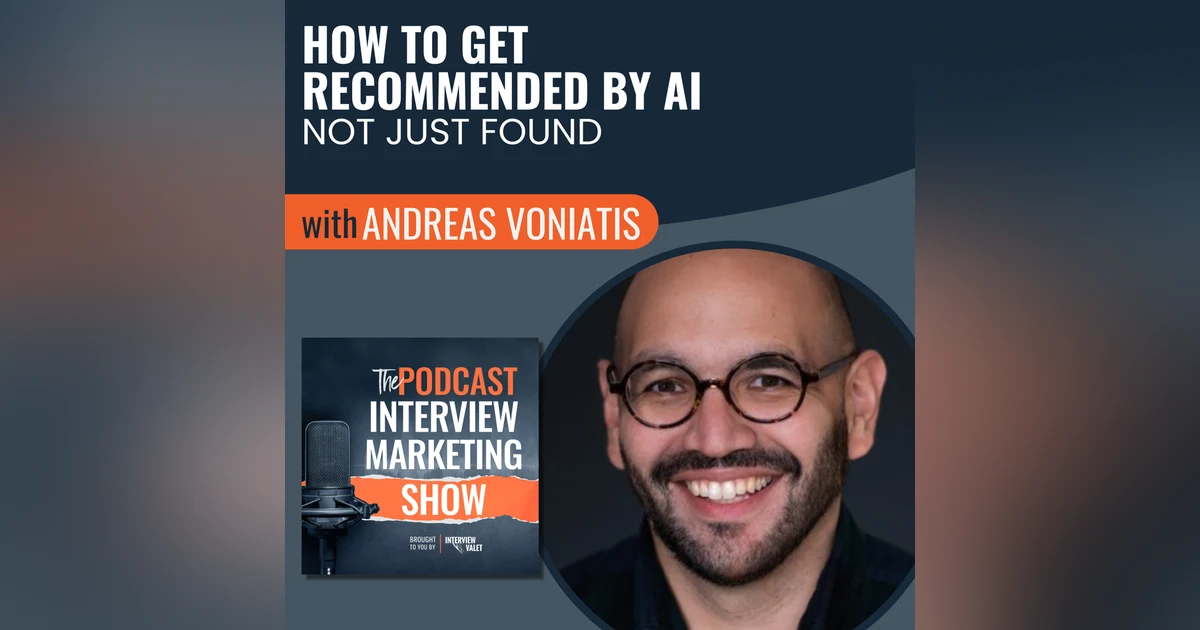
How to Get Recommended by AI, Not Just Found with Andreas Voniatis

 Apple Podcasts
 Spotify
 YouTube
 AI isn't rewarding noise, it's rewarding signal. Andreas Voniatis, who built his first machine learning model in 2019 and founder of Artios.io, joins Tom Schwab to break down how AI search (GEO) is fundamentally different from traditional SEO.
Generic, rehashed content won't get you recommended. Proprietary research, real conversations, and original insights will. Discover why podcast interviews are uniquely positioned to feed AI the kind of content it's looking for, how to become visible, and, more importantly, be recommended.
Timestamps From This Episode:
[02:48] Original content makes AI models smarter and makes you more visible
[04:45] AI search is 8x more expensive than Google, so it requires high-value, unique content to justify the cost
[07:19] SEO vs GEO. AI is persona-driven, not keyword-driven
[14:18] Why old SEO hacks no longer work
[21:38] Podcasts & AI indexing transcripts feed AI. Video is the future
Resources From This Episode:
artios.io/winning
PodcastInterviewMarketing.com
InterviewValet.com
Looking For More?
Here are some resources to help you get started with a Podcast Interview Marketing strategy to grow your brand or business.
 |  |  |
Unknown Speaker (0:00): It just goes to show, it doesn't matter whether you're in GEO or social media or or or video production. You know, you you you need to have something that stays above the noise.
Host (0:11): Welcome to the podcast interview marketing show where we explore big ideas with leading experts on how to grow your brand and business with targeted podcast interviews.
Andreas Voniedes (0:23): Welcome to another episode of the podcast interview marketing show. Today I'm talking with Andreas Voniedes from Arteus and we're looking at something a shift that every coach, consultant, author and professional service business owner needs to understand today. You see for years the game was search, keywords, backlinks, blog posts, maybe even a few tricks to make Google notice you. But as Andreas explains, AI is changing all of the rules. It's not just looking for more content, it's looking for better content, new insights, original thinking, real conversations, the kind of signal that rises above all of this AI noise and that's why podcast interview marketing is more powerful than ever.
Andreas Voniedes (1:15): You see your podcast is not just more content, it's real conversations where your perspective, your experience, your stories, and your proprietary insights can come through in a way that generic AI written articles never could. If you want AI, your ideal clients, and even the marketplace to recommend you, You can't just repeat what everyone else is saying. You need to teach something new. You need to be useful. You need to be trusted.
Andreas Voniedes (1:47): Today Andreas will help us to become not just visible in the age of AI but recommended. Let's get to it. Andreas, I am so excited to talk with you today. You know, we've talked before and I love your insights, your background on AI, right? Back in 2019 you built your first LLM That was before most people knew what the letters AI stood for.
Andreas Voniedes (2:14): Now today you're helping people and companies get recommended on AI. I love you back to your first principles look on how to actually make it work, not just hacks and tricks and all the rest of that. So let's start from the beginning. AI is changing how experts get found, What do they need to be thinking about so that they can be recommended, so they're helping the training data so that they get not only visible but recommended?
Unknown Speaker (2:48): So great question, Tom. If you want to be more visible on in AI search, what you need to be doing is giving AI what it really wants, and that is, content that makes its models smarter because AI has no reason to change the status quo and feature your company if you're not giving something in return. So you really need to be coming up with content that helps AI get smarter and therefore provide a better service to users of AI.
Andreas Voniedes (3:21): So it's not just more, right? It's not just the noise, it's something new, something insights there?
Unknown Speaker (3:29): It is. Yeah. Absolutely. So using, the SEO tactics of desk based research will not work. You know, with SEO in the last two decades, we've seen, many SEO consultants and teams, they would look at the top 10, look at take all of the best sections in the top 10, make this slightly longer and better, and and that and that worked.
Unknown Speaker (3:54): You know? It worked, for a very long time. With AI, that's not gonna work. Even if you prompt engineer, your research, as part of your content, it's not going to work because it's not teaching AI anything new. What it is doing, you know, AI will realize very quickly that the content came from AI and therefore, is not making its LLM models any smarter.
Andreas Voniedes (4:20): You mentioned something we were talking about. It actually doesn't want to go through all of that noise because it's expensive. Compute time for them is money. So if you're just rehashing what they've already done or you're publishing what AI has already created there, it it actually is a negative thing.
Unknown Speaker (4:45): That's right. It costs eight times more to process a prompt in an AI search compared to a Google search. So AI is heavily constrained by the computing power. It's incredibly expensive. So that's why the information gain requirements to succeed and be visible in AI search are far, far higher compared to a search engine.
Andreas Voniedes (5:10): So where do you see that AI is going to get this information? Right? If it doesn't want information that it already created, where is it looking for the signal, right, that net new information?
Unknown Speaker (5:25): Well, that's a great question. So AI is still crawling the web and it's still relying on search partners like Google and other publishing partners. But what it's really looking for are unseen insights, insights that have not yet been published in the world before or at least new to its models. So so what what you need to be producing is is research grade reports that actually show that there's a significant difference between your content and all of the content that's on the Internet. You need to show con your content is not simply adding to the noise but adding value in order to justify that eight times, that that eight times, in costs compared to a Google search.
Andreas Voniedes (6:14): I think of Christopher Lockhead calls it content free content. Right? Where there's no new ideas in it. It's just a rehash of something else. Right?
Andreas Voniedes (6:25): There's no point of view on it. It's just like it's a cover album for, for everything else that's out there. People don't pay attention to it. As you say, it's expensive for AI to pay attention to it.
Unknown Speaker (6:40): Absolutely. Content free content. I think that worked for SEO. It certainly won't work for AI. It really does demand something new, as in, content value content, if that's the way to put it.
Andreas Voniedes (6:57): Oh yeah, imagine that content with content. And I guess that even builds, you know, it's this noise versus signal, the attention versus trust. And you were talking about that a little bit, that AI recommends who they trust, not just, you know, keyword optimized. Could you expand on that a little bit?
Unknown Speaker (7:19): Yeah. That's right. So, if you think about a search engine, it has a very narrow input window, I e, a keyword phrase, and the output window is pretty limited as well because it's just a list of, web links, whereas AI has a very wide output window and a very wide input window. So, AI is a lot more smarter. I know we all we've all witnessed how search engines over the years have tried to move towards personalized search, AI, well, with the level of technology that it's at, it can take into account the context of who you are, you know, not just what you want but how you want it, what the constraints are.
Unknown Speaker (8:05): So, AI from that perspective can can take a much, wider set of inputs such as, you know, instead of the the the SEO playbook, tactic of, you know, what is disaster recovery, for example. You know, from a from a search engine perspective, that works really well because it wasn't persona driven, whereas AI is persona driven. So it's not just a case of you want disaster recovery or or men's jeans. You know, if you type to men's jeans in the Google search, you could get anything from luxury brands to the very sort of, cheap brands, whereas AI can take that into account. You know, you're going to a party.
Unknown Speaker (8:56): There's gonna be a bunch of a listers there. You know, recommend some some some some genes, you know, and and AI can cope with that, and it can give you really bespoke recommendations because it has a much wider context window. Whereas the search engine, it will give you a list of results, but it doesn't really know as, you know, whether to give you Versace or or or, American Apparel. So, yeah, that that's the power of AI and that's and that shows that your content has to be much more persona driven than it would have done in the, age of of, search.
Andreas Voniedes (9:37): Even to the point AI will now give me what I want as opposed to what I ask for, right? So when I misspell genes, it doesn't come up showing me chromosomes or something. I always am amazed sometimes when people go back to what worked in the last generation, right? When I hear people talking about, well, what keywords should you put into your podcast interviewer? It's got to have the keyword in the title.
Andreas Voniedes (10:04): To me, that is as archaic as your your company should start with Amco. Right? Because as people are flipping through the yellow pages, the phone book, the first thing they'll come to is yours because it starts with an a a, And I'm like, that doesn't work anymore in the same way that keywords aren't working in in the land of, AI.
Unknown Speaker (10:30): Yeah. So, I mean, there's still a bit of a reliance on on keywords but you're absolutely right. You know, one of the things that AI has that search engines don't have is a memory. Right? So it can remember what you typed before.
Unknown Speaker (10:46): So it has a, you know, it memorizes a conversation whereas a search engine, you know, you you type something else following, your previous query and it doesn't take the previous query into account like AI does. And and so, you know, it, it is less keyword focuses because, it's more conversation and more persona driven.
Andreas Voniedes (11:11): So what are you calling it now? I've, cause I've, I think I've used two or three words here. I hear AEO, I hear GEO. How do you think about it?
Unknown Speaker (11:20): Well, I don't endorse the New York Times, but last year, in La last year, they declared SEO was there then hello, GEO. So I'm gonna go with GEO. I I'm seeing that GEO is used more often. And I see answer engine optimization or AEO as a subset of GEO because with GEO, you're both trying to be cited and the answer, whereas AEO seems to be a lot narrower where you adjust the answer, but it doesn't, it doesn't have any kind of, any reference to to being cited, which is very valuable.
Andreas Voniedes (11:59): Let's drill down there a little bit on AEO. One of my books that I really like, Marcus Sheridan, wrote this book called They Ask You Answer. Right? It seemed easy enough, and in the SEO terms, right, you could find that. Even, you know, you go speak at a live event when they ask you questions, make sure you answer them and realize that other people have that.
Andreas Voniedes (12:23): How do you find out from an AEO, an answer engine optimization, how do you find out what people are asking about that are your ideal clients?
Unknown Speaker (12:34): So that's a really great question because we don't have the keyword tools, that in in geo as we do in SEO. And even the keyword tools in SEO are quite questionable because a lot of the data comes from Google Ads, which is an auction. And so Google deliberately hides, the those true keyword insights. So you can use Google Search Console, but even that is quite limited because it's for the search engine, for Gemini or Google AI overviews, but you do get some leakage on occasion. So what we do is rather than trying to prompt engineer, prompts or or or or questions that your target buyer might ask, what we do is we data mine the Internet and and and what we do is we by data mining the Internet and by focusing on the persona and looking at their opinions, we're able to see what it is they care about.
Unknown Speaker (13:37): And that to me is far better than any keyword research tool because when you know what they care about, you you then know what articles to produce.
Andreas Voniedes (13:46): I love that because it's like it almost like starts with the problem, right? What's the problem they're searching for? What do they care about? Then you can start talking about, you know, the solution or how you see the world.
Unknown Speaker (14:00): Absolutely. And even within within a topic, not only do you know what they wanna discuss, you know how they're discussing it, you know what they think, you know what the opinions are, and that creates very persona rich insights that would make an AI model smarter.
Andreas Voniedes (14:19): Excellent. And, you know, we were talking and you said something about that, you know, it's just not the SEO playbook anymore. You know, do these five hacks and you'll be on page one. Even if you do the stuff right, follow the best practices, it may not save your pipeline. To me that's scary because whether or not you believe the New York Times that SEO is dead, it's definitely dying.
Andreas Voniedes (14:45): Paid ads are dying. The yellow pages, there's still some people that say it's alive. I think we can bury that one by now, but all of these things are getting less efficient. I'm sorry. They're getting more efficient, but less effective.
Andreas Voniedes (15:02): As one ramps down, you've got to ramp the other one up. So what do you think most people are missing in where we're going with this?
Unknown Speaker (15:12): Yeah. I think we we're we're increasingly living in the multichannel world. You should never be over reliant on a single channel. I would agree with you that, while I won't go as far as saying SEO is dead, I think the industry itself is on life support. So, you know, all of these hacks that you you mentioned, to me, these hacks are just hygiene factors, you know, like, make sure you do schema, make sure you, restructure your content into FAQ format.
Unknown Speaker (15:50): The trouble is with all of these low cost hacks is if you can do it, so can everybody else including your competition. So it's not the game changer. The game changer is insights that teach that that teach the world something new and also make, AI smarter. And if if I could just continue, the the thing I wanna mention as well is that, with SEO content, nobody would be seen dead sharing, an article on, you know, what are men's genes because it's really obvious or what is disaster recovery. If you're selling disaster recovery to a CTO, which most, disaster recovery companies are, your your target buyer persona already knows what disaster recovery is.
Unknown Speaker (16:43): So so what so by producing reports that that teach AI and people something new, you've now suddenly got content not just for search engines. You've also got content, that appeals to your target buyer. You know? So instead of what is disaster recovery, it might be, you know, what what were what was what what are the attacks you were defending against? Or what what what attacks did you encounter that prompted you to to to to to take out the disaster recovery.
Unknown Speaker (17:22): You see? But others other buyers want to learn from other buyers. So you can't get that from SEO content, but you can get it from GEO content.
Andreas Voniedes (17:33): Interesting. And I love how you said for different channels, right? You always say, well, you should write for your, ideal client or super consumer, but it's also, you're still writing a little bit for SEO right just the way the hygiene that you put it together and then also that you're writing it for the search engines that refer your clients and I keep going back is it that refer or who refer And it's like, well, if it's an object, it's that, but if it's a person, and that's what so many of these referrals feel like when AI tells you something. So that's very interesting.
Unknown Speaker (18:14): Yeah, absolutely. And the the other thing, you know, if you're producing really good content that makes AI smarter, guess what? People want it. You know, you'll find that you're by being cited, you're almost getting free public relations because journalists are looking for data and trends. And if you're producing research grade reports like we are, then you're you're gonna suddenly find that your content is earning backlinks from top tier publications.
Unknown Speaker (18:44): It's also, you know, people will create social posts on LinkedIn, for example, and they will reference, one of the statistics that is mentioned in your report. So this is not just for search. This is for people and and that manifests itself in in ways such as, public relations or or or, or social media posts.
Andreas Voniedes (19:10): And it's what we talk about. Right? Don't do one interview 50 times. Right? That sort of becomes just noise.
Andreas Voniedes (19:17): But if you've got new content, new data, new insights for that, people will listen. And so will the other channels too.
Unknown Speaker (19:26): Yes, 100%.
Andreas Voniedes (19:29): Talk to me a little bit more about how you apply this because one of the things that amazed me is when we first talked and you're like, yeah, we'll guarantee that we can get you the improvements on this. And I was like, at first it's like, no, that sounds too good to be true. Right? There's a lot of people that say that, but we've known each other for a while here. And you know, you're not just an AI guru that figured out, AI a year ago.
Andreas Voniedes (19:55): You've been doing this and seeing great results. So what does that look like?
Unknown Speaker (19:59): Yeah. So when you've built an AI from scratch, you know you have a pretty good understanding of what it is AI is looking for. And the reason why we're able to, make good on those guarantees is because we take care of the research that we know will make AI models, smarter, and that's because we're using the very same data sources that AI relies upon. And, also, we're promoting it using digital PR. We'll and that includes not just increasing your authority, but also, increasing the sentiment, of your brand, on the Internet because AI is quite sensitive to that, because because AI is very smart.
Unknown Speaker (20:46): So, it's it's by producing, insights, from data sources that AI relies on. We we're pretty we're we're pretty confident and so far it's proved to be the case, across all of our clients that we can meet those performance standards that are guaranteed.
Andreas Voniedes (21:10): Full disclosure here, Andres is also a client of Interview Valet. When he reached out to us, was so amazed with what he was talking about. I'm like, Oh, let's get you on the podcast interview marketing show because I'm learning so much just from our initial conversations here. So how do you see the podcast interviews playing into, not only talking to your ideal clients, but the AI?
Unknown Speaker (21:38): Yeah. Absolutely. So with podcast interviews, you'll find with, platforms like YouTube, they have a transcript. And so AI will will will extract all of that. AI is not quite mo multimodal yet.
Unknown Speaker (21:58): As in when when I talk about multimodal, it's not able to pass videos and images, you know, as part of its standard process for data extraction to feed its models. So but but that will change because we're we're already seeing models from China that are using image encryption instead of text encryption, which means that the throughput of AI will will, will improve by a factor of ten, ten x, and that means that it will become multimodal. So if you're not in podcasts today, you would most certainly want to be tomorrow because, you know, it will start taking in video feeds and image because of the advances in technology to to feed those into the model.
Andreas Voniedes (22:44): And it's funny even you say podcast. Right? And people are I I think they've given up now saying, no. Podcasts are just audio. No.
Andreas Voniedes (22:51): 96% of podcasts now are video too, so when you talk about multichannel, they're, not only are people indexing you, listening to you all kinds of ways, but so is the AI.
Unknown Speaker (23:06): Well, your your team will know, from our conversations that I was very keen on podcast hosts that have a a well maintained YouTube channel. So, absolutely, I I think, you know, and video is a lot more engaging than static text. You know, you're seeing, you're seeing because of AI, it's added a lot of noise in the marketplace, not just in terms of the amount of apps that are get launched now, that are vibe coded, but also in terms of the amount of marketing noise. You know, you're you're seeing a lot of, AI generated scripts that are that are using captions on LinkedIn, for example. And, actually, you know, it just goes to show, it doesn't matter whether you're in GEO or social media or or or video production.
Unknown Speaker (23:52): You know, you you you need to have something that stays above the noise, and and video is a lot more engaging as a reel compared to static text. So that's another advantage of podcasts. You you, you know, you need to get into it because, you know, it's not just the podcast itself and the brand awareness benefit, but it's also the benefits of AI and social media to to to stand out to to be stand out above the noise.
Andreas Voniedes (24:22): And is that real conversation? Because as you were saying that, all I could think of is the people that you can tell that it was AI written script for it, and you can watch their eyes go left and right as they're reading the AI. If I can pick it up, so can the, AI engines.
Unknown Speaker (24:40): Very much so. I mean, AI written, captions on social media, you know, they've got all these icons and then dashes, and it's also certain language patterns as well, that make it really quite obvious and almost, I would say, off putting, if I'm honest.
Andreas Voniedes (24:58): Yep. Well, my team has always joked that, if there isn't a typo or a grammatical error in an email from me, it didn't come from me.
Unknown Speaker (25:09): Well, sometimes I'm deliberately making the language inconsistent in my emails to, to make it, to make it quite obvious that it was me writing it and not AI.
Andreas Voniedes (25:20): Yeah. And you think about this conversation. Every sentence isn't grammatically correct. Sometimes we talk over each other. If somebody listens to this, it's like, no, this is two people having a conversation about what the future looks like.
Andreas Voniedes (25:36): This is not AI creating a podcast based on everything it knows about the past.
Unknown Speaker (25:43): Yeah. A 100%. You'll be pleased to know I'm not a hologram, of Andreas. I I'm the real real McCoy.
Andreas Voniedes (25:51): Well, I was a holograph, I'd choose a better one. But as we wrap this up, what would you say somebody right now that is thinking about it? They've heard a lot of noise around it. What was the clarity that you would give to somebody that's a thought leader, a humble hero that wants to get their message out there that could really help the world if the world only knew about them and AI recommended them?
Unknown Speaker (26:19): Could you rephrase your question slightly? Yeah. Thank you. Sorry.
Andreas Voniedes (26:27): I'm I'm famous for giving a long question that's got three questions in it. Right? Pick anyone you want to.
Unknown Speaker (26:34): Yeah.
Unknown Speaker (26:36): And No, start over from the beginning here.
Unknown Speaker (26:39): Okay, great. Did you wanna tell me the intent of your question? Is it the the guaranteed winning thing? No. It's more
Unknown Speaker (26:50): like it's like what how they should think about it, what they should do.
Unknown Speaker (26:54): Oh, yeah. Great. Great.
Andreas Voniedes (26:55): That sort of thing. Okay. So, Andreas, as we wrap this up here, the question I have is there's so many people out there that are thought leaders. They're humble heroes. They've got a great product, a great service.
Andreas Voniedes (27:08): They could help the world if the world only knew about them and AI would recommend them. So what would you say to them? What's the how should they be thinking about this or what's the one thing that they should do to take action here?
Unknown Speaker (27:25): Absolutely. The what they should what what business leaders should be doing to be visible in AI is they should be carrying out, proprietary research, that can be used in their reports because proprietary research is obviously unique to them and, therefore citation worthy to AI search platforms. They're gonna get the credit and therefore they're on the path to becoming the answer in AI.
Unknown Speaker (27:52): Real content, just not content free content.
Unknown Speaker (27:55): Indeed. There's such thing as free lunch.
Andreas Voniedes (27:58): Well, people love this. Right? Where can they find more about you, everything you do, and you're gonna really help them, start to get found in GEO and AEO?
Unknown Speaker (28:12): Absolutely. We have a number of, free mini books on our website and people wanting to know more can visit. Artyos.io That's artios.io/guaranteed-winning.
Andreas Voniedes (28:33): Well, definitely check it out, Andreas. What is normal, what's ordinary to you is amazing to others, and you're a breath of fresh air in this whole AI discussion. You've built one. You've seen people use them, and, definitely check out arteus.io. You'll be glad you did.
Unknown Speaker (28:54): Thank you so much.
Andreas Voniedes (28:55): What a great conversation with Andreas. The big takeaway for me is this. AI is not rewarding noise. It's rewarding signal. The signal that comes from original insights, real experience and content that actually helps people make better decisions.
Andreas Voniedes (29:14): That should be encouraging to the humble heroes listening here. You don't need to be louder than everyone else. You don't need to chase every new hack. You need to share what you know in a way that serves your ideal clients and gives both people and AI a reason to trust you. So here's the next action step.
Andreas Voniedes (29:36): Before your next podcast interview, ask yourself, what can I say that my ideal client hasn't heard a 100 times before? Bring a story, a statistic, a piece of proprietary research, a client insight, or just a hard earned lesson. Don't do one interview 50 times. Don't just keep telling your story. Make every conversation a chance to teach something new.
Unknown Speaker (30:02): And as I say in my book, Podcasts, Profits, this isn't magic, it's a system. The goal is not just to get heard, it's to help the right people know, like, and trust you, and then take the next steps with you.