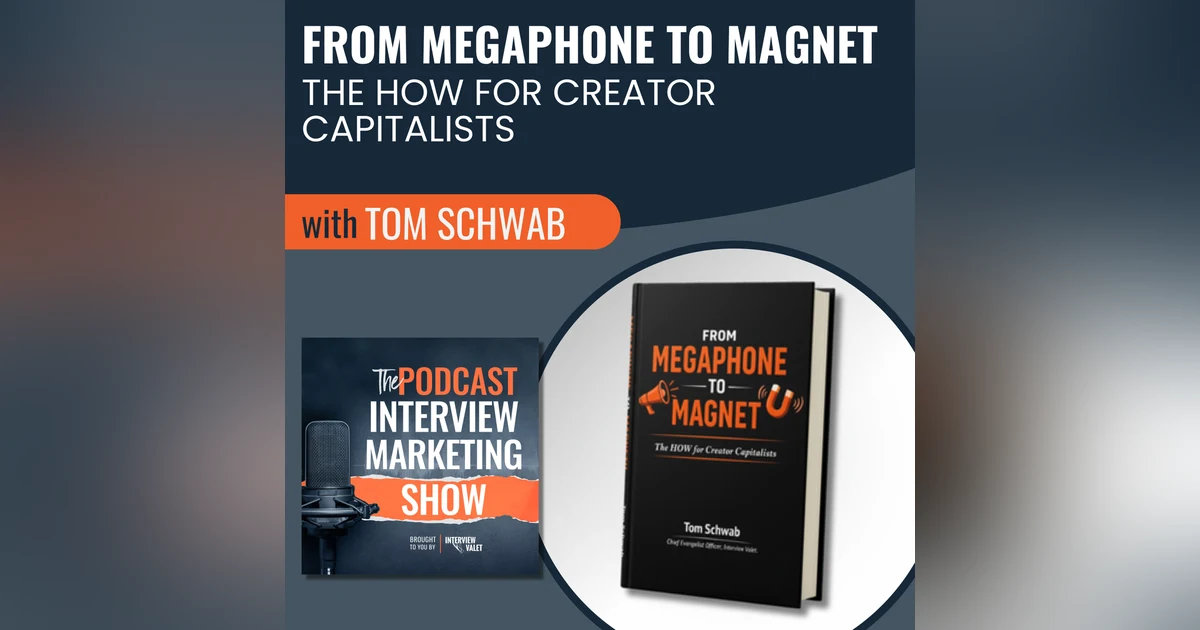
From Megaphone To Magnet: The How For Creator Capitalists


 Apple Podcasts
 Spotify
 YouTube
 In this special solo episode, Interview Valet founder Tom Schwab reads his new minibook, From Megaphone to Magnet: The HOW for Creator Capitalists, a practical companion to the bestselling Creator Capitalist by Christopher Lochhead and Eddie Yoon.
Tom breaks down why broadcasting your message to everyone is the wrong strategy, and how strategic podcast interviews serve as the most powerful and most overlooked vehicle for building reputation capital and relationship capital. From context and conversation to conversion and continuity, Tom shares a repeatable four-move playbook to help thought leaders stop shouting into the void and start attracting the right clients.
Timestamps From This Episode:
[02:34] The Map and The Vehicle
[04:09] The Big Reframe
[08:28] The two capitals that compound
[12:57] One conversation away
[18:20] The Four Move Playbook
Resources From This Episode:
Download the minibook – InterviewValet.com/minibook
Get the minibook on Amazon Kindle – From Megaphone to Magnet
PodcastInterviewMarketing.com
InterviewValet.com
Looking For More?
Here are some resources to help you get started with a Podcast Interview Marketing strategy to grow your brand or business.
 |  |  |
Tom Schwab (0:00): The difference does not emerge from a megaphone. It does not reach the right people by broadcasting to everyone. It compounds quietly, consistently, and powerfully through conversations, through strategic podcast interviews.
Tom Schwab (0:17): Welcome to the podcast interview marketing show where we explore big ideas with leading experts on how to grow your brand and business with targeted podcast interviews.
Tom Schwab (0:29): This is Tom Schwab and welcome to the Podcast Interview Marketing Show. Once a month, I'm going to do an episode like this one where instead of interviewing a guest, I share something that we've been working on inside Interview Valet. Today, well, that's the first one. Now, if you believe the knowledge economy is over and you're wondering what's next, you may have heard of Creator Capitalists. It's the latest book by the category pirates Christopher Lockhead, Eddie Yoon and Katrina Kirsch and it lays out what comes after the knowledge economy.
Tom Schwab (1:05): A world where creators don't just share what they know, they build categories, audiences and businesses. It's a brilliant book. Highly recommend you read it. But here's the question. It leaves you with how do I do it?
Tom Schwab (1:22): How do I actually implement it? Well, this is the howl for creator capitalist. It's called from megaphone to magnet. Today I want to give you, my audience, the first shot at it. You've got three ways to grab it.
Tom Schwab (1:39): You can download the PDF, it's beautifully designed over at podcastinterviewmarketing.com. Number two, you can get it on Amazon if you'd like to
Tom Schwab (1:50): have it on Kindle or in print. Or three, just stay right here because for the next twenty minutes or so, I'm going to read you the whole thing. Consider it the audio version just for podcast listeners. So grab a coffee, settle in, here we go. From Megaphone to Magnet The Howl for Creator Capitalists by Tom Schwab, Chief Evangelist Officer, Interview Valet.
Tom Schwab (2:18): This work is a companion to Creator Capitalist. Discover your superpower, design your dream career, and get paid to be you by the category Christopher Lockhead and Eddie Yoon, quoted with admiration and attribution. If you haven't read this book, you're missing out. Introduction The Map and the Vehicle Creator Capitalist gives you the map. It's one of
Tom Schwab (2:45): the most clear eyed, well constructed frameworks for understanding how value is created in this modern AI economy. The authors nail the shift from knowledge worker to creator capitalist. The compounding nature of the four capitals, the death of the generic expert, and the rise of the category designing practitioner. It's the map for today. This book?
Tom Schwab (3:14): This book is the vehicle. Specifically, it's the vehicle most creator capitalists overlook, the one sitting in plain sight, underestimated by almost everyone who could benefit from it the most. That vehicle is podcast interviews. Not hosting a podcast, not being a repetitive guest who shows up, tells their story, and hopes something happens. A strategic podcast interview designed from the first conversation to build the two capitals that compound fastest: reputation capital and relationship capital.
Tom Schwab (3:54): In the chapters that follow, you'll see the shift from megaphone to magnet. You'll see why most people broadcast and get ignored with the noise, while others strategically get heard and attract their super consumers. You'll understand the specific mechanics of context, conversation, conversion, and continuity. These are the four moves that separate a podcast appearance that disappears in the noise from one that compounds. You already have the map.
Tom Schwab (4:27): Let's get you
Tom Schwab (4:27): moving. Chapter one: The Big Reframe Most entrepreneurs have been told the same story about how to build visibility.
Tom Schwab (4:36): Create content, post consistently, build an audience, wash, rinse and repeat. It sounds logical. It's also the vast majority of B2B practitioners and thought leaders. A strategy that takes years to produce meaningful results, if it produces them at all. Creator capitalists name the problem precisely.
Tom Schwab (5:00): The authors describe what happens when that flywheel gets working. Your visibility grows and suddenly you're getting invited into podcasts, webinars and guest articles reaching even larger audiences. Read that again. Your visibility grows and suddenly you're getting invited onto podcasts, webinars, and guest articles reaching even larger audiences. Even in the book Creator Capitalist itself podcasts are the flywheels that accelerates.
Tom Schwab (5:35): So why would you wait to get invited? The megaphone trap. Most entrepreneurs approach visibility the same way. They grab the megaphone and they turn it to eleven. They start their own podcast.
Tom Schwab (5:49): They launch a newsletter. They post on LinkedIn three times a day. They create content, more content, and more content. They shout their message into the void, just hoping that the right people will hear it. The diagnosis of creator capitalists is accurate.
Tom Schwab (6:09): The authors are right that reputational capital is built on what problems you solve, not on self
Tom Schwab (6:15): promotion. They're right that personal branding, it's become a disease. But here's what happens to smart entrepreneurs who internalize this message. They take the right idea and they apply the wrong strategy. They become a one person media company.
Tom Schwab (6:35): They invest thousands of followers, creating for an audience they don't have yet. They build the intellectual infrastructure, the framework, the point of view, the language, but they have no distribution. They have an engine, but they don't have a transmission. The megaphone broadcasts to everyone. The magnet, it attracts the right ones.
Tom Schwab (7:01): The magnet alternative. There's a different approach. Instead of broadcasting to everyone, you become a magnet for the right people. The megaphone strategy, well it creates contents, publishes it on your own channels, hope your ideal client finds you, and
Tom Schwab (7:22): you compete with every other creator making noise in the same space. Then there's the magnet
Tom Schwab (7:27): strategy. You show up on podcasts where your ideal clients are already listening. You have a real conversation with a trusted host who's already built the audience that you want to reach. You let the host's credibility transfer to you, building your reputation capital. You let the audience come to you because they heard you think differently about their problem.
Tom Schwab (7:55): The megaphone says, Hey everyone, it's me. The magnet says, Here's the problem you didn't know you had and here's how I think about it differently about solving
Tom Schwab (8:08): Creator capitalist is relentless on this distinction. The authors call out practitioners who market themselves instead of the problem they solve. They're spot on. The irony is that most effective vehicle for doing exactly what they recommend marketing the problem and not yourself well, that's strategic podcast interviews placed on shows where your super consumers are already listening. Here's the reframe: You don't need a bigger audience.
Tom Schwab (8:40): You need access to the right one, the stage someone else has already built, in the context where trust has already been established. Chapter two: The Two Capitals that Compound. Creator capitalists describe four types of capital that compound for modern entrepreneurs: intellectual, reputation, relationship, and financial. All four matter, but two of them compound fastest through strategic podcast interviews.
Tom Schwab (9:13): Understanding why changes how you think about every appearance you make. Reputation capital, the borrowed stage. Reputation capital is built on trust. Not your trust in yourself, but the market's trust in you. Here's the problem with building reputation capital through your own channels: you're starting from zero.
Tom Schwab (9:39): Every newsletter subscriber, every LinkedIn follower, every podcast listener has to decide from scratch whether you're worth their attention. A podcast interview inverts this dynamic entirely. When a host invites you onto their show, they're extending their credibility to you. The audience already trusts the host. The host's endorsement is implicit in the invitation.
Tom Schwab (10:08): Your appearance is a standard of trust. You don't start from zero, you start from the host's reputation. Here's an example. Craig Cote is a CPA who helps business owners reduce their tax liability. He had a solid body of content and a list of the 10 most overlooked tax deductions for entrepreneurs.
Tom Schwab (10:30): The content was great, but his results were inconsistent. When he stopped presenting it as generic advice and started contextualizing it specifically for the audience on each show he appeared on, something changed. Same tips, different title, different framework, different language, different results. The content didn't change, the context did. Content
Tom Schwab (11:00): without context is a gift left unopened. This is the mechanism behind building reputation capital quickly through podcast interviews. It's just not the content you bring, it's the context in which you deliver it. Context amplified by the host's questions, framed specifically for the audience that the host knows and has built, delivered in the language of that specific community.
Tom Schwab (11:29): Relationship capital, the long game.
Tom Schwab (11:33): Relationship capital is the network of people who know you, trust you, and think of you when the right opportunities arise. Most guests treat podcast hosts as gatekeepers, the people to get past in order to reach the audience. The practitioners who build relationship capital, well, they treat hosts as peers, collaborators, and long term connections. Ari Galper, the world's number one authority on trust based selling and the creator of Unlock the Game, built a global reputation not by chasing clients but by creating the conditions for trust. He approached every podcast appearance the same way.
Tom Schwab (12:18): He approached a sales conversation with genuine curiosity about the host's world, not just the audience's. The result was not just audience reach, it was a network of hosts, each of them a credible voice in their community who referred him, recommended him, and thought of him when the right opportunities arose. Creator Capitalist describes relationship capital as the most underrated of the four. The authors are spot on, and targeted podcast interviews are among the most efficient ways to build that at scale. The compounding insight.
Tom Schwab (13:00): Every strategic podcast interview builds two things simultaneously:
Tom Schwab (13:04): reputation capital with the audience and relationship capital with the host. Most guests focus only on the audience. The best ones, well they cultivate both. Chapter three: One Conversation Away Here's a question most experts never ask. What does my ideal client need to hear?
Tom Schwab (13:27): In what context? From whose mouth? To trust me enough to take that next step. Not, what do I want to say? Not, what are my talking points?
Tom Schwab (13:39): Or, what does this specific person need to hear? In the specific context,
Tom Schwab (13:46): to move. The answer to that question determines everything.
Tom Schwab (13:50): The shows you pursue, how you frame your expertise, what you offer at the end of the conversation, and what happens after the episode goes live. The right show. Not every podcast is an opportunity. Most are noise. The right show is not the most popular show.
Tom Schwab (14:12): It's the show where your super consumers, the people most likely to buy, most likely to refer, most likely to become true believer in your category, the ones that they're already listening to.
Tom Schwab (14:26): Barbara Turley runs the Virtual Hub. It's a virtual assistant and operations company. When she was booked on a podcast with a physician focused audience, she had a choice that most guests never consciously make. She could deliver her standard introduction, the one that worked for general businesses audiences, and
Tom Schwab (14:47): hope a few physicians might find it relevant. But she did something different. Barbara tailored her entire introduction just for physicians.
Tom Schwab (14:57): Her talking points address the specific operational challenges that only physicians face. Her examples, they came from her work with the medical practice.
Tom Schwab (15:08): Her language matched the way the physicians described their problem. The results were different, too. The same expertise, the same offer, the same host, but different context and different outcomes.
Tom Schwab (15:25): The right conversation. Creator capitalist is clear that the creator capitalist does not compete on knowledge alone. They compete on perspective, a point of view that reframes the problem in a way that only they can frame it. The podcast interview is the ideal format for demonstrating this, not a keynote where you broadcast to an audience that didn't even choose to be there, not a LinkedIn post where you have thirty seconds to interrupt, a conversation with a trusted host in a format that the audience has opted into on a topic the audience specifically wants to explore. The conversation is where your perspective becomes real, Not a polished version of your book, not the compressed version of your elevator pitch.
Tom Schwab (16:20): The alive, responsive, in the moment version that emerges when smart hosts ask good questions.
Tom Schwab (16:29): This is the version that builds trust. This is the version that converts. A great podcast interview is not a performance. It's proof that you understand the problem that your ideal client is trying to solve and that you think about it differently. The right next step.
Tom Schwab (16:50): The conversation is not the destination, it's the beginning. Most guests treat the episode as the deliverable. It's not. The episode is the invitation. The destination is whatever happens next.
Tom Schwab (17:06): The call booked, the resource downloaded, the relationship initiated, the highest converting podcast guest design the next step before they record the episode. They know exactly where they want the listener to go, what they want them to feel when they get there, and what they need to find waiting for them. The next step is not a generic website.
Tom Schwab (17:32): It's a dedicated welcome page built for the specific audience of the specific show. Continuing on the specific conversation, the guest started on air. Our client Paul McManus, author of The Million Dollar Producer, focused exclusively on financial advisors. When he appeared on a podcast for professionals, his welcome page didn't say welcome podcast listeners. It said something specific to that show, the host, the audience, and what they had just heard him discuss.
Tom Schwab (18:07): His conversion rate was not accidental. We engineered it.
Tom Schwab (18:13): One conversation away. Your ideal client is listening to podcasts right now. They are one well placed, well framed, well followed up conversation away from becoming someone who trusts you enough to take the next step. Chapter four: The Playbook The Shift from Megaphone to Magnet. It's not just a mindset shift, it's a system shift.
Tom Schwab (18:39): Mindsets don't produce results, systems do. The creator capitalists who build durable reputation and relationship capital through podcast interviews, but not winging it. They're following a repeatable playbook. The playbook has four moves. Move one: Context first.
Tom Schwab (19:03): Before you think about what you want to say, think about who you are saying it to. Every podcast has a community. That community has a shared language, shared problems, shared aspirations, and shared frustration. The guest who enters that community as a guest, curious, contextual, specific, they're received differently than the guest who enters as a broadcaster.
Tom Schwab (19:33): Context first means you reach out to the
Tom Schwab (19:35): host Before you outline your talking points, before you decide what story to tell, you understand the community you're entering. What does this audience already believe? What have they tried that hasn't worked? What would they need to hear to believe that your approach is different? Here's an action.
Tom Schwab (19:59): For every show you target, listen to three episodes, not just to learn about the hosts,
Tom Schwab (20:04): but to learn about the audience. What questions come up repeatedly? What frustrations surface? What language do guests and hosts use to describe their problem?
Tom Schwab (20:16): Move two: Conversation as Proof. Your credentials do not build trust. Your thinking does. The podcast conversation is the best opportunity most experts will ever have to demonstrate how they think. Not what they know, but how they think.
Tom Schwab (20:37): The difference matters. Anyone can memorize what you know, but no one can replicate how you think.
Tom Schwab (20:45): The guests who convert listeners into clients are not the ones who recite their credentials most efficiently or present their keynote. They're the
Tom Schwab (20:56): the ones ones who reframe the problem in a way that makes the listener think, Wow, I've never heard it described that way, and now I can't see it any other way. That reframe, that's your intellectual capital made visible. It's the proof that you're not just another expert with a framework. You're someone who sees the problem differently, and that difference is exactly what makes you memorable. Here's another action item.
Tom Schwab (21:26): Identify your single most powerful reframe. That one idea that, when you share it, makes people stop and say, Oh, I never thought about it that way.
Tom Schwab (21:37): Build every podcast appearance around demonstrating that reframe, not explaining your credentials or sharing your story. Move three: Convert the curious. The episode goes live. Listeners hear it. Some of them are interested.
Tom Schwab (21:56): What happens next? For most guests, the answer is nothing deliberate. The episode exists. The listeners have to find them. The guest hopes hope is not a strategy.
Tom Schwab (22:09): The magnetic guest intentionally engineers what happens next. They create a dedicated welcome page, not a home page, not a bio page, not a link tree, a page built specifically for the audience, specifically for the show they appeared on. The page continues the conversation. It references what was discussed. It offers genuinely useful resources to that specific audience.
Tom Schwab (22:38): It makes this next step obvious and easy. Barbara Turley didn't need more interviews. She needed one physician focused interview built with the precision, with a welcome page that continued that conversation to an offer designed for that community. Craig Cody didn't need new content, he needed a new context. Here's another action item.
Tom Schwab (23:07): Before your next podcast appearance, build a dedicated welcome page for that show's audience. Reference the conversation. Offer specific resources relevant to that community. Give them a next step. Make it clear, then measure what happens.
Tom Schwab (23:29): Move four, the three yes ladder. Not every listener is ready to buy. Most are not. The mistake is offering only one path, the big yes or nothing at all. Making it a take it or leave it, it destroys trust.
Tom Schwab (23:48): The three yes ladder give every listener three ways to engage,
Tom Schwab (23:52): calibrated to where they are in the relationships with
Tom Schwab (23:55): you. The small yes, the quick win. This could be a quick win resource, a checklist, a guide, a framework they can use immediately. Low commitment, high relevance. It demonstrates your thinking without asking for anything significant.
Tom Schwab (24:15): The medium. Yes. That deeper dive. This is deeper proof of your expertise. Could be a case study, a book, a short course, a deeper guide.
Tom Schwab (24:27): More commitment, more value for the listeners who found the episode compelling and want to go further. The heck yes, the real conversation. A discovery call, a consultation, a first product for the listener who is ready. When they hear you and arrive with credit card in hand, ready to buy, don't slow them down in a funnel. The latter, it doesn't pressure anyone.
Tom Schwab (24:55): It simply makes the path clear for people who are already moving in your direction. The playbook in one sentence. Show up in the right context, demonstrate how you think, make the next step easy, and give every level of interested listener a clear path forward. Conclusion Your difference matters more than ever. We're living through the most interesting and difficult time in history to build a thought leadership business.
Tom Schwab (25:29): Interesting because the tools available to distribute ideas, to reach audiences, to build credibility to scale, they're unprecedented. The barriers that once protected mediocre experts from real competition, they've fallen. The floor has risen. It's difficult for the exact same reasons. In a world where anyone can publish and at scale, the question is no longer whether you have something to say.
Tom Schwab (26:01): It's whether you have something worth hearing and whether the right people hear it in the right context. Creator capitalist is right. The most valuable thing you can offer in this environment is not your knowledge. It's your difference, your perspective, your reframe, the specific way you see the problem that your ideal client has been trying to solve. The
Tom Schwab (26:29): difference does not emerge from a megaphone. It does not reach the right people by broadcasting to everyone. It compounds quietly, consistently, and powerfully through conversations, through strategic podcast interviews that put you in the right context, in
Tom Schwab (26:48): the right conversation, with the right next step for the right listener. You are one conversation away. The question is not whether you have something to say, it's whether the right people are in the room when you say it. This is the shift from megaphone to magnet. This is the how.
Tom Schwab (27:11): Stay strong. The world needs to hear you now more than ever. So there you have it. From megaphone to magnet, the how for creator capitalists. If
Tom Schwab (27:21): something in there hit you, here's the one thing I asked. Tell me what you thought of this format. Just go ahead and send me an email at Tom at Interview Valet, leave a review, or send me a DM on LinkedIn. Whatever's easiest for you. If these monthly solo drops are valuable, I'll keep them going.
Tom Schwab (27:40): If not, tell me that too. And remember, the world doesn't need more noise. Stop being the megaphone. Stop trying to turn it to 11. It's time to start attracting the clients you actually want.
Tom Schwab (27:54): Use podcast interview marketing as the magnet that pulls in your super consumers and the profits they bring with them. This is Tom Schwab. Go be a magnet.